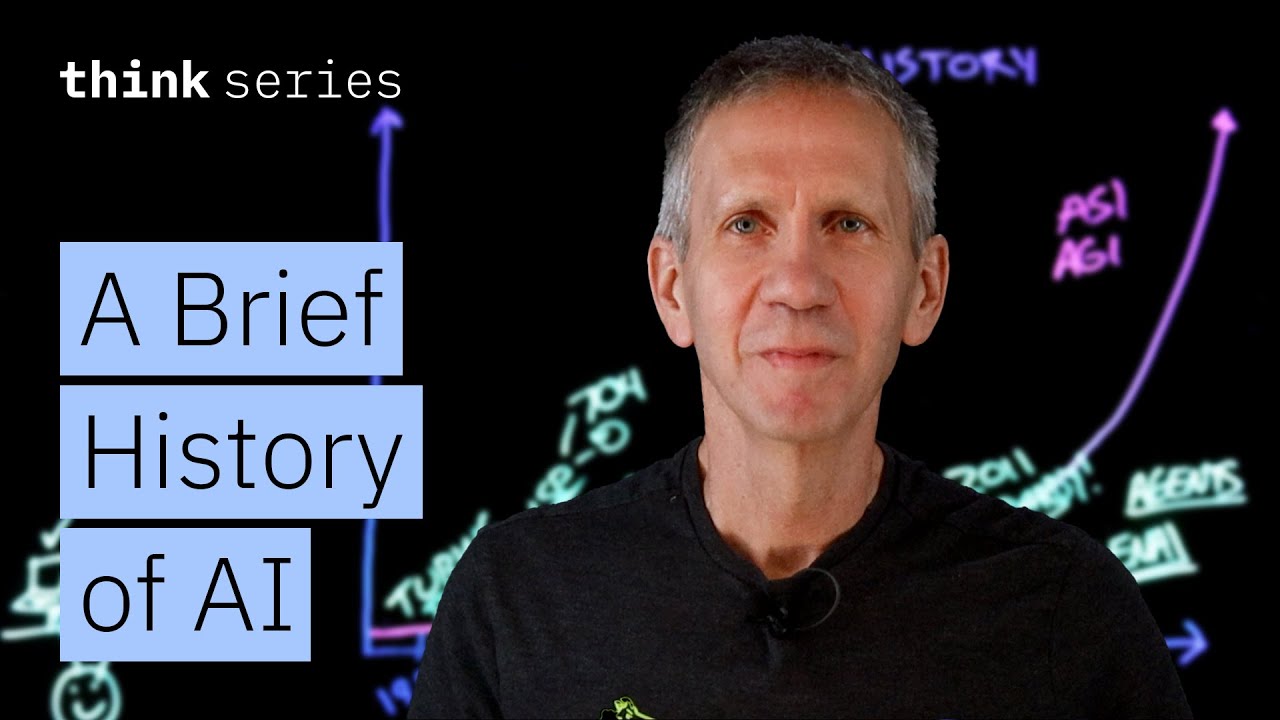
Artificial intelligence (AI) has a rich history spanning over 70 years, evolving from simple programmed systems to today’s advanced neural networks. The journey began with Alan Turing in 1950, who proposed the Turing Test as a way to measure machine intelligence. The test involves a human communicating with either a computer or another person without seeing them, and if the human cannot distinguish the computer from a person, the machine is considered intelligent. The term “AI” was coined in 1956, marking the formal beginning of the field.
In the early days, AI programming relied heavily on languages like Lisp and Prolog, which required explicit coding of rules and logic. Lisp, introduced in the late 1950s, was based on recursion and was complex but powerful. Prolog, emerging in the 1970s, focused on programming with logic and rules to make inferences. However, these systems were brittle and required manual updates to improve intelligence. Early chatbots like ELIZA in the 1960s demonstrated basic natural language processing by mimicking a psychologist’s conversational style, giving users a sense of interacting with an intelligent entity.
The 1980s saw the rise of expert systems, which aimed to provide advice based on predefined rules but ultimately failed to meet high expectations due to their inflexibility. A major milestone came in 1997 when IBM’s Deep Blue defeated world chess champion Garry Kasparov, proving that computers could outperform humans in complex strategic tasks. This success reignited interest in AI, leading to the growth of machine learning and deep learning in the 2000s. Unlike earlier systems, these approaches allowed AI to learn from data by recognizing patterns, enabling more sophisticated and scalable intelligence.
Another significant breakthrough occurred in 2011 when IBM’s Watson won the game show Jeopardy!, showcasing AI’s ability to understand and process natural language, including idioms and puns, across a broad range of topics. This achievement highlighted the potential of AI to handle complex, real-world language challenges quickly and accurately. The next big leap came around 2022 with the advent of generative AI based on foundation models, which powered advanced chatbots capable of generating text, images, and sounds. This era brought AI into the mainstream, sparking excitement and concerns about both its capabilities and ethical implications.
Looking ahead, AI is moving toward greater autonomy with agentic AI, where systems operate independently to achieve goals using various services. The future envisions the development of artificial general intelligence (AGI), which would match or surpass human intelligence across all domains, and eventually artificial superintelligence, far exceeding human cognitive abilities. While progress has accelerated dramatically, the journey from narrow AI to these advanced forms continues, with ongoing debates about AI’s true potential and limitations. The next part of the series promises to explore what AI can and cannot do at present.