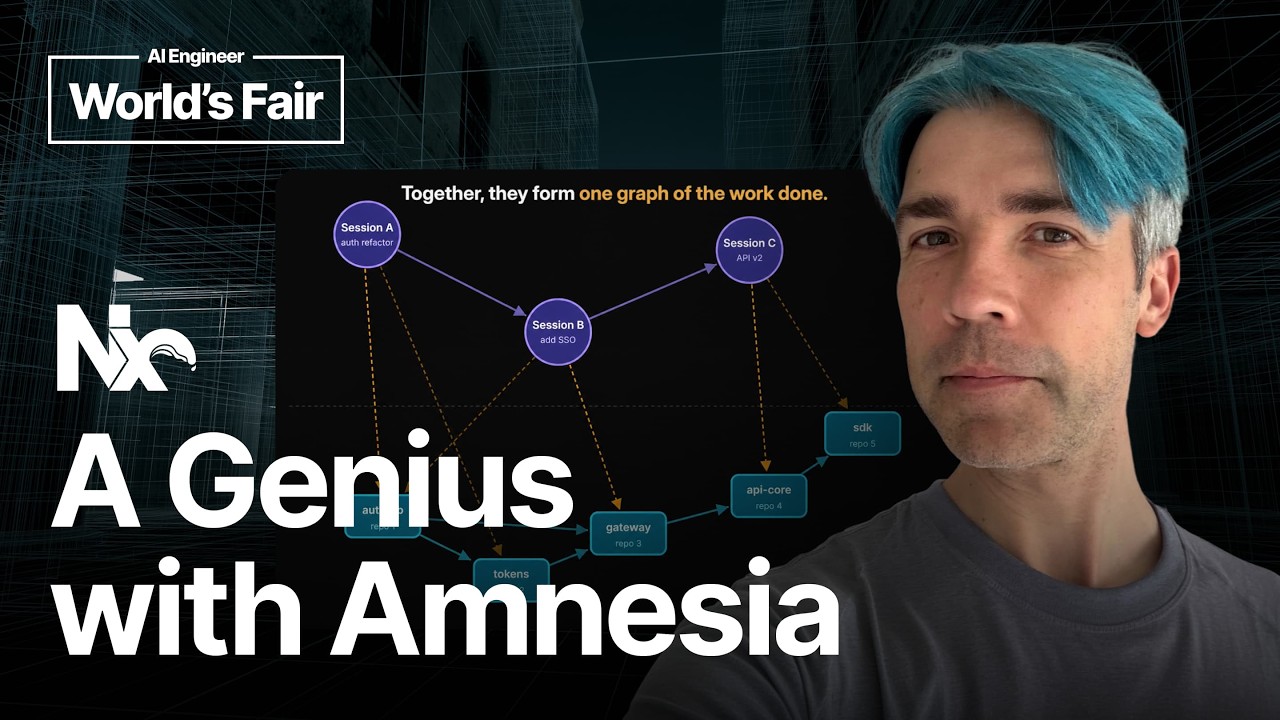
In the video, Victor Savkin introduces the challenges faced by AI agents when working on complex software projects, likening the experience to having a genius engineer like John Carmack who can only see a tiny part of the codebase and forgets everything after each session. This results in repeated explanations and inefficiencies, as agents are limited by their inability to see the entire system (repo-bound) and their lack of memory (amnesia). He illustrates this with an example where a simple UI change requires multiple re-explanations across different repositories and teams, highlighting the time and cognitive costs involved.
Victor identifies two core problems: the spatial limitation where agents only operate within single repositories without understanding how they interconnect, and the temporal limitation where agents have no episodic memory, forcing humans to act as the memory. This leads to poor coordination, inability to enforce standards across repos, and failure to catch integration issues early. The current state of AI agents is compared to working with extremely constrained visibility and memory, making complex multi-repo development cumbersome and error-prone.
To address these issues, Victor presents Polygraph, an agent-agnostic meta harness designed to unify multiple repositories into a single dependency graph, creating the illusion of one large codebase for the agent to work with. Polygraph analyzes metadata from thousands of repos, understands their relationships, and allows agents to operate across them seamlessly. It manages multi-repo changes as if they were single-repo changes, coordinating pull requests, CI runs, and fixes in an integrated manner, thus eliminating the need for repeated explanations and reducing developer overhead.
Polygraph also solves the memory problem by capturing all work sessions, agent interactions, and changes, enabling agents to have a photographic memory of the entire organization’s code and history. This allows sessions to be paused, shared, and resumed across different machines and agents, facilitating collaboration and continuity. Developers can pick up where others left off without losing context, and agents can reference past decisions and best practices, improving consistency and reducing redundant work.
Finally, Victor demonstrates how Polygraph can be used in practice, showing its intuitive interface for selecting repos, starting sessions, and managing multi-repo changes. He emphasizes that Polygraph is not tied to any specific AI agent and can work with various models. By lifting the spatial and temporal constraints on agents, Polygraph transforms the development experience, enabling agents to function as a collective intelligence with full context and memory, greatly enhancing productivity and code quality in large, complex software organizations.