Matthias Luebken from Tavon presents Pi, an open-source, minimalistic coding agent within the OpenClaw framework designed to run language model-driven tools iteratively for specialized tasks, emphasizing its extensibility, modularity, and integration into existing workflows like CRM and ERP systems. He encourages developers to experiment with Pi’s flexible API and architecture, highlighting its potential as a foundational technology for future intelligent software despite current challenges in security and sandboxing.
In this talk, Matthias Luebken from Tavon introduces Pi, an open-source coding agent embedded within the OpenClaw framework, emphasizing its minimalistic design and potential for building intelligent agents. He highlights the evolving nature of coding agents, noting that the field is still in its infancy with no established patterns, encouraging developers to experiment and explore the capabilities of Pi. Drawing inspiration from Ken Thompson’s philosophy of writing programs that do one thing well, Matthias illustrates how coding agents can be specialized tools integrated into broader workflows, such as Co-Work’s Excel skill that leverages small CLI tools to interact with spreadsheets.
Matthias explains the core concept of an agent as a language model-driven entity that runs tools in a loop to achieve goals, using context and tool calls iteratively. He showcases a simple CRM lead qualifier built with Pi, demonstrating how agents can interact with backend systems and be extended with hooks and event subscriptions for enhanced control and enterprise features. The coding agent itself is described as an agent with a runtime and shell environment, typically using Bash, which allows it to execute commands and tools dynamically, exemplified by OpenClaw’s handling of voice messages through tool calls like ffmpeg.
A significant part of the presentation focuses on Pi’s extension API, which enables interaction not only with backend systems but also with user interfaces, such as dropdown selections in terminal environments. Matthias envisions this framework evolving to support web-based UIs and more complex multi-channel environments, as seen in OpenClaw’s architecture that supports multiple agents, sessions, and plugin mechanisms for orchestration and routing. This modularity allows for flexible deployment of agents tailored to specific tasks and customer contexts, enhancing their practical utility in real-world applications.
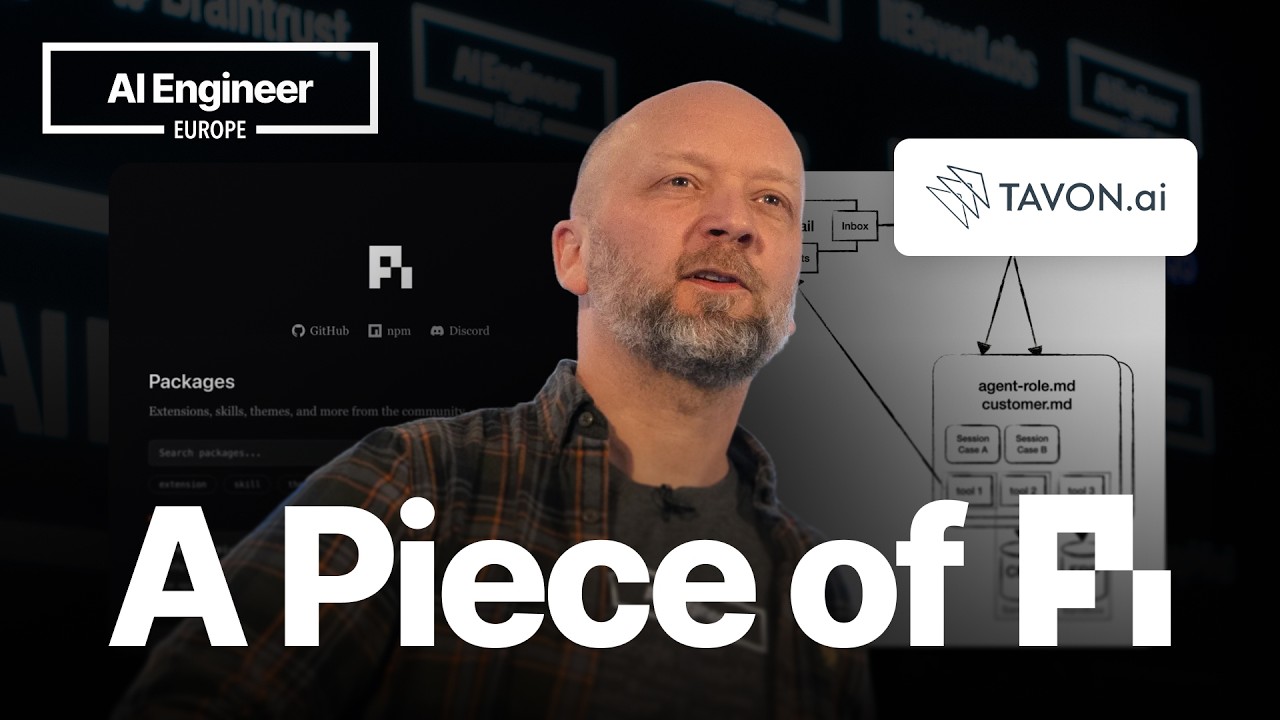
Matthias shares a practical use case involving a sales process automation system where incoming emails trigger agents that handle requests for proposals by interacting with CRM and ERP systems through secure CLI tools. Each customer has a dedicated agent session enriched with metadata to customize behavior, enabling efficient and context-aware responses. The system generates draft emails for users to review, allowing them to stay within their familiar email environment while benefiting from AI-driven assistance behind the scenes. This approach exemplifies how coding agents can be seamlessly integrated into existing workflows to improve productivity.
In conclusion, Matthias stresses that coding agents like Pi are poised to become foundational components of future software systems. He encourages developers to experiment with Pi due to its minimal and open design, which facilitates learning and customization. While acknowledging ongoing challenges such as sandboxing and security, he points to promising developments like Nvidia’s OpenClaw policy framework. Overall, the talk underscores the transformative potential of coding agents and invites the community to actively participate in shaping this emerging technology.