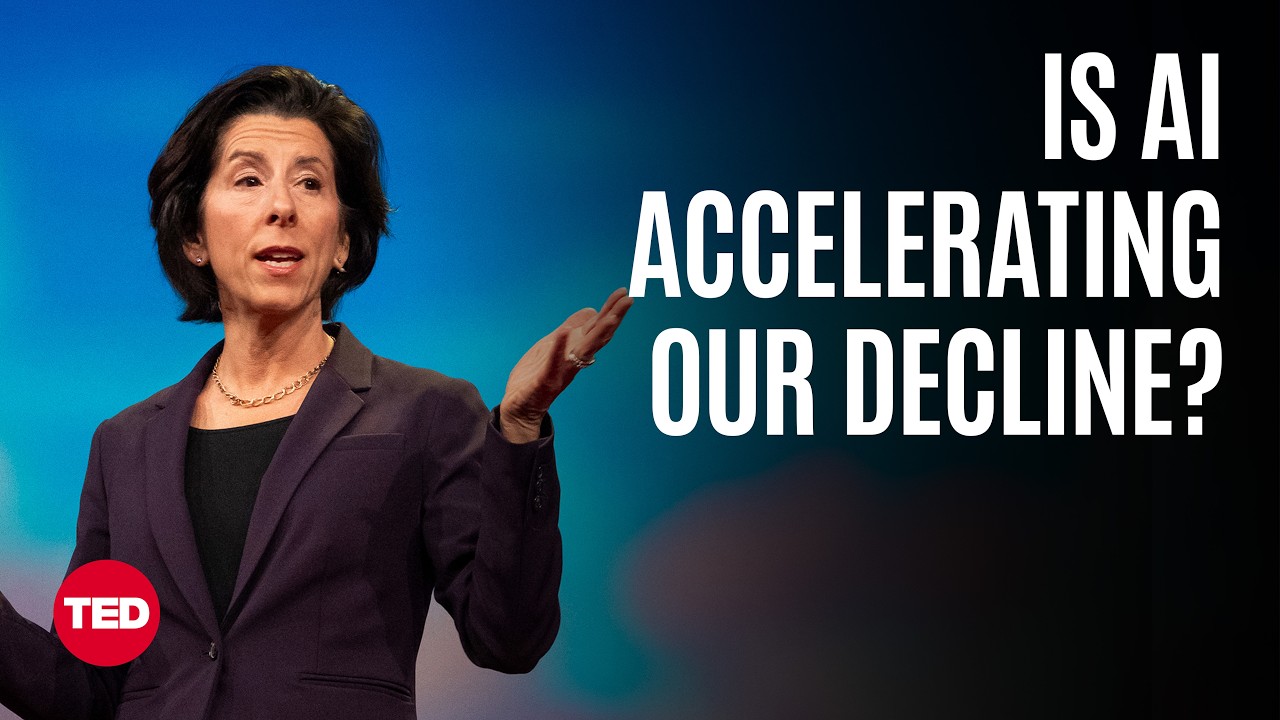
Gina Raimondo argues that for America to lead in AI, it must pair technological innovation with robust workforce support, including revamped training programs and career transition assistance, to prevent economic decline and social unrest caused by mass job displacement. She advocates for a collaborative approach between government, industry, and education to create continuous learning opportunities and proactive retraining, ensuring that AI’s benefits are widely shared and the country’s future is actively shaped.
In her TED talk, Gina Raimondo emphasizes that for America to lead the global AI race, it is not enough to excel in technology alone; the country must also ensure that its workforce is prepared and supported through the transition to an AI-driven economy. She warns that displacing millions of American workers without a solid plan will lead to economic decline, social unrest, and political instability, which in turn could result in excessive regulation that stifles AI innovation. Raimondo argues that the U.S. needs a dual strategy focusing on both technological advancement and human capital development to truly succeed.
Raimondo is optimistic about AI’s potential to boost productivity, creativity, and job creation over time, but she is concerned about the near-term disruption to workers. She highlights that tens of millions of Americans hold jobs vulnerable to automation and that the current workforce and career transition systems are ill-equipped to handle this shift. She stresses the importance of providing more than just empathy to anxious workers; instead, the country needs concrete plans and actions to support them through retraining and career transitions.
A key component of Raimondo’s vision is a revamped workforce training system that is closely aligned with industry needs. She points out that employers have the most accurate understanding of current and future skill demands, yet the existing education and training systems do not adequately reflect this. She shares the example of TSMC’s chip manufacturing expansion in Arizona, where collaboration between industry, community colleges, and government created tailored training programs that successfully met workforce needs. Raimondo also calls for continuous learning opportunities throughout people’s careers, moving away from the outdated “one-and-done” education model.
Beyond training, Raimondo highlights the inadequacy of the current career transition support system, which relies heavily on unemployment insurance designed for a different era. She proposes additional measures such as temporary wage support for workers who take pay cuts when switching fields and self-employment assistance for those starting new businesses. She envisions a future where companies proactively retrain employees before layoffs and support redeployment, backed by government incentives that reward businesses for investing in their workforce rather than opting for layoffs.
Finally, Raimondo draws lessons from America’s past economic transitions, particularly the painful consequences of offshoring manufacturing jobs without adequate support for displaced workers. She stresses the urgency of doing better this time with AI, advocating for a grand bargain between government and business to create a smooth transition. With strong incentives, innovation, and determination, she believes America can harness AI’s potential while ensuring that all Americans benefit, ultimately shaping a future that is not predetermined but created through collective effort.