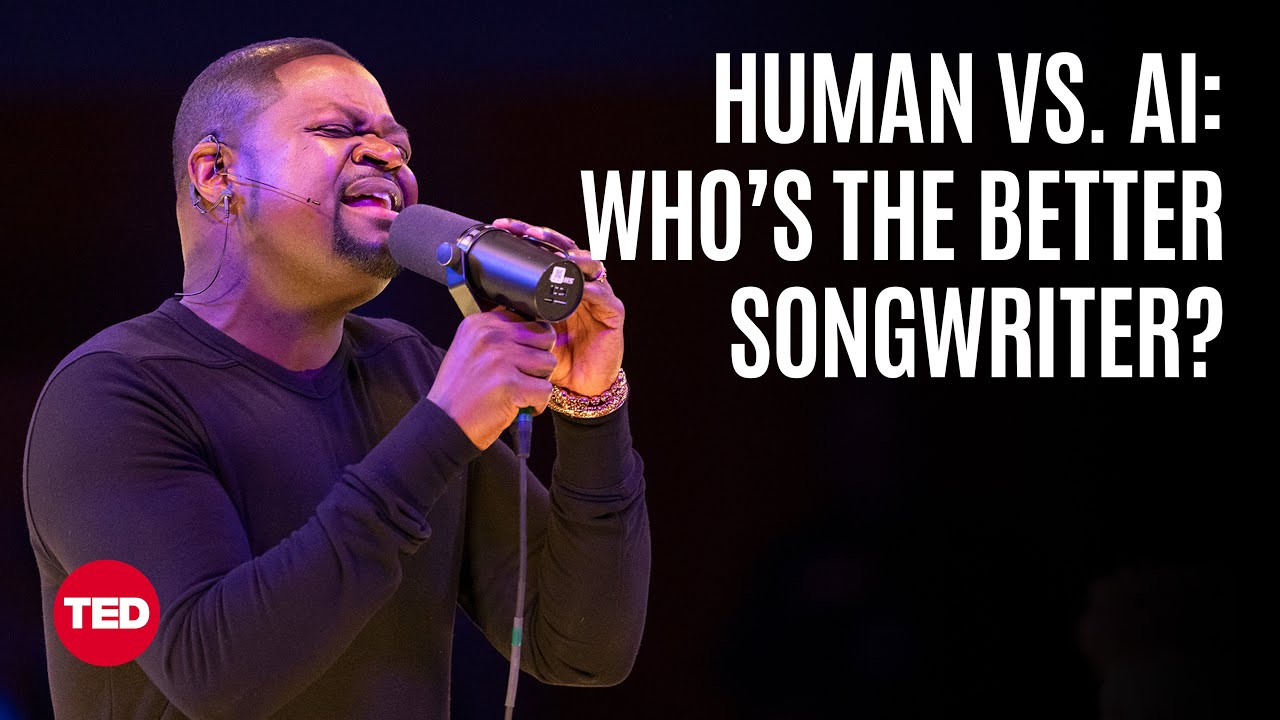
In his TED talk, songwriter Jason “Poo Bear” Boyd explores the impact of AI on music creation, emphasizing that while technology can enhance creativity and efficiency, it cannot replicate the emotional depth and authenticity of human artistry. Through a live songwriting battle with an AI tool, he demonstrates that audiences still prefer music infused with genuine human experience, advocating for a future where technology supports rather than replaces human creativity.
Jason “Poo Bear” Boyd, a renowned songwriter and producer, begins the TED talk with a live performance, showcasing his vocal talent and discussing what makes a great song. He emphasizes the importance of simplicity and effectiveness in songwriting—creating music that is memorable for children yet stimulating for sophisticated listeners. Poo Bear shares that his creative process is rooted in years of trial and error, always striving for a balance between accessibility and emotional impact.
The conversation shifts to the role of technology in music creation. Poo Bear recounts his journey from analog recording methods in the 1990s to embracing digital tools like Pro Tools and Auto-Tune. He acknowledges that while he was initially hesitant, especially with AI, he now sees these tools as time-saving aids that enhance creativity rather than diminish it. However, he is cautious about fully relying on AI, preferring to use it for generating ideas or concepts rather than composing music itself, as he believes the “soul” of music comes from human experience.
Poo Bear and host Elise Hu discuss the implications of AI in the creative industries, particularly the challenges it poses for up-and-coming songwriters and producers. Poo Bear expresses concern that AI could make it harder for new artists to develop a unique sound and break into the industry, as AI-generated music becomes more prevalent and potentially indistinguishable from human-made music. He stresses the need for legal guardrails to protect original creators from having their styles and works replicated by AI without credit or compensation.
The conversation also touches on the cyclical nature of music technology. Poo Bear draws parallels between the excitement over AI and past innovations like drum machines and synthesizers, noting that while new technology often dominates for a time, audiences eventually crave the authenticity and emotional resonance of live, analog performances. He predicts that despite the rise of AI, there will be a resurgence of interest in live music and real instrumentation, as people seek genuine, in-person experiences that technology cannot fully replicate.
To illustrate the current capabilities and limitations of AI in music, Poo Bear engages in a live “songwriting battle” against Suno, an AI music generation tool. With audience input, he crafts a song hook and post-hook in real time, then prompts Suno to generate a similar piece. The audience overwhelmingly prefers Poo Bear’s human-created version, reinforcing his point that while AI is a valuable tool, it cannot replace the emotional depth and soul of human artistry. He concludes by advocating for a future where technology and human creativity coexist, with the irreplaceable human element always at the core of great music.