The video introduces the concept of AI agents, which are autonomous systems capable of perceiving their environment, making decisions, and taking actions to achieve specific goals. It highlights the challenge of enabling multiple AI agents to collaborate effectively, especially when solving complex problems that a single agent cannot handle alone. For example, in travel planning, various specialized agents like flight, hotel, and excursion agents need to work together. The video points out that integrating these agents can be difficult, particularly when using third-party agents with unknown communication protocols. To address this, the A2A Protocol (Agent2Agent) was developed as a standardized way for AI agents to communicate, collaborate, and authenticate securely.
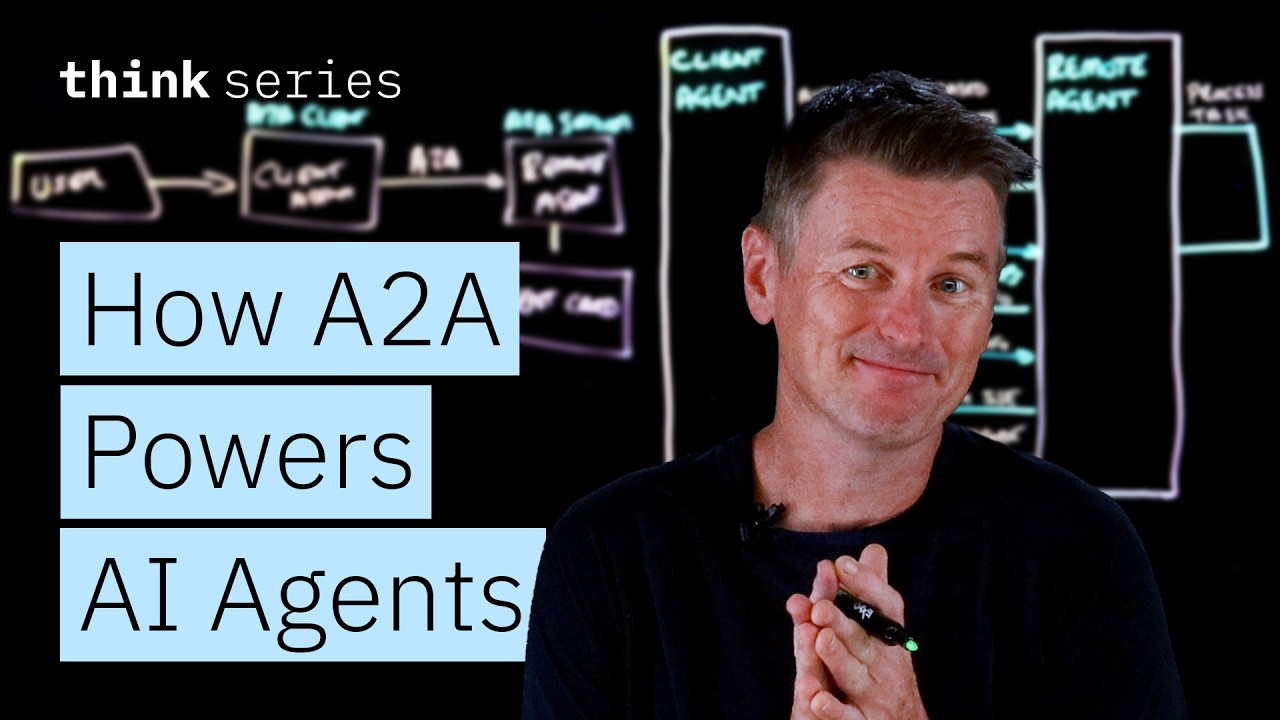
The A2A Protocol was introduced by Google in April 2025 and is now an open-source project managed by the Linux Foundation. The protocol defines core actors in the interaction: the user (which can be a human or automated service), the client agent acting on behalf of the user, and one or more remote agents that perform tasks. The client agent initiates requests to remote agents using the A2A protocol, which can also be referred to as the A2A client and server. This setup allows agents to dynamically interact in a mesh-like network, where an agent can be a client in one context and a remote agent in another.
The communication process in A2A involves three main stages: discovery, authentication, and communication. During discovery, the client agent finds remote agents by accessing their published “agent cards,” which are JSON metadata documents containing information about the agent’s identity, capabilities, service endpoint URL, and authentication requirements. Authentication follows, where the client agent authenticates based on the security scheme specified in the agent card, and the remote agent manages authorization and access control. Finally, communication occurs via JSON-RPC 2.0 over HTTPS, allowing the client agent to send tasks and receive responses, including any generated artifacts like documents or images.
For tasks that take longer to complete, such as those involving human interaction or external events, the protocol supports streaming updates using Server-Sent Events (SSE). This enables the remote agent to send real-time status updates to the client agent over an open HTTP connection. The protocol’s design emphasizes privacy by treating AI agents as opaque entities, meaning they collaborate without exposing their internal workings, proprietary logic, or tools. This approach helps preserve data privacy and intellectual property while leveraging widely adopted standards like HTTP, JSON-RPC, and SSE, making it easier for enterprises to adopt the protocol.
While the A2A Protocol offers significant benefits in standardizing AI agent communication, discovery, and authentication, it is still in its early stages. The video acknowledges ongoing challenges such as improving security, governance, and performance tuning. Nonetheless, A2A establishes a trusted universal communication channel and a common language for AI agent ecosystems, which is a crucial step forward in enabling complex multi-agent collaboration. The video suggests that AI agents and their interactions will continue to be an important topic in the future.