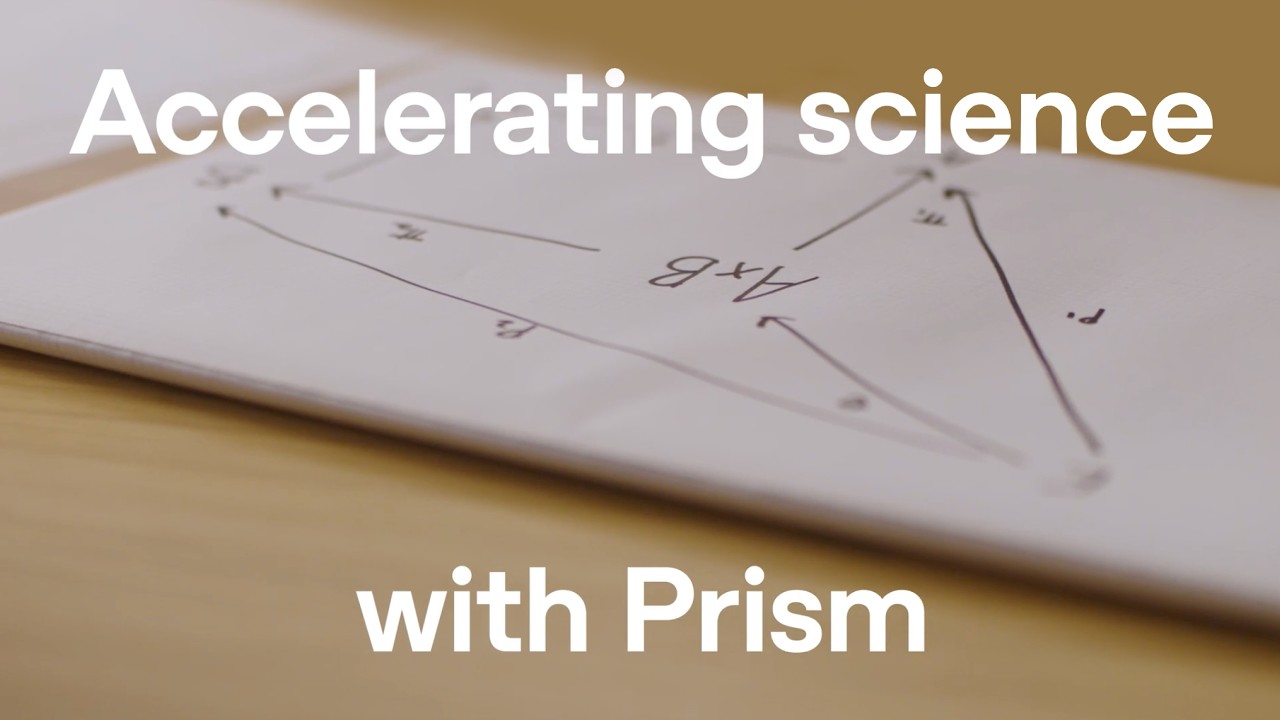
The video discusses the launch and capabilities of Prism, a new AI-native environment designed to accelerate scientific research and writing. The presenters highlight how recent advancements in AI, particularly with GPT-5.2, have already contributed to solving open problems across various scientific fields such as mathematics, biology, physics, chemistry, and material science. They note that much of the tooling used by scientists has remained unchanged for decades, and Prism aims to modernize this by integrating AI directly into the scientific workflow, making advanced AI assistance accessible and easy to use for researchers.
Prism is introduced as a free platform that embeds AI into the environments where scientists already work, such as LaTeX editors. This integration eliminates the need to switch between separate chatbots and editing tools, streamlining the research and writing process. The presenters emphasize that Prism is not just about improving AI models but also about making these models more usable and context-aware within the scientist’s daily workflow. The goal is to reduce time spent on formatting and editing, allowing researchers to focus more on actual scientific inquiry.
A demonstration follows, showing how Prism enhances the writing and editing of scientific papers. The user can invoke ChatGPT directly within the LaTeX environment to improve the clarity and quality of their writing, with suggested edits highlighted for easy review and approval. This feature allows for granular control over the text, ensuring that the scientist maintains authority over the content while benefiting from AI-powered suggestions. The presenters highlight how this seamless integration saves time and improves the overall writing process.
Prism also addresses other pain points in scientific work, such as creating technical diagrams and managing references. The AI can convert hand-drawn diagrams into publication-ready figures within seconds, a task that previously required significant manual effort and technical know-how. Additionally, Prism can search for relevant literature, format citations correctly, and insert them into the document, all while maintaining full awareness of the project’s context. Multiple chat windows can be opened to handle different tasks simultaneously, effectively giving the researcher a team of AI assistants.
Finally, the presenters discuss how Prism’s capabilities extend beyond text editing to substantive scientific reasoning. The AI can check mathematical calculations, verify the correctness of equations, and engage with the scientific content itself, not just the language. This reduces the burden of repetitive or tedious tasks, allowing scientists to devote more time to creative and meaningful research. The team expresses optimism that Prism and similar AI tools will significantly accelerate scientific progress by removing much of the drudgery from research workflows and making advanced AI assistance universally accessible.