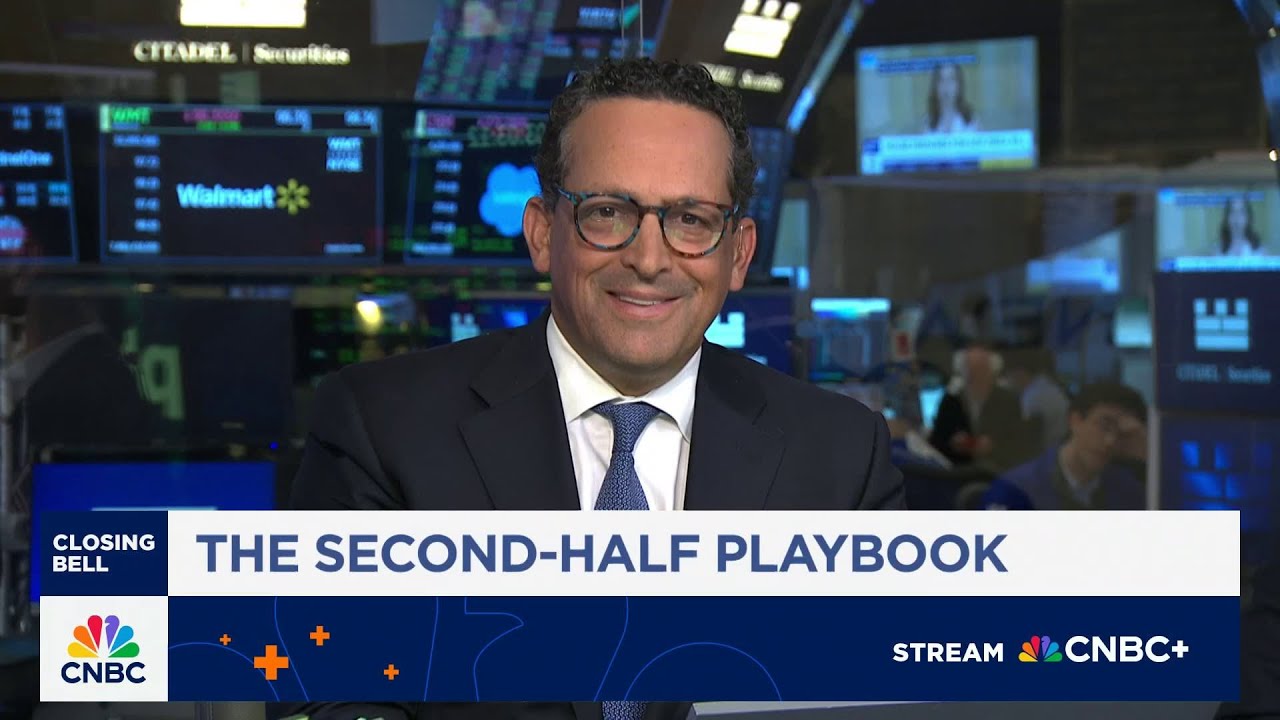
Adam Parker expresses cautious optimism about the stock market, emphasizing the long-term growth potential driven by AI investments expected to pay off around 2026, despite short-term challenges like tariffs and margin contractions in mid-sized companies. He highlights improved investor sentiment, the resilience of the financial sector, and the possibility of new market highs, underscoring a favorable risk-reward balance fueled by AI-driven productivity gains.
In the discussion with CNBC contributor Adam Parker, he highlights the cautious optimism surrounding the stock market as it enters the second half of the year. While acknowledging factors like tax bills, earnings rate cuts, and tariffs, Parker emphasizes that the overarching driver remains the long-term potential of artificial intelligence (AI). He notes that investments made in 2023 and 2024 are expected to bear fruit around 2026, making it risky to turn overly negative on the market despite short-term challenges.
Parker reflects on his own experience earlier in the year, where he anticipated a market downturn due to tariffs and volatility but was proven wrong as the market continued to climb. He attributes this resilience to the limited impact of tariffs on major companies and the financial sector’s strong position. This has led him to believe that the risk-reward balance remains favorable, especially with the expectation of margin expansion driven by AI deployment in the coming years.
Addressing concerns about market complacency amid new highs, Parker points out that while large-cap stocks are leading the gains, mid-sized companies are experiencing margin contractions. This suggests underlying vulnerabilities and a potential growth scare between August and October. However, investors remain hesitant to turn fully negative, buoyed by the prospect of AI-driven productivity improvements in 2026 and 2027, which continues to shape their positioning.
Parker also notes a shift in investor sentiment compared to a few weeks prior. Although rhetoric was negative earlier, actual positioning was less so, and momentum has since improved moods. The market’s performance is seen as a leading indicator, suggesting earnings may not be as weak as previously feared. He highlights that many investors now entertain the possibility of the market reaching new highs, such as the S&P 500 hitting 7000 by year-end, a scenario that few had seriously considered before.
Finally, Parker expresses confidence in the financial sector, identifying it as a unique area with both offensive and defensive investment opportunities. He suggests that within financials, there is potential to outperform the broader market, marking a rare instance in his career where sector-specific strategies could yield significant gains. Overall, while cautious, Parker remains optimistic about the market’s trajectory, driven largely by the transformative potential of AI and solid fundamentals in key sectors.