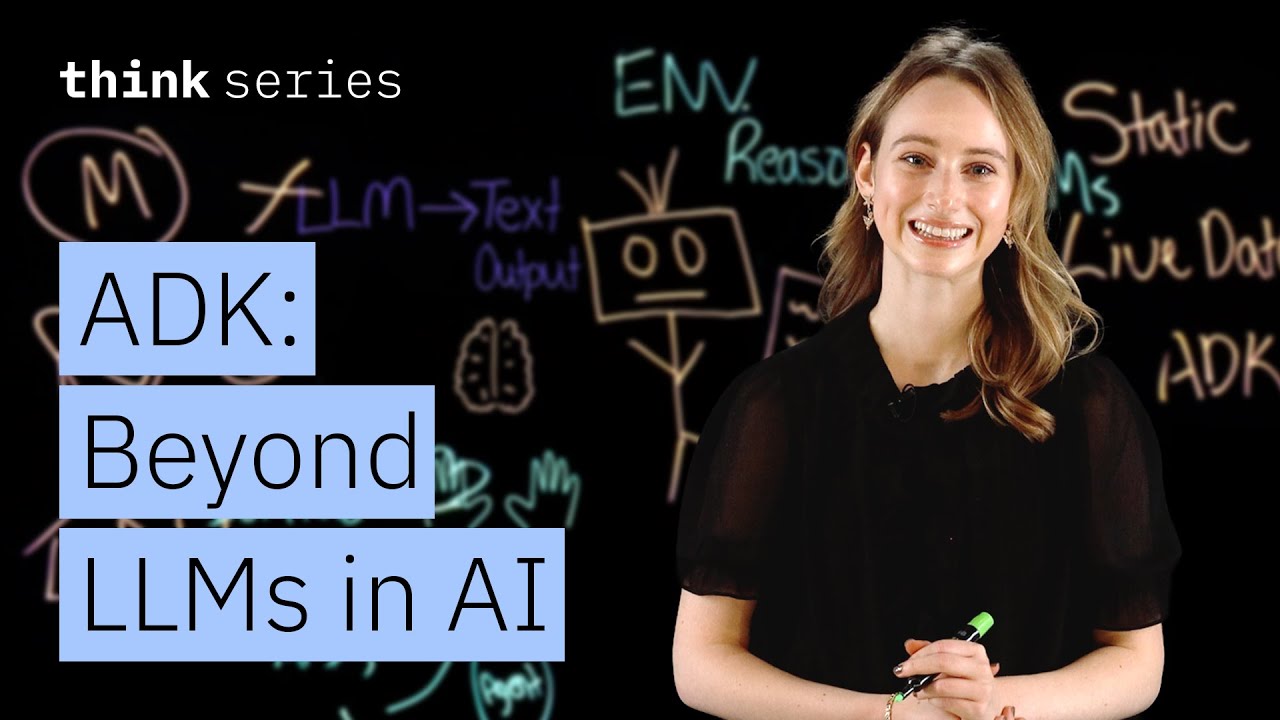
The video introduces the concept of moving beyond large language models (LLMs) in artificial intelligence by using Agent Development Kits (ADKs) to build autonomous AI agents. While LLMs excel at generating text and responding to prompts, they are limited to reactive tasks and cannot process sensor data or make independent decisions. ADKs, on the other hand, provide the tools necessary for AI agents to sense their environment, reason over data, and take actions, making them more like partners that can collaborate and co-create value in real-world scenarios.
A key distinction highlighted is that LLMs are primarily the “voice” of AI, responding to user inputs, whereas ADKs give AI the “hands and brain” to observe, decide, and act autonomously. This shift is crucial in fields like robotics and automation, where static models are insufficient. For example, in manufacturing, an autonomous agent built with an ADK can monitor equipment, detect issues in real time, and take corrective actions such as pausing production or alerting technicians, thus preventing costly breakdowns.
The video walks through a practical example of building a smart office agent in six steps. First, the problem and goal are defined: monitoring temperature and lighting, adjusting settings as needed, and sending alerts if anomalies are detected. Inputs come from sensors measuring temperature, light, and motion, as well as external APIs for weather and scheduling data. The agent’s outputs include controlling HVAC systems, adjusting lighting, and sending notifications through platforms like Slack.
The technical assembly involves using Python as the programming language for logic, an IoT hub to collect sensor data, and REST APIs to communicate with devices and systems. The process includes testing and refining the agent by simulating various scenarios and adjusting its logic based on performance. Ethical considerations are emphasized, such as implementing manual overrides, logging actions for transparency, and ensuring user consent for monitoring.
Finally, the video stresses the importance of building agents around the principles of fairness, safety, and trust. This involves preventing bias, having backup plans for failures, and maintaining transparency in decision-making. As ADKs continue to evolve, autonomous agents are expected to play significant roles across industries like smart cities, education, agriculture, and finance. The video encourages viewers to explore open-source ADKs and contribute to the development of smarter, more connected autonomous systems, marking a new era in AI beyond just larger models.