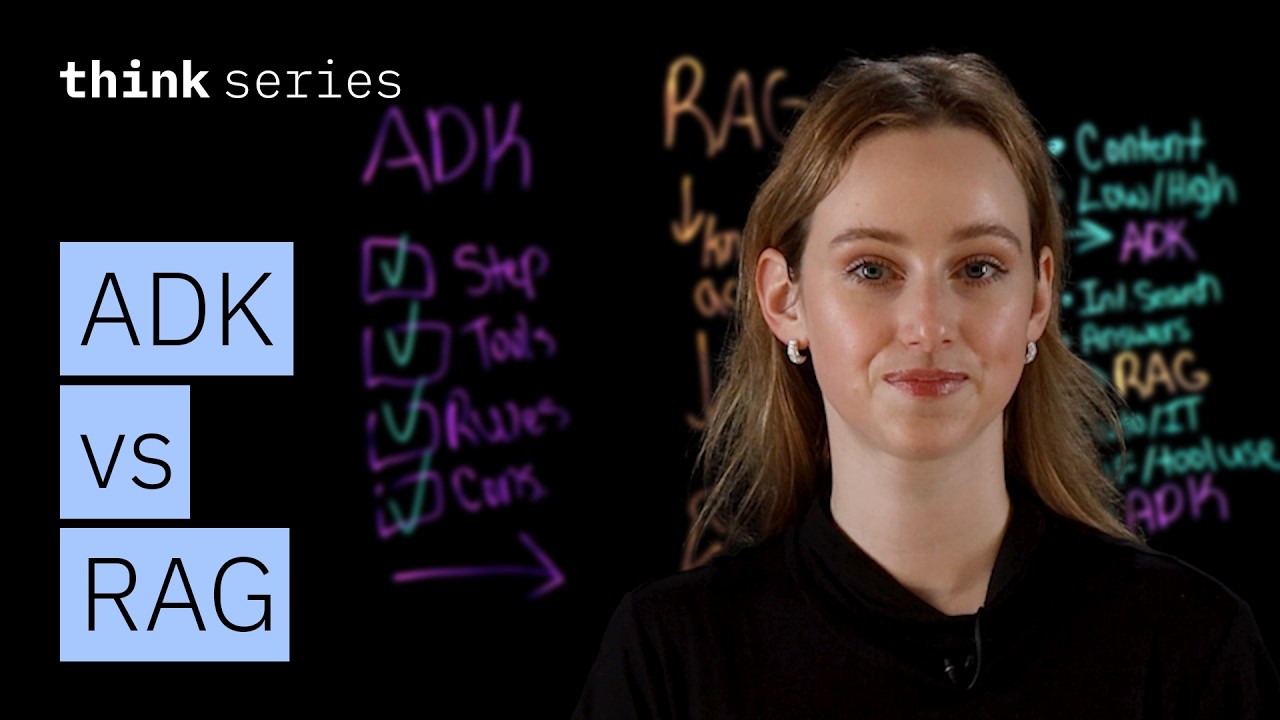
The video uses the analogy of a hardware store to explain how to choose between two AI system architectures: ADK (Agent Development Kit) and RAG (Retrieval-Augmented Generation). Just as a hardware store has two main aisles—one with tools that perform tasks and another with reference guides that provide information—AI systems can be designed either to act like tools that perform multi-step tasks or to function like reference guides that retrieve and provide accurate information. Understanding whether your AI needs to act or recall information is key to selecting the right approach.
ADK systems focus on action and reasoning. They are designed to perform multi-step workflows, use tools, follow rules, and make decisions in a consistent and repeatable manner. This approach is ideal when the AI needs to execute procedural tasks such as drafting content, assisting with IT or HR workflows, coordinating tasks, or triaging operations. The strength of ADK lies in its ability to reason through problems step-by-step rather than relying on memory or document retrieval.
On the other hand, RAG systems emphasize knowledge accuracy by connecting to external documents and retrieving relevant information before generating responses. This architecture is best suited for scenarios where the data itself is the source of truth, such as referencing policies, technical manuals, or large knowledge bases. RAG excels in handling high-volume, detailed, and frequently changing information, making it ideal for knowledge search, research assistance, legal or medical document lookup, and technical support grounded in documentation.
In many real-world applications, a hybrid approach combining both ADK and RAG is most effective. In such systems, ADK manages the task flow, logic, and decision-making, while RAG ensures that the information used is accurate and grounded in domain-specific documents. This combination is particularly useful for complex use cases like legal and engineering co-pilots, healthcare assistants, and enterprise task coordinators that require both reasoning capabilities and access to detailed knowledge.
Ultimately, choosing the right AI stack depends on whether your AI needs to act, know, or do both. ADK is like the tool aisle, enabling the AI to perform actions and workflows, while RAG is like the reference aisle, providing accurate information to ground those actions. Most successful AI projects leverage both approaches, using tools to build and guides to ensure correctness, thereby creating intelligent and well-informed systems tailored to their specific needs.