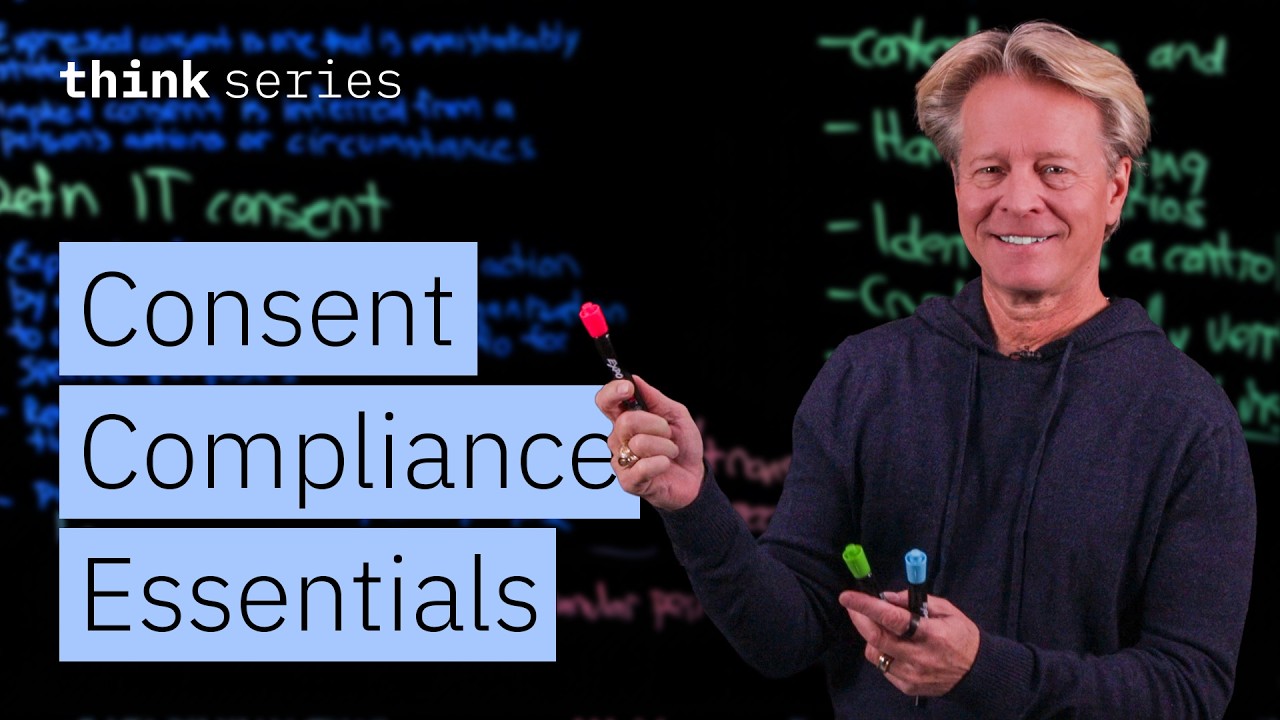
The video begins by distinguishing AI agents from traditional AI outputs, emphasizing that agents execute actions on behalf of users. This necessitates a clear framework for what actions are permitted, who delegates authority, and the scope and duration of that delegation—concepts collectively referred to as agentic consent. The presenter first defines general consent, explaining express consent as explicit agreement with conditions, and implied consent as inferred through actions, setting the foundation for understanding consent in more complex systems.
Next, the video explores IT consent, which involves explicit, informed, and voluntary permission by a user for an organization to collect, process, or use their data. This consent is typically given through clear affirmative actions such as clicking accept buttons or checking boxes, often specifying what data can be used and for what purposes. This traditional model, however, contrasts with agentic consent in AI systems, where permissions cannot be static or one-time due to the dynamic and autonomous nature of agents that may change their scope of work as they operate.
Agentic consent requires a context-aware and dynamic approach because AI agents operate in non-deterministic environments where scenarios and actions can evolve. Identity governance plays a crucial role here, as it authenticates users and agents, defines permissible actions, and enables cryptographic verification to maintain trust and observability. Importantly, agents must act with users rather than replace them, ensuring human oversight and control remain central to AI operations.
To implement agentic consent effectively, the video suggests granular permissions that specify exactly what an agent can do, such as reading but not sending or deleting emails, combined with time-restricted and transaction-based access. Just-in-time prompting is also recommended, where agents request user consent in real-time for sensitive actions or when no existing policy covers a scenario. This human-in-the-loop approach allows for consent to be recorded, policies to be updated, and ongoing governance to adapt to new situations.
Finally, the video highlights emerging compliance considerations around agentic consent, including transparency, revocability, and personalization. Users must have visibility into what consents have been given and how their data is used, the ability to revoke or modify consent at any time, and control over specific data access preferences. In summary, agentic consent is framed as a living, evolving contract between humans and machines, grounded in identity, intent, and context, designed to preserve trust, safety, and governance as AI autonomy scales.