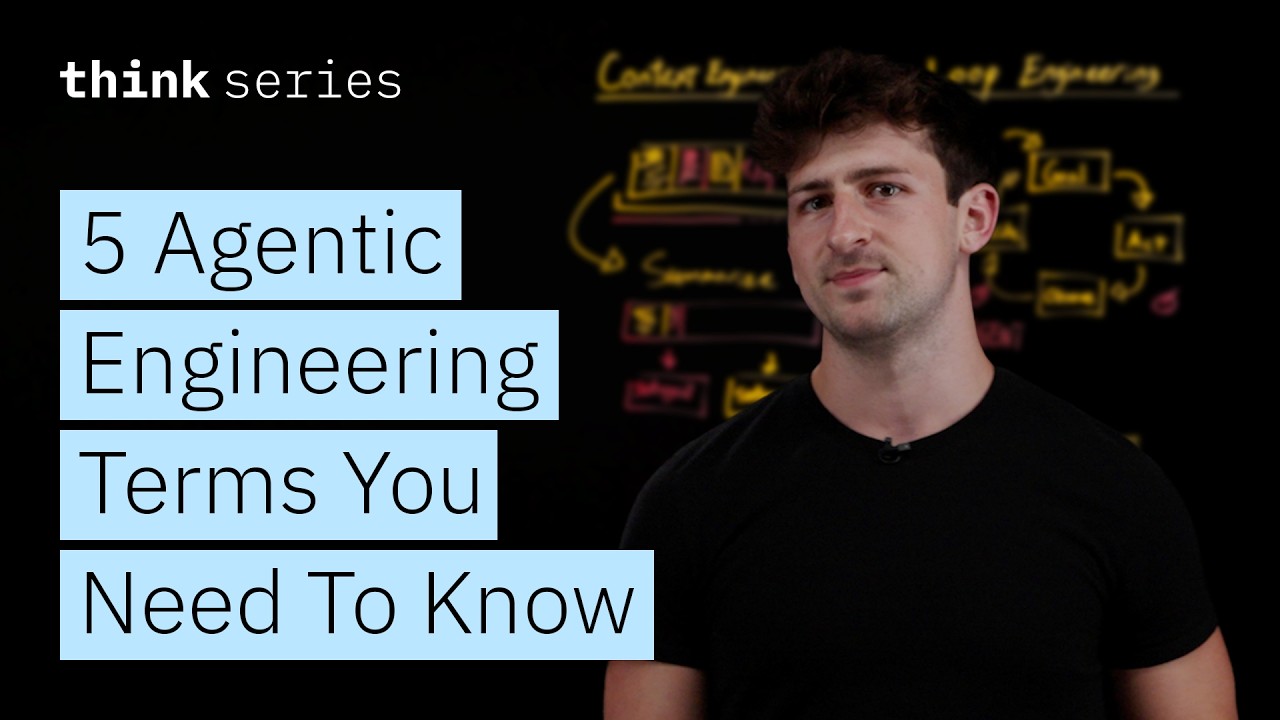
The video explores the emerging field of agentic engineering, highlighting how AI-assisted development is transforming software creation, with some top teams having over 80% of their code generated by AI. Central to this transformation is the concept of prompt engineering, which involves crafting precise instructions for AI models to follow. Effective communication with the model, often requiring domain expertise, is emphasized as more crucial than the model’s inherent capabilities. Techniques like few-shot prompting and chain-of-thought examples are particularly useful for smaller models that run locally or on edge devices.
Context engineering is introduced as the practice of managing everything the AI model “sees” within its context window, including system prompts, tools, documents, and codebases. Since the quality of responses can degrade as the context window fills, strategies such as summarizing or compacting information and using sub-agents to handle specific tasks help maintain efficiency. Sub-agents operate independently to gather information or perform research, then feed their results back into the main context, optimizing the model’s performance without overwhelming it.
Harness engineering refers to the infrastructure surrounding the AI model that enables it to act, verify its actions, and iterate autonomously. This includes runtime environments that execute commands, manage context windows, and provide sandboxing for security. Harnesses also orchestrate sub-agents and integrate with existing development tools like CI pipelines and observability stacks, allowing the AI to test code changes, detect conflicts, and improve outputs without constant human intervention.
Loop engineering involves creating feedback loops where AI agents continuously act, observe outcomes, and decide whether to continue or stop based on success criteria. These loops can be triggered automatically by events such as scheduled times, pull requests, or bug reports, enabling more autonomous workflows. Extending this concept, graph engineering connects multiple agents in parallel, allowing them to collaborate on different aspects of a project simultaneously, though this approach can be resource-intensive due to token limits and costs.
Finally, the video discusses the concept of a software factory, which automates the entire software development lifecycle using specialized AI agents for distinct tasks like coding, testing, and task management. These agents require isolation (via containers or sandboxes), identity management for access control, and observability to track their activities. While these advanced setups are more suited for teams, fundamental concepts like prompt engineering, context management, and harness engineering are valuable for developers at all levels, signaling a future where AI-driven development becomes increasingly prevalent.
Useful Links