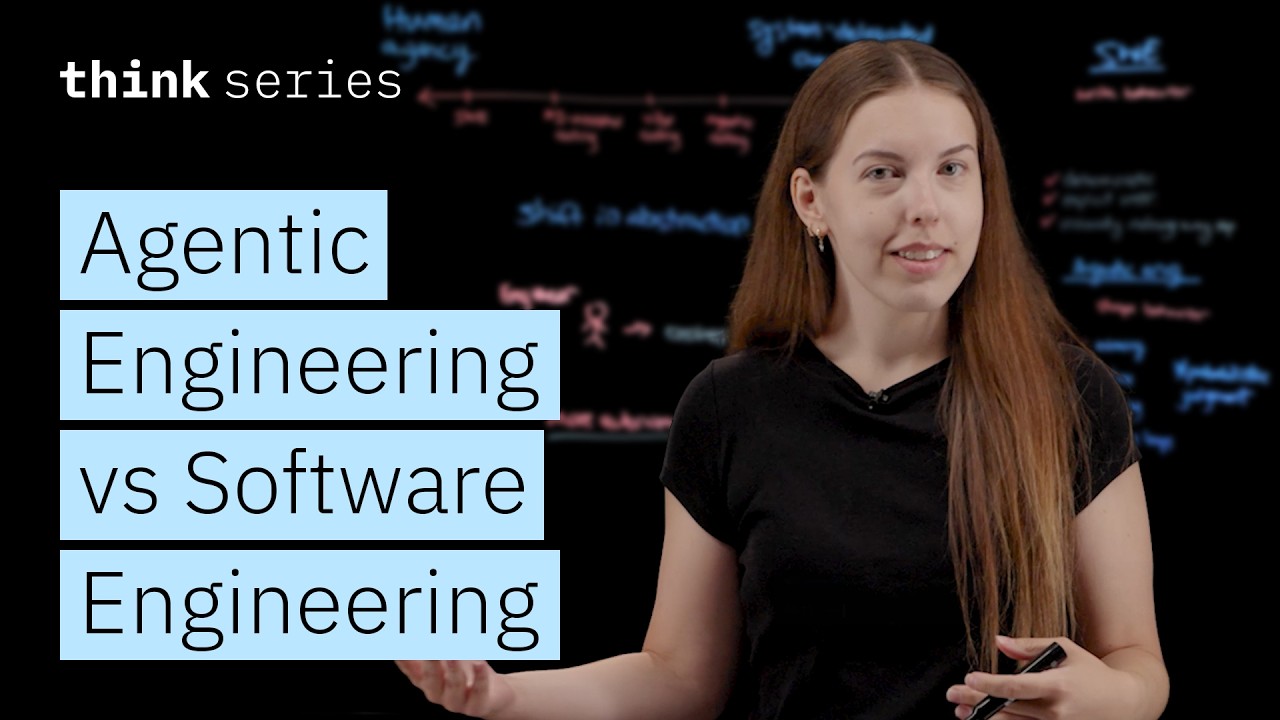
The video explores the evolving landscape of software development, highlighting a shift from traditional software engineering to what is now termed agentic engineering. Traditionally, software engineering involved writing explicit, deterministic instructions where developers controlled every aspect of the code, ensuring predictable outputs for given inputs. However, with the advent of AI-assisted coding and large language models, this paradigm is changing. Instead of manually coding every detail, developers now increasingly define goals and intents, allowing AI agents to handle execution, planning, and iteration, marking a move from deterministic logic to probabilistic judgment.
Agentic engineering represents a new approach where AI systems act as autonomous agents capable of planning, coding, debugging, and iterating with limited human supervision. This contrasts with traditional software engineering and AI-assisted coding, where humans retain full control or primarily assist with code generation. The video presents a spectrum of human-AI collaboration: from traditional coding, through AI-assisted and vibe coding (where developers guide AI with natural language intent), to agentic coding and finally agentic engineering, which involves designing environments for autonomous AI systems to operate and adapt dynamically.
A key point emphasized is that agentic engineering does not replace human engineers but transforms their role. Engineers shift from writing every line of code to orchestrating and supervising AI agents, ensuring reliability and quality in probabilistic workflows. This increased autonomy of AI systems raises the importance of human oversight to manage risks such as hallucinations, misinterpretations, or poor architectural decisions by AI. The challenge moves from manual coding to verifying, constraining, and guiding AI-driven processes, highlighting the continued need for engineering expertise.
The video also addresses concerns within the developer community, acknowledging skepticism about the reliability and maintainability of AI-generated code. While vibe coding enables rapid prototyping, it can lead to technical debt without disciplined engineering practices. Agentic engineering, therefore, stresses maintaining engineering rigor even as abstraction layers increase. It encourages a culture of experimentation balanced with accountability, ensuring that AI accelerates development without compromising code quality or architectural integrity.
Looking ahead, the video suggests that as AI capabilities grow, the terminology and practices around AI-assisted development will continue to evolve. Developers’ roles will increasingly focus on designing, shaping, and supervising AI behaviors rather than direct coding. For those uncertain about adopting these tools, the advice is to start small, integrate AI assistance gradually, and maintain a strong emphasis on understanding and quality rather than blind automation. The video concludes by inviting viewers to engage further with AI topics and emphasizes the ongoing transformation in software engineering driven by AI collaboration.