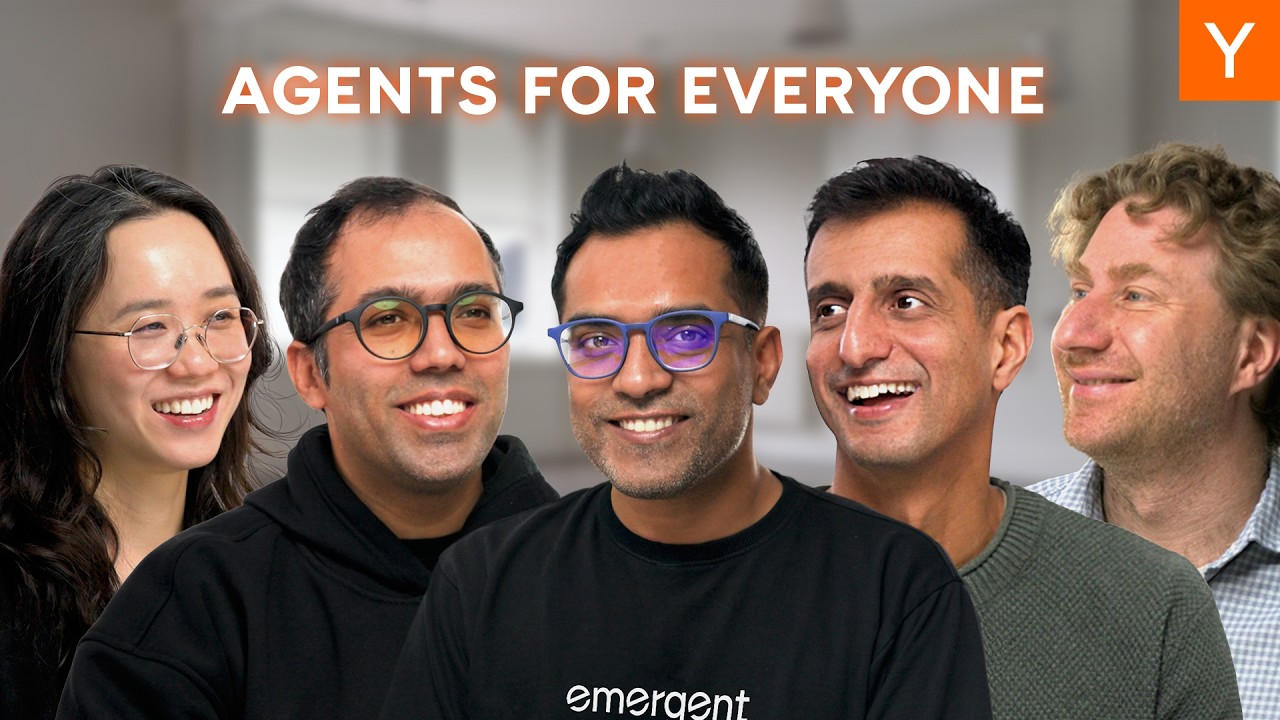
Certainly! Here’s a five-paragraph summary of the video transcript:
The video features an interview with Makund and Madav Jar, twin brothers and founders of Emergent, a rapidly growing AI platform that enables anyone—including non-technical users—to build and deploy production-ready software using AI agents. The founders share their backgrounds in engineering and deep learning, and describe how their initial focus was on automating software testing for enterprises. However, after realizing the broader potential of their technology, they pivoted to creating a general-purpose coding agent and eventually shifted their focus to empowering non-technical users to build real, production-level applications.
Emergent’s growth has been remarkable, with over 7 million apps built on the platform within eight months of launch. The founders attribute this success to their decision to target users who want to build serious, business-critical applications, rather than just prototypes. They emphasize that 80% of their users have no programming background and are often small business owners or solopreneurs who previously relied on spreadsheets or expensive dev shops. Emergent’s platform abstracts away technical complexities, allowing users to create and iterate on apps through natural language prompts, and even handles backend infrastructure, deployment, and version control.
A key differentiator for Emergent is its robust engineering foundation, which includes a custom-built infrastructure and advanced agent architecture. The platform uses multi-agent systems, long-term memory, and continual learning to improve agent performance over time. This allows users to build complex, full-stack applications that can scale with their needs. The founders also highlight their unique approach to user experience, hiding technical details from non-technical users while still providing powerful tools for those who need them.
The discussion touches on broader industry trends, such as the impact of AI on software engineering jobs and the future of SaaS. The founders argue that rather than eliminating jobs, AI platforms like Emergent expand the market by enabling more people to create software and start businesses. They foresee a shift towards highly personalized, agent-driven software, where users can build custom solutions tailored to their specific needs. This democratization of software development is leading to a “Cambrian explosion” of creativity and entrepreneurship, with niche applications emerging that would never have been built in a traditional software landscape.
Finally, the founders discuss their company culture, hiring practices, and global ambitions. With a core team based in Bangalore and a presence in San Francisco, they emphasize high standards, ownership, and customer empathy. Every team member interacts directly with users to better understand their needs. The founders see Emergent as part of a new wave of global tech companies emerging from India, and they are excited about the societal impact of giving more people agency to turn their ideas into reality. They conclude by expressing optimism about the future, anticipating even more complex and collaborative agent-driven applications as AI capabilities continue to advance.