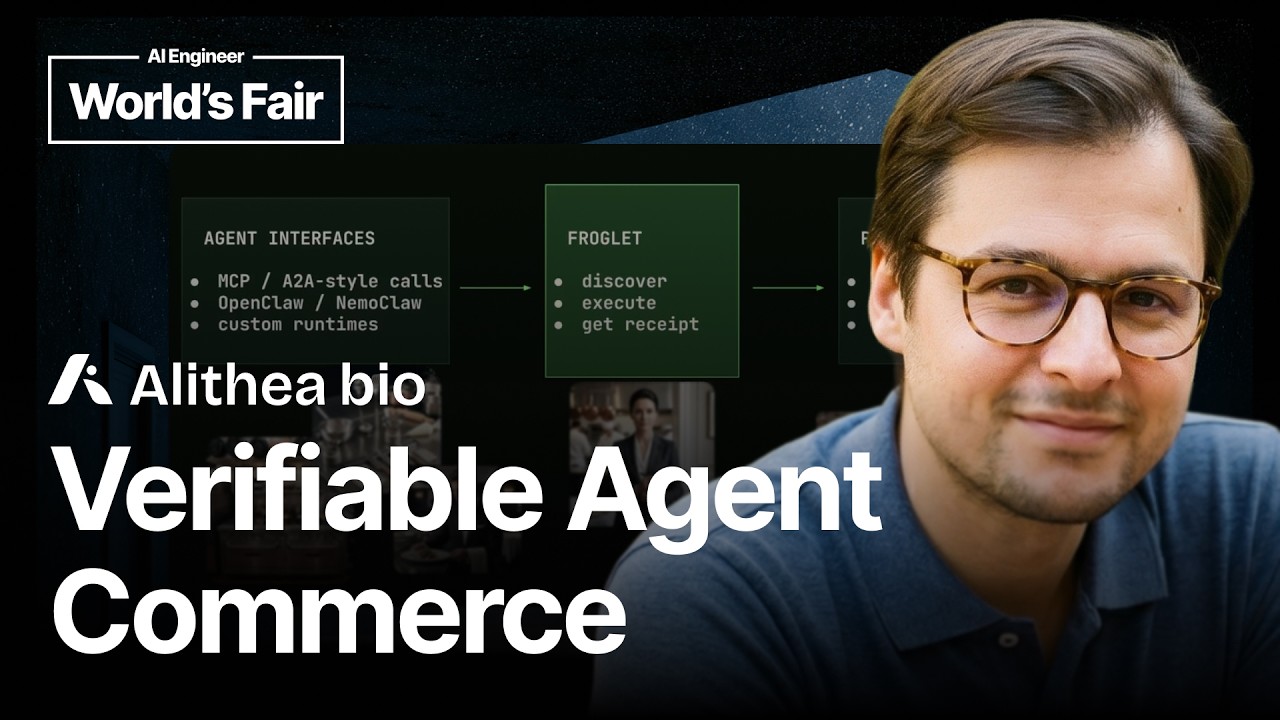
Armanas Povilionis from Alithea Bio introduces Froglet, an open-source protocol designed to address a critical gap in agentic automation within life sciences, particularly in immuno-oncology and immunopeptidomics. He emphasizes that while adding more tools to AI agents improves local efficiency, it does not solve the broader challenge of collaboration and trust in scientific workflows. Scientific research is inherently collaborative and requires a verifiable chain of receipts to ensure every step is trustworthy, repeatable, and scalable across organizational boundaries.
Using an analogy, Armanas compares agents with better tools to cooks with better knives, which only enhances local work. In contrast, scientific work resembles running a Michelin-star restaurant, where success depends on a coordinated supply chain, consistent quality, and reliable delivery. Current AI agents have many tools but lack the ability to manage budgets, negotiate services, and transact across organizations autonomously. Froglet aims to elevate agents from mere tool users to executive chefs who can discover suppliers, coordinate workflows, and maintain verifiable records of all transactions.
Froglet operates as a protocol that integrates with existing tools and payment systems without forcing uniform software stacks. It enables agents to discover services, negotiate terms, request work, and receive cryptographically verifiable receipts proving that tasks were completed as agreed. This lightweight transaction layer drastically reduces the time and cost of establishing reusable workflows, making collaboration more efficient and transparent. The protocol supports multiple roles—provider, requester, and marketplace—within the same node, facilitating direct peer-to-peer interactions without intermediaries.
In a live demonstration, Armanas shows how Froglet can be used both remotely and locally via Docker, highlighting its ease of installation and use. He illustrates how an AI agent, such as Claude, can interact with Froglet to publish services, invoke computations (like adding two numbers), and receive verifiable results. This interaction showcases Froglet’s ability to offload complex workflows from large language models, enabling agents to handle service discovery, execution, payment, and receipt generation seamlessly and securely.
In conclusion, Froglet represents a significant step toward enabling collaborative, scalable, and trustworthy scientific automation. By providing a standardized interface for agents to transact and verify work across organizational boundaries, it supports perpetual science automation and fosters collaboration. Armanas invites the community to explore Froglet through their website and GitHub, encouraging participation in advancing this open protocol for agentic automation in life sciences and beyond.