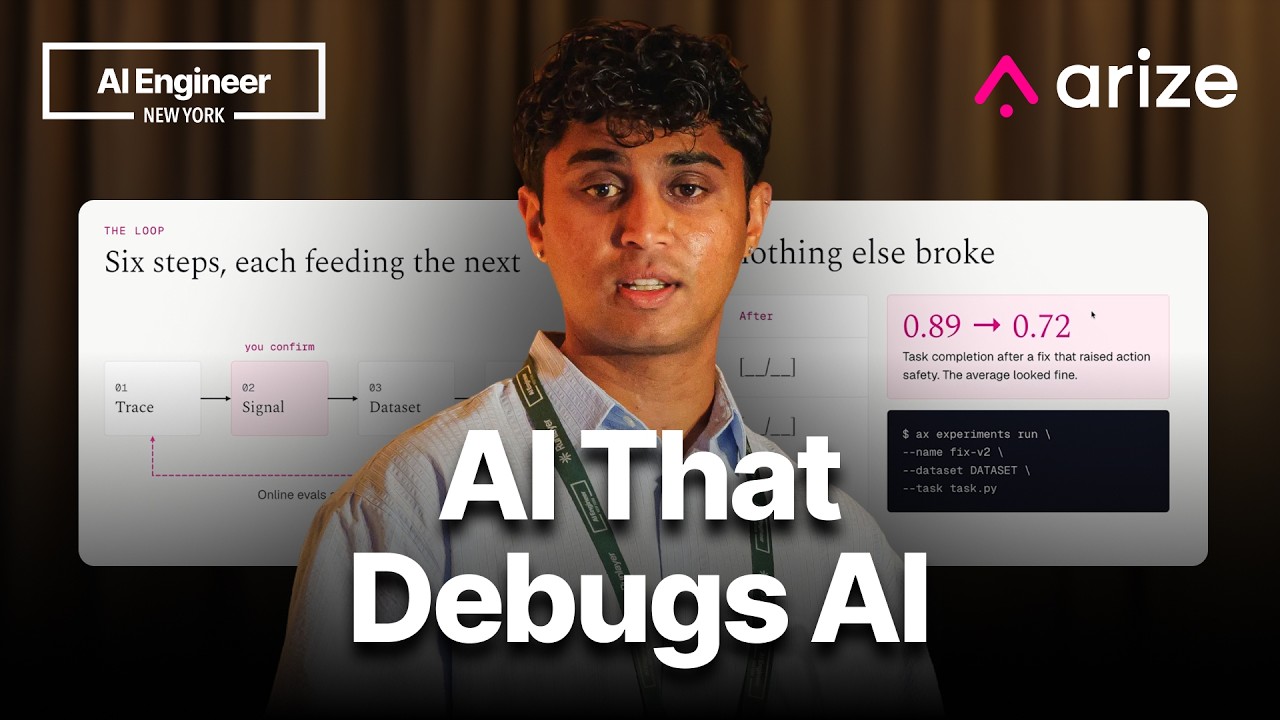
Fouad Ali, a product manager at Arize AI, presented a workshop on building self-improving loops for AI agents, focusing on how agents can learn from their failures using human feedback, trace data, and automated evaluation. He introduced Arize’s platform, which facilitates tracing agent behavior, clustering failures, proposing fixes, and validating those fixes through experiments. The workshop used a demo agent called Wonder Toys, a shopping assistant with a deliberately planted bug, to illustrate how the system detects issues like redundant search retries and proposes automated fixes by analyzing production traces and source code.
The core of the platform is the Signal agent, which continuously monitors agent traces on a configurable schedule, clusters failure patterns, and generates actionable insights. Signal can automatically create evaluation tests (evals) to catch recurring issues and even open pull requests with proposed code fixes. This process helps reduce the manual burden on engineers by automating the detection and initial resolution of problems, while still involving humans at critical points such as validating fixes, curating datasets, and designing evals to ensure quality and relevance.
Ali emphasized the importance of maintaining a “living fixture” dataset that grows over time with new failure cases, enabling continuous regression testing and preventing recurring bugs. Evals can be deterministic code checks or more qualitative assessments using LLMs as judges or even agents as judges, depending on the complexity of the evaluation needed. He also discussed the trade-offs between running evals in development pipelines versus production environments, highlighting cost considerations and the need to balance thoroughness with efficiency.
The experimentation phase validates proposed fixes by rerunning agents against failure cases and scoring their performance to ensure the fix resolves the issue without causing regressions elsewhere. This validation can be integrated into CI/CD workflows, providing confidence before deploying updates. Ali also touched on advanced features like auto-routing low-confidence eval results to human reviewers and integrating with various tools and data sources, enabling a flexible and scalable approach to agent self-improvement.
In conclusion, Ali encouraged attendees to leverage Arize’s open-source tools and managed platform to instrument their agents, collect trace data, and implement self-improvement loops. He stressed that while automation handles the heavy lifting of data analysis and fix proposals, human judgment remains crucial for validation and continuous improvement. The vision is to create an end-to-end system where agents autonomously improve over time with minimal human intervention, ultimately enhancing reliability and reducing operational burdens.
Useful Links