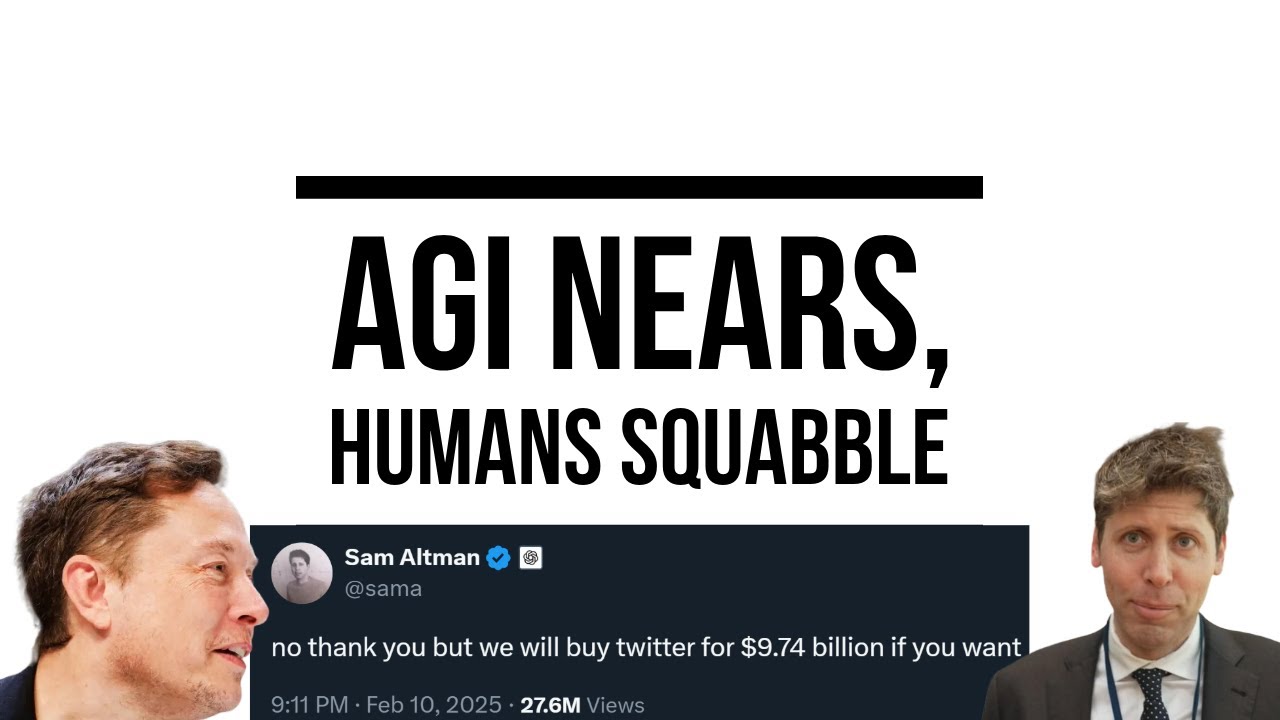
The video explores the rapid advancements in artificial general intelligence (AGI) and the societal implications, highlighting contrasting views on its impact on jobs and wealth distribution among influential figures like the U.S. Vice President and Sam Altman of OpenAI. It emphasizes the urgency for proactive measures and thoughtful policy-making to address the challenges posed by AGI, including potential job displacement, geopolitical power shifts, and ethical concerns regarding inequality.
The video discusses the rapid advancements in artificial general intelligence (AGI) and the societal implications that accompany these developments. It highlights the contrasting views among influential figures, such as the U.S. Vice President, who believes AI will enhance productivity without replacing jobs, and Sam Altman, CEO of OpenAI, who warns of potential job losses and the shift of power from labor to capital. The video emphasizes the urgency of addressing who will benefit from AGI, as various stakeholders, including Elon Musk and Microsoft, vie for control over OpenAI and its future.
The video outlines several key developments in AI, particularly focusing on the capabilities of models like OpenAI’s Codex and GPT-3.5. These models are not merely imitating human performance but are demonstrating advanced problem-solving skills and self-teaching through reinforcement learning. The speaker notes that AI systems are increasingly surpassing human benchmarks in coding and other tasks, suggesting that the potential for AGI is closer than previously thought. The discussion also touches on the implications of these advancements for white-collar workers, as AI systems are becoming adept at performing complex tasks traditionally done by humans.
Investment in AI is another critical theme, with Altman suggesting that the returns on investment in AI are exponentially greater than the initial input. This creates a cycle of continuous funding and development, leading to the potential for vast wealth generation through AGI. However, the video raises concerns about how this wealth will be distributed, especially as Altman has previously indicated that OpenAI aims to capture and redistribute wealth generated by AGI. The speaker questions the feasibility of ensuring that the benefits of AGI reach all of humanity, particularly in light of the potential for widespread job displacement.
The video also addresses the geopolitical implications of AGI, suggesting that nations that achieve AGI first may leverage their advancements to dominate economically and militarily. The speaker references a RAND Corporation paper that warns of the risks associated with AGI, including mass surveillance and the potential for authoritarian control. The discussion raises ethical concerns about how AGI could exacerbate inequalities between nations and within societies, particularly if powerful AI systems are concentrated in the hands of a few corporations or governments.
Finally, the video concludes with a call for proactive measures to prepare for the societal changes that AGI will bring. The speaker emphasizes the need for early intervention and thoughtful policy-making to address the challenges posed by AGI, including the balance of power between labor and capital. As AI continues to evolve rapidly, the urgency for global cooperation and accountability in AI governance becomes increasingly apparent. The video encourages viewers to reflect on the implications of these advancements and consider what actions should be taken to ensure a beneficial future for all.