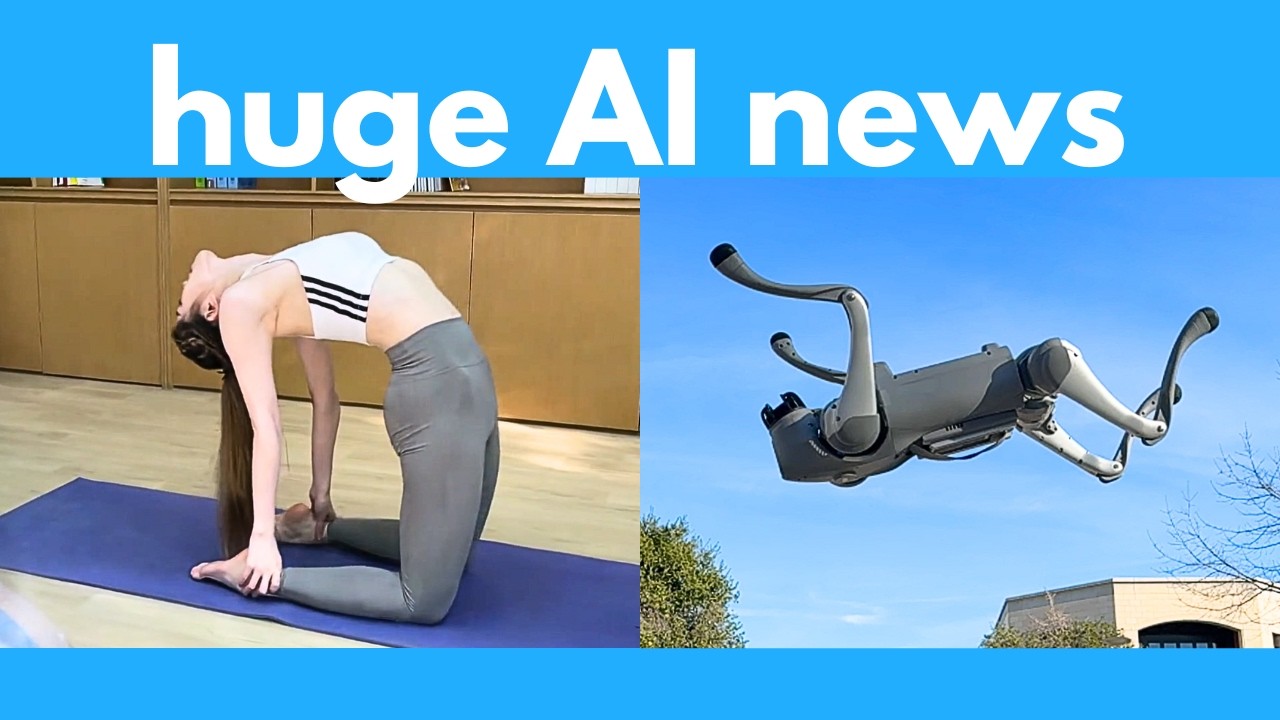
The video discusses a groundbreaking week in artificial intelligence, highlighting several new AI tools and advancements that have emerged. One of the standout innovations is a tool capable of transforming multi-view RGB videos into smooth, long volumetric videos. This technology allows users to navigate around a 3D scene captured from multiple camera angles, making it ideal for applications in virtual reality, sports, and performances. The new processing technique, called temporal Gaussian hierarchy, enhances the efficiency and quality of rendering these videos, making it a significant leap forward in 3D video generation.
Another impressive AI tool introduced is called Wonderland, which can generate entire 3D scenes from a single image. This tool allows users to navigate around the generated environment, maintaining consistency and realism even beyond the original image’s edges. Wonderland utilizes a camera-guided video diffusion model, enabling users to specify camera trajectories for animations. This capability sets it apart from previous tools, making it a versatile option for creating dynamic 3D content.
The video also showcases Genesis, a highly realistic physics simulator that can simulate various materials and phenomena with remarkable accuracy. Genesis can operate at speeds exceeding 43 million frames per second, allowing for ultra-slow-motion simulations. This tool has applications in robotics training, video game development, and animation, providing a cost-effective way to create realistic simulations without the need for physical prototypes.
Additionally, the video introduces CAP 4D, an AI that creates realistic 4D avatars from one or more images. This tool allows for real-time animation and manipulation of avatars, making it suitable for various applications, including gaming and virtual reality. The video emphasizes the quality and consistency of the avatars generated by CAP 4D, positioning it as a leading option in the realm of avatar creation.
Finally, the video highlights Google’s new video generator, V2, which boasts superior quality and realism compared to existing models. V2 can create videos in up to 4K resolution and is expected to revolutionize content creation by enabling users to produce Hollywood-level films with simple prompts. The video concludes by mentioning other notable AI advancements, including OpenAI’s new model, which has achieved impressive benchmarks in coding and general intelligence, indicating significant progress toward artificial general intelligence (AGI).