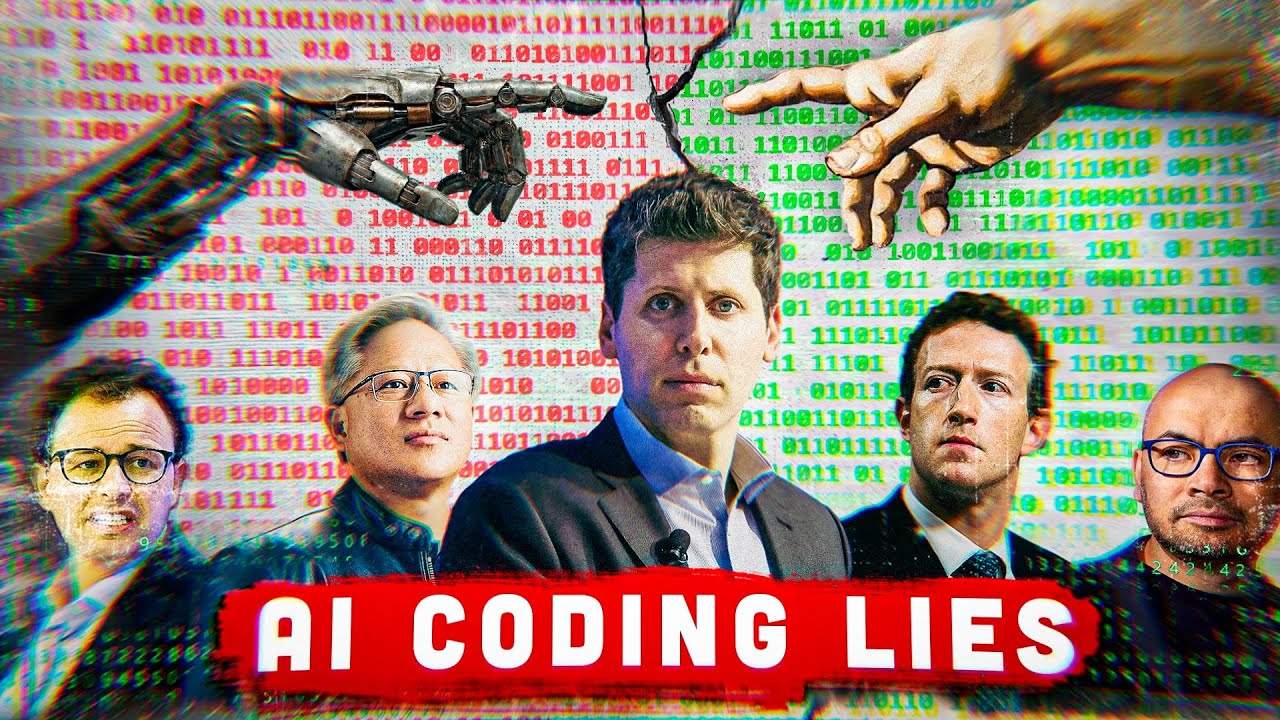
The video debunks seven common myths about AI’s coding abilities, arguing that AI lacks true understanding, often increases developer workload, and is not rapidly replacing programmers as claimed. It cautions that much of the AI industry is financially unsustainable, advising developers to rely on their own expertise rather than overestimating AI’s current capabilities.
The video challenges seven common myths about AI’s capabilities in coding. First, it argues that AI is not truly “great” at coding because it doesn’t understand code like a human does; instead, it predicts likely outputs based on prompts. The speaker emphasizes that the value of a programmer lies in their understanding and mental models, not just in generating code. Furthermore, the supposed productivity of AI-generated code is undermined by the increased time developers spend debugging and reviewing AI output, with many reporting more time spent fixing “almost right” code.
Second, the video disputes the idea that AI is improving exponentially and will inevitably replace programmers. It points out that simply increasing model size yields diminishing returns, as seen in recent AI benchmarks. The speaker highlights that longer context windows and more complex agent architectures often lead to higher failure rates, not better results. Studies show that limiting the tools and context available to AI can actually improve its performance, and that longer AI conversations tend to produce worse outcomes and higher costs.
Third, the notion that AI is only ineffective due to a “skill issue” is dismissed. The video claims that AI tools are intuitive and easy to use, and that so-called “AI skills” can be learned quickly. However, domain expertise remains crucial for evaluating AI output, meaning that senior developers benefit most from AI assistance. The myth that “AI won’t replace you, but a developer using AI will” is also debunked with an example: students who relied on AI tools performed worse on exams than those who used traditional search methods, suggesting overreliance on AI can erode real skills.
Fourth, the idea that AI is already replacing junior and mid-level engineers is refuted. The speaker explains that the decline in junior hiring began before the widespread adoption of AI tools and is more closely tied to economic cycles than to technological change. Senior engineers are not opposed to AI out of stubbornness or fear of change; in fact, they use AI the most and are confident in their expertise. Their skepticism comes from practical experience: AI-generated code often increases technical debt and workload, especially in debugging and code review.
Finally, the video addresses the belief that AI is not a bubble because of its revenue and infrastructure investments. The speaker argues that much of the AI industry’s financial activity is circular and unsustainable, with companies like OpenAI needing to raise enormous sums just to stay afloat. The short lifespan of AI hardware further undermines claims of long-term infrastructure investment. The advice for software engineers is to be cautious about working for AI-heavy startups, as they are likely to be the first to face cuts if the bubble bursts. Ultimately, the speaker encourages developers to play along with AI trends as needed, but to rely on their own expertise to solve problems effectively.