This week in AI has been packed with groundbreaking developments across various domains. Google introduced Spark VSSR, a powerful open-source video upscaler that significantly enhances low-quality videos to high resolution, outperforming existing models and supporting diverse content types including wildlife, architecture, and animations. Meanwhile, Miniax released its M2.7 model, notable for its self-evolving capabilities where the AI improves itself autonomously during training, achieving competitive benchmarks in coding and real-world tasks at a fraction of the cost compared to closed models. Xiaomi also unveiled two advanced AI models: Mimo V2 Pro, optimized for agentic tasks with over a trillion parameters, and Mimo V2 Omni, a multimodal model capable of understanding and generating text, images, video, and audio, both accessible via API and online platforms.
In education and interactive AI, OpenMIC emerged as an open-source platform creating virtual AI classrooms with multi-agent orchestration, offering slides, quizzes, simulations, and AI classmates for immersive learning experiences. Complementing this, Metaclaw enhances AI agents like OpenClaw by enabling continuous learning through regular conversations, automatically updating its skill library and improving performance over time. On the video generation front, Dreamverse showcased near real-time video creation and editing on a single high-end GPU, allowing users to generate and modify videos swiftly with impressive speed, though with some quality trade-offs.
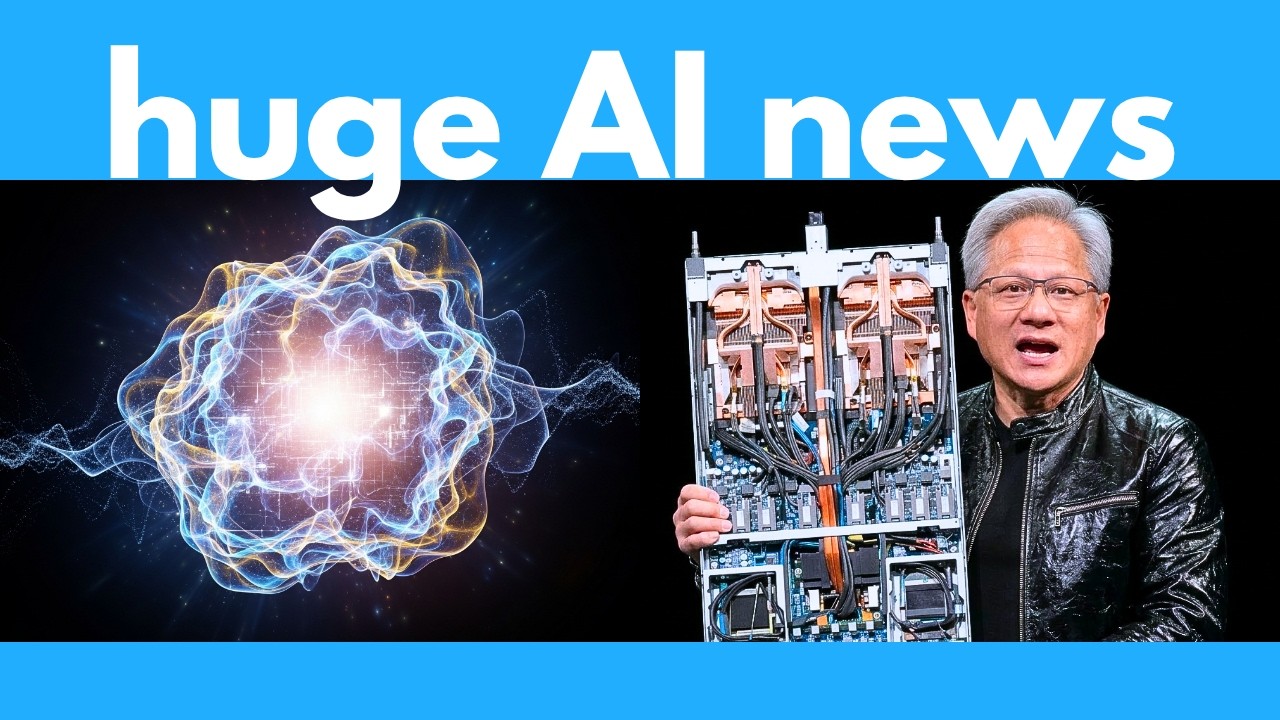
Nvidia’s GTC conference revealed ambitious projects including the Vera Rubin platform, a vertically integrated AI supercomputer designed for massive-scale AI agent deployment, featuring specialized chips like the Gro 3 LPU for ultra-low latency AI model inference. They also introduced Nemo Claw, an enterprise-grade secure version of OpenClaw for deploying autonomous AI agents with strict data and network controls. Nvidia expanded its open-source AI ecosystem with models like Neotron for language and reasoning, Cosmos for physics simulation, Isaac Groot for humanoid robot control, and Bio Nemo for biological research. Additionally, DLSS 5.0 was announced, merging traditional 3D graphics with AI-driven neural rendering to enhance game visuals efficiently.
Robotics advancements included humanoid robots training for a half marathon in Beijing and sophisticated demonstrations of robotic hand swarms controlled by a single human operator, showcasing high precision and tactile feedback. Open-source 3D modeling tools like SegV Genen and SK Adapter were introduced, enabling efficient part segmentation and skeleton-conditioned 3D model generation, respectively. Google enhanced its Stitch platform for AI-powered UI design with new features like multi-image references and voice prompting, alongside upgrading AI Studio into a full-stack coding environment capable of autonomously building complete applications with front-end, back-end, database, and authentication integration.
Finally, AI deepfake technology advanced with ID Laura, a unified model generating synchronized deepfake videos by combining image, audio, and text inputs, outperforming existing multi-step approaches. State-of-the-art research agents Miro Thinker 1.7 and H1 demonstrated exceptional predictive abilities, accurately forecasting events like gold prices, Super Bowl winners, and Grammy dominants, surpassing top closed models in benchmarks. These agents employ rigorous planning, tool use, and verification loops to ensure reliable and evidence-backed conclusions. Overall, this week’s AI news highlights rapid progress in self-improving models, interactive learning, video generation, robotics, and enterprise AI infrastructure, signaling exciting directions for the future.