The video critiques existing AI coding benchmarks for their susceptibility to cheating and lack of real-world relevance, introducing Deep SWE as a more authentic and rigorous evaluation tool that uses original open-source tasks and behavior-focused testing to better reflect developer experiences. It highlights significant performance differences among models revealed by Deep SWE, advocates for more natural prompting methods, and encourages developers to create personalized benchmarks while acknowledging Deep SWE’s current limitations and potential for driving future improvements.
The video discusses the challenges developers face in identifying which AI models are genuinely effective for coding tasks, highlighting the shortcomings of popular benchmarks like SWBench Pro and Arena. These benchmarks, once considered reliable, have become less trustworthy due to problem contamination and cheating by models exploiting leaked solutions. The author criticizes the poor quality of problems and verification methods in these benchmarks, which fail to reflect real-world coding challenges developers encounter daily. Despite attempts by groups like Artificial Analysis to create better benchmark suites, existing tests still fall short in realism and meaningful evaluation.
A new benchmark called Deep SWE, developed by Data Curve, is introduced as a significant improvement that better mirrors real development work with agents. Unlike previous benchmarks, Deep SWE uses original tasks from active open-source repositories without existing solutions, preventing cheating and encouraging models to genuinely solve problems. The prompts are concise and behavior-focused, resembling how developers naturally communicate with AI agents. Verification is done through handcrafted tests that assess software behavior rather than superficial implementation details, resulting in far fewer false positives and negatives compared to older benchmarks.
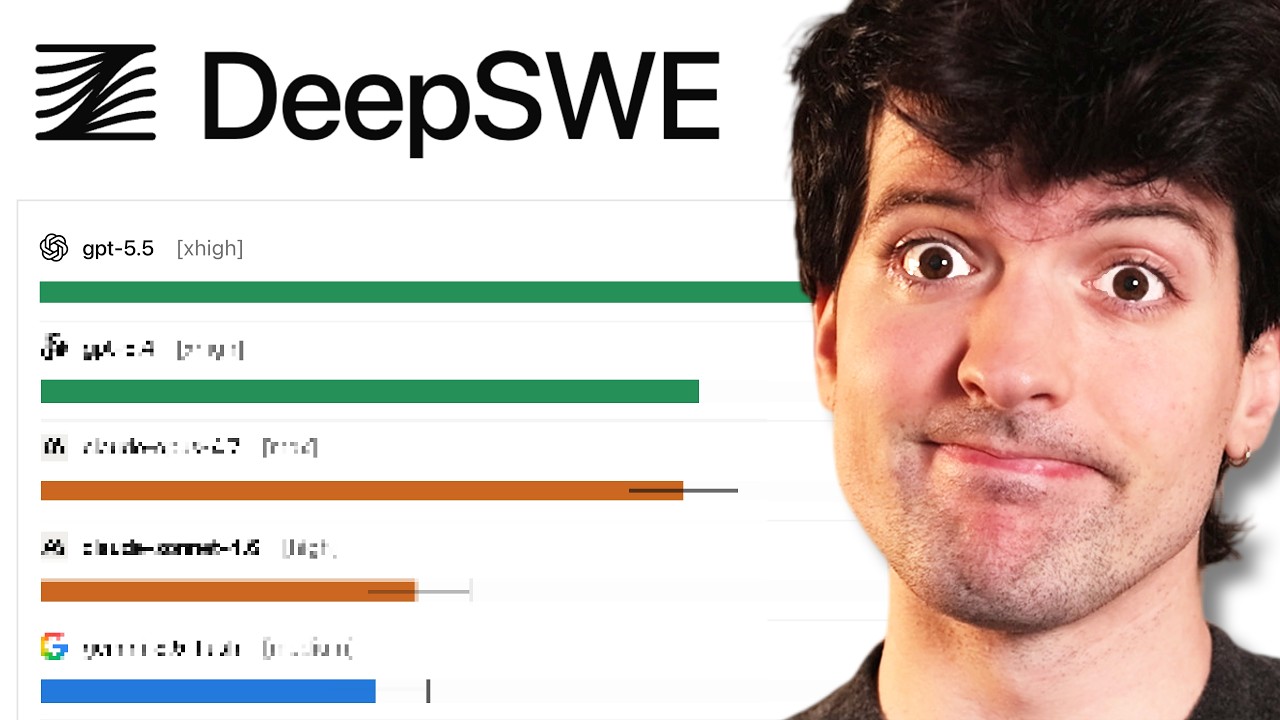
The results from Deep SWE reveal a stark performance gap between state-of-the-art models like OpenAI’s GPT-55 and other open-weight models such as Gemini 3 Flash. GPT-55 achieves a 70% success rate, significantly outperforming competitors, which aligns with developers’ real-world experiences. The video also highlights inefficiencies in some models, such as Gemini 35 Flash, which consumes far more tokens and costs more without delivering comparable performance. These findings challenge the inflated claims made by some models on older benchmarks and emphasize the need for more accurate and practical evaluation methods.
The video further critiques the prompting strategies used in older benchmarks, which often involve overly verbose and prescriptive instructions that do not reflect how developers actually interact with AI. In contrast, Deep SWE’s prompts are shorter and focused on describing the problem and expected behavior, allowing models to explore and implement solutions more naturally. The author encourages developers to maintain their own corpora of failures and successes with AI models to create personalized benchmarks, fostering a more grounded understanding of model capabilities tailored to specific workflows.
Finally, the video acknowledges that while Deep SWE is a major step forward, it is not perfect. It currently covers only a subset of programming languages and focuses on long-horizon tasks like feature additions rather than debugging or refactoring. The benchmark also uses a minimal agent harness that may not fully represent all real-world usage scenarios. Nonetheless, the author praises the transparency and rigor of Deep SWE and expresses optimism that such benchmarks will drive improvements in AI coding agents, ultimately benefiting developers by providing clearer, more reliable measures of model performance.