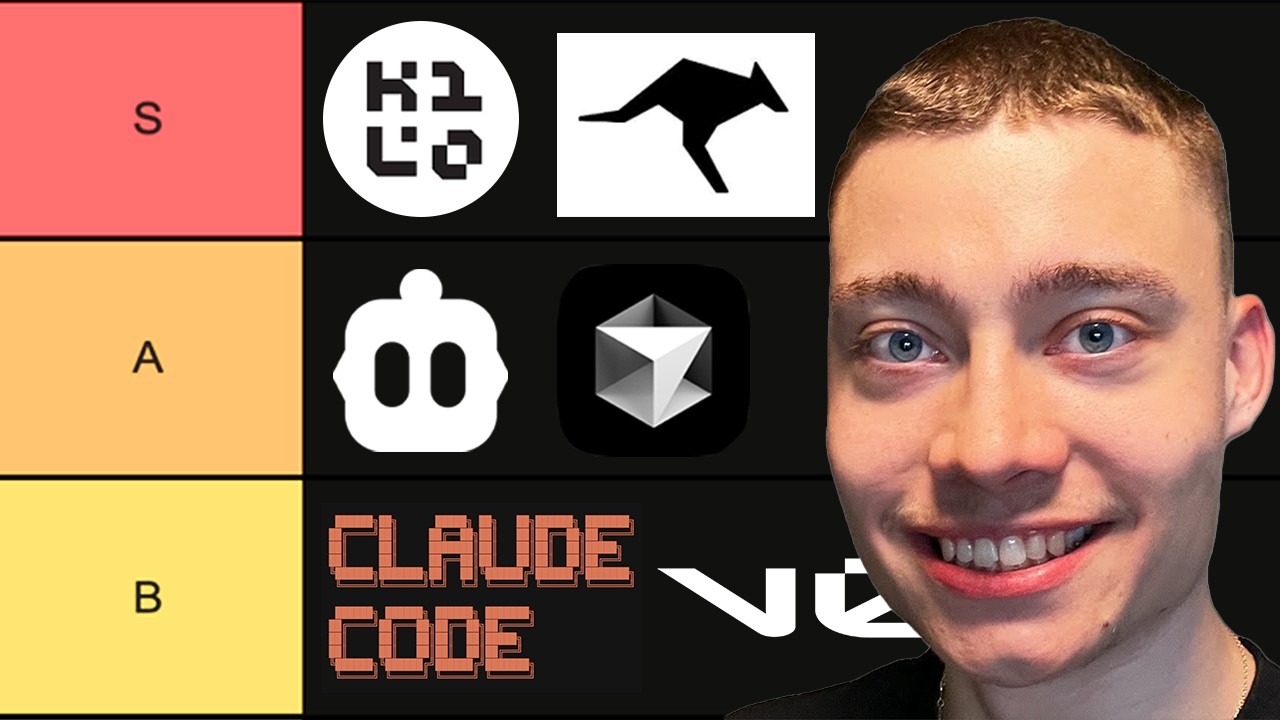
In this video, David Andre, founder of vector.ai, discusses the rise of next-generation AI coding extensions that are transforming software development. He explains why many developers are moving beyond popular tools like Cursor and Cloud Code to adopt more versatile and powerful AI extensions such as Client, RU Code, and Kilo Code. These new tools offer significant advantages, including compatibility with any code editor, support for multiple AI model providers via OpenRouter, and being free and open source. This flexibility allows developers to customize their AI coding experience and leverage the latest AI models, unlike more restrictive platforms that only support specific providers.
David introduces Client as the foundational AI coding extension, ideal for beginners due to its simplicity and ease of setup. He then explains RU Code as an enhanced fork of Client, designed for intermediate users who want more control, including features like slash commands and codebase indexing. Indexing converts the entire codebase into a vector database, enabling semantic search and faster code navigation, which is particularly useful for large projects. RU Code also supports multiple specialized modes and integrates with task management tools like Vectal, enhancing productivity and project context retention.
The video highlights GLM 4.6 as the best open-source coding model currently available, outperforming many closed-source models like Sonet 4.5 on various benchmarks while being significantly more cost-effective. David emphasizes that these open-source models are rapidly closing the gap with proprietary ones, making them a compelling choice for developers seeking high performance without the high costs. He also showcases Kilo Code, his favorite extension, which combines the best features of Client and RU Code into a clean, customizable interface. Kilo excels in AI programming by supporting architect mode for software design, detailed context visualization, and advanced autocomplete features.
David contrasts these new extensions with established tools like Cloud Code and Codex, noting that while Codex remains the most powerful due to its integration with OpenAI’s GPT-5 Codex model and cloud-based task management, it is limited to OpenAI models. Cloud Code is praised for its polished terminal UI but is less flexible in model support. He stresses the importance of adaptability in the fast-evolving AI coding landscape, encouraging developers to experiment with new tools regularly to stay ahead. David also promotes his community, New Society, as a resource for learning advanced AI programming skills and staying updated on the latest developments.
In conclusion, David advocates for embracing these modern AI coding extensions to become a more productive and effective developer. He underscores that AI programming is evolving beyond simple “vibe coding” into a serious discipline focused on architecture, planning, and scalable software development. By leveraging tools like Client, RU Code, and especially Kilo Code with powerful models like GLM 4.6, developers can build sophisticated applications more efficiently and cost-effectively. He encourages viewers to explore these tools, stay adaptable, and join communities like New Society to thrive in the rapidly changing AI-driven coding world.