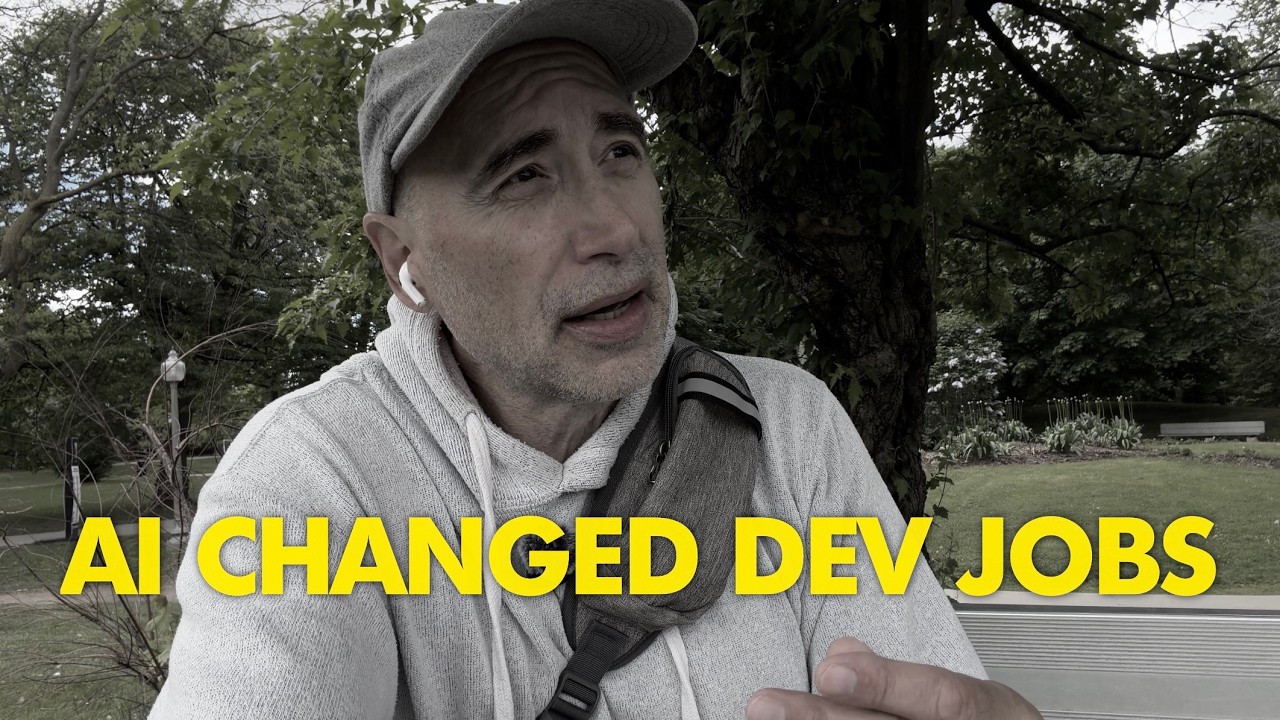
The video discusses how AI is transforming developer jobs rather than eliminating them, drawing parallels to past technological shifts where certain entry-level roles disappeared as older technologies fell out of favor. The speaker emphasizes that while traditional coding jobs using outdated languages or frameworks are vanishing, new opportunities arise for those who learn to effectively leverage AI tools. AI is described as a powerful but imperfect assistant—essentially a sophisticated associative array that lacks true logical reasoning and often makes mistakes, requiring human oversight and expertise to verify and correct its outputs.
The speaker highlights an Apple study that tested AI models against new, unseen benchmarks, revealing their inability to generalize or think logically, which explains why AI can hallucinate or produce erroneous results. This underscores the necessity for developers to understand AI’s limitations and to integrate it thoughtfully into their workflows. The analogy is made that AI is like a very fast but inexperienced junior developer who needs constant supervision. The video also critiques the fear-driven narratives around AI, suggesting that such “doom porn” is often used to manipulate public perception and investment rather than reflect reality.
Regarding productivity, the speaker predicts a 25-35% overall gain from AI adoption, which will accelerate software development cycles and create new job opportunities rather than simply eliminate existing ones. Companies will release updates faster, and new roles will emerge that combine traditional skills with AI proficiency. The speaker advises newcomers and junior developers to learn AI deeply, beyond just casual use, to remain relevant. Mastery of AI involves understanding different models, prompt engineering, orchestration, and integration into business processes, which is complex but essential for future job security.
The video dispels the myth that developers will become mere spec writers handing off tasks to AI, explaining that software development will remain an iterative, agile process where AI assists in generating boilerplate code and components under human guidance. The speaker shares personal experience developing AI-first applications that save significant time but still require careful review. The transition period may involve layoffs of those who lack AI skills, but ultimately, AI will enable the creation of many new jobs and use cases that were previously impossible, much like how the rise of the web created entirely new industries and roles.
In conclusion, the speaker encourages viewers to embrace AI as a tool that levels the playing field and expands opportunities rather than a threat that will destroy jobs. Drawing on three decades of experience, the speaker warns against listening to uninformed commentators and fearmongers. Instead, they advocate for learning and adapting to AI’s capabilities to thrive in the evolving tech landscape. The overall message is optimistic: while entry-level roles are changing, the future holds abundant new possibilities for those who develop AI skills and integrate them effectively into their work.