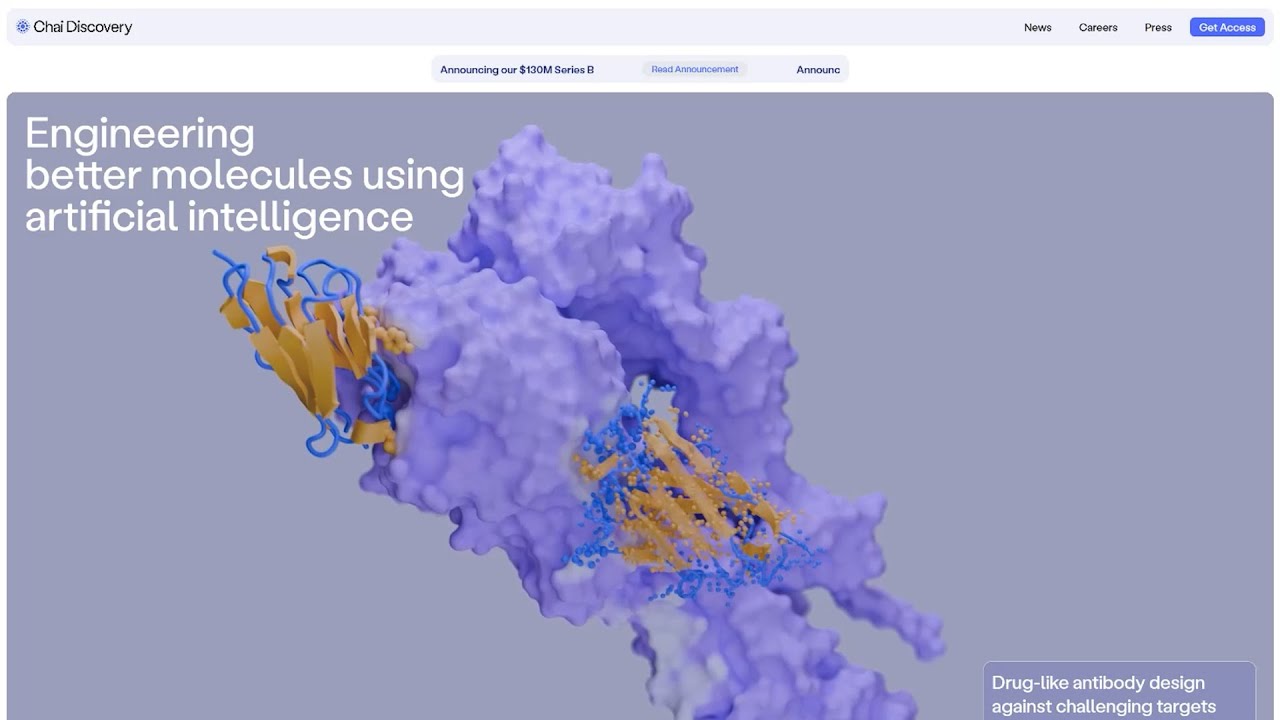
AI drug-discovery firm Chai has raised $130 million in Series B funding to accelerate its innovative research using AI to design novel molecules, achieving a breakthrough success rate of 15-20% in lab-tested molecules with its latest model, Chai 2. This funding will enhance computational resources, expand the team, and develop advanced software tools, aiming to revolutionize drug discovery by enabling pharmaceutical companies to create previously impossible medicines more efficiently by 2026.
The AI drug-discovery firm Chai has raised $130 million in a Series B funding round to accelerate its groundbreaking research in designing novel molecules using artificial intelligence. The company has recently achieved significant breakthroughs, demonstrating the ability to create molecules previously thought impossible. This new capital will be used to intensify their research efforts, expand their team, and scale the deployment of their AI models to develop innovative drugs at an unprecedented pace.
Investors see 2026 as the “year of deployment” for AI in drug discovery, following a 2025 marked by discovery and development of new medicines through AI. Pharmaceutical companies adopting this technology are expected to gain a competitive edge by discovering medicines that could not have been found through traditional methods. The release of Chai’s latest antibody generation model, Chai 2, was a pivotal moment, showcasing a leap in success rates from an anticipated 1% to an impressive 15-20% of molecules functioning effectively in lab tests.
This leap in success rate is transformative for the pharmaceutical industry, where traditionally, discovering new molecules has been akin to searching for a needle in a haystack. Chai’s AI models have demonstrated over an 85% success rate in achieving basic drug-like properties computationally, significantly reducing the uncertainty and variability inherent in lab-based molecule discovery. While further research and clinical trials remain necessary, this advancement signals a shift from theoretical AI applications to practical tools that can deliver real-world medicines.
The funding will also support the substantial computational resources required to run these complex AI models, as well as the extensive lab experiments needed to validate their predictions. Additionally, Chai is investing heavily in building software and tooling to create a comprehensive computer-aided design suite for molecules. The company is also focused on attracting top talent in AI and drug discovery to maintain its leadership and continue pushing the boundaries of what is possible in this space.
Looking ahead, the hope and expectation for 2026 is that pharmaceutical companies will be able to discover medicines more efficiently and effectively using AI. This technology enables the creation of drugs that leverage known biology and previously impossible chemistry, resulting in curative medicines that could not have been developed otherwise. For the general public, the most tangible benefit will be the emergence of new, impactful medicines that improve and save lives, marking a significant milestone in the integration of AI into healthcare.