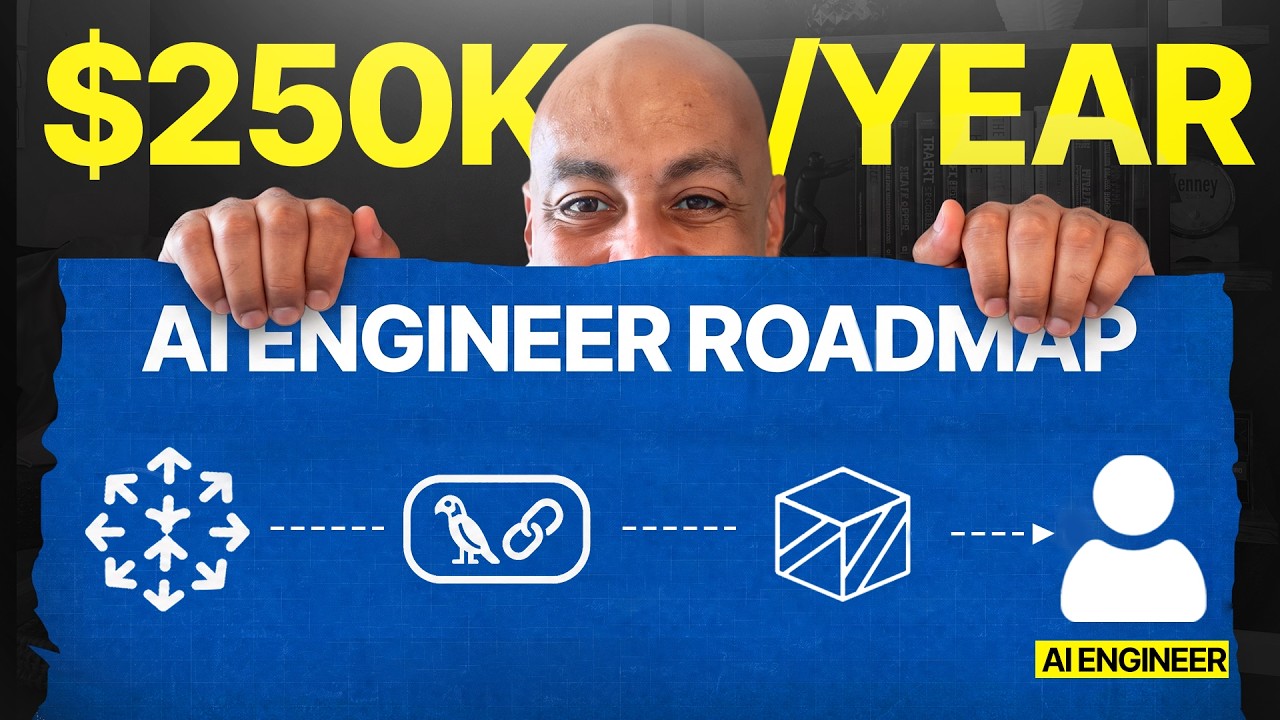
The video discusses the emerging role of an AI lead or AI engineer within companies, a position that has become increasingly important over the past 18 months but often lacks formal job postings. This role typically falls to someone who can bridge the gap between AI hype and practical implementation, rather than the most senior engineer or the person with the loudest opinions online. The speaker shares personal experience transitioning from a non-traditional tech background to becoming an AI lead by focusing on practical AI engineering rather than deep theoretical knowledge. The key takeaway is that companies need someone who can translate AI ambitions into workable solutions, often becoming a “forward deployed engineer” who embeds within teams to build and refine AI systems.
To become this AI lead, the speaker emphasizes that you don’t need an advanced degree in machine learning or to master complex math. Instead, practical skills like full stack development, API integration, and database management are foundational. Understanding Retrieval-Augmented Generation (RAG) is critical, as it underpins most production AI systems by providing models with accurate, relevant data rather than allowing them to generate ungrounded responses. The speaker warns against simplistic tutorials and stresses the importance of handling real-world challenges like data chunking, reranking, and maintaining context in dynamic datasets.
Another essential skill is understanding the difference between agent architectures and workflows. Many companies mistakenly push for complex AI agents that try to do everything, when simpler, well-structured workflows would be more effective and cost-efficient. Knowing when to build an agent versus a workflow—and being able to explain these choices clearly—sets a good AI lead apart. Additionally, the speaker highlights the often-overlooked importance of observability, cost management, and evaluation (evals) in AI systems. These practices ensure that AI solutions remain reliable, cost-effective, and maintainable over time, much like traditional software engineering testing.
The speaker advises building a comprehensive AI project that involves messy, real-world data and incorporates RAG, agent or workflow design, and observability tools like Langsmith. This hands-on approach forces learning across all necessary skills and prepares you to iterate and improve your system using modern AI tools and libraries. The process of building, testing, and rebuilding is crucial to mastering AI engineering in practice. The speaker also recommends exploring vector databases and tool calling to create flexible, efficient AI solutions tailored to specific business needs.
Finally, the most critical skill for becoming an AI lead is articulation—the ability to clearly explain and defend your technical decisions to non-technical stakeholders such as CEOs, product managers, and executives. Since AI is a rapidly evolving field with many one-way technical decisions, your capacity to communicate the rationale behind your choices is often more valuable than the code itself. The speaker encourages regular practice of explaining your work out loud to build this skill, which is essential for gaining trust and leadership in AI initiatives. This emphasis on communication, combined with practical engineering skills, forms the core roadmap to becoming the AI lead in any company.