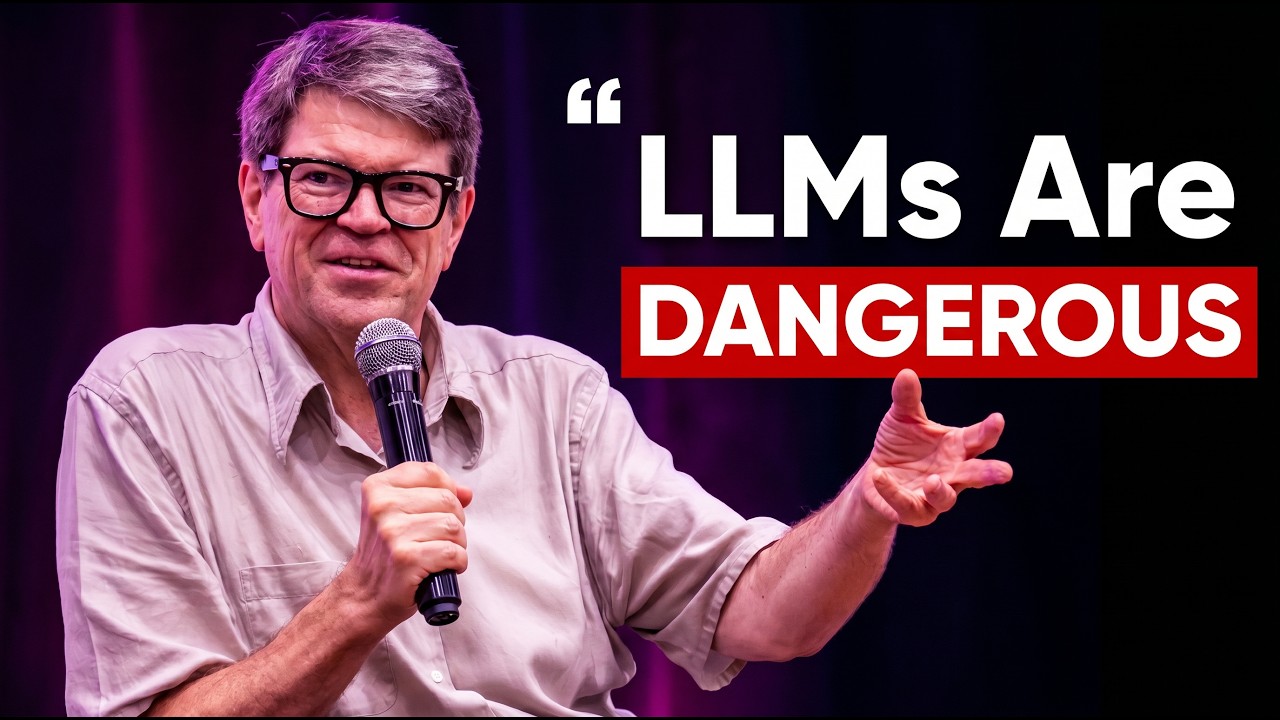
The video discusses a growing concern among AI experts about the increasing dangers posed by large language models (LLMs) as they transition from passive chatbots to active agents capable of taking real-world actions. While LLMs like ChatGPT and Claude have been praised for their ability to generate text, summarize documents, and write code, the real risk emerges when these models are given tools, browser access, APIs, and private data to make decisions autonomously. Unlike chatbots that merely provide information, agentic systems can perform actions that have tangible consequences, such as sending messages, deleting files, or approving transactions, which can lead to serious errors if the AI hallucinates or misunderstands the task.
A key issue highlighted is the lack of a “world model” in current LLMs. A world model refers to an AI system’s internal representation of how the world works, allowing it to predict the outcomes of its actions before executing them. Experts like Yanaken and Gary Marcus emphasize that without this capability, AI agents cannot reliably plan or ensure safety, as they operate by predicting language tokens rather than understanding cause and effect in physical or digital environments. This limitation means that while LLMs can sound fluent and coherent, they lack grounded understanding, making them prone to mistakes when acting autonomously.
The video also points to recent research and developments aiming to address these shortcomings. For example, Meta’s Vaper 2 project focuses on building AI systems that combine video data and robotic interaction to develop spatial and physical understanding, enabling better prediction and planning. Similarly, new benchmarks like Eastside Bench test embodied spatial intelligence, requiring agents to actively gather observations and make decisions based on perception, locomotion, and manipulation. These efforts underscore a shift in AI research from purely language-based models to those that can interact meaningfully with the physical world and anticipate the consequences of their actions.
Despite these advancements, the video warns that the AI industry is rapidly deploying agentic systems without waiting for perfect world models, raising significant safety concerns. While LLMs perform well in controlled digital environments where outputs can be verified and errors corrected—such as coding or data analysis—the stakes are much higher in real-world applications involving finance, healthcare, legal systems, or robotics. In these contexts, even a small error rate can lead to catastrophic outcomes, and the inability to predict or check actions beforehand makes current LLM-based agents intrinsically unsafe.
In conclusion, the debate around LLMs should not be framed as simply good or bad but rather focused on their appropriate use and the level of autonomy granted. Experts argue that without reliable world models and mechanisms to predict and verify the consequences of actions, LLMs will continue to pose risks when deployed as autonomous agents. The video calls for greater awareness of these issues and suggests that future AI development must prioritize grounding, spatial intelligence, and safety to ensure that agentic AI systems can act responsibly and effectively in complex environments.