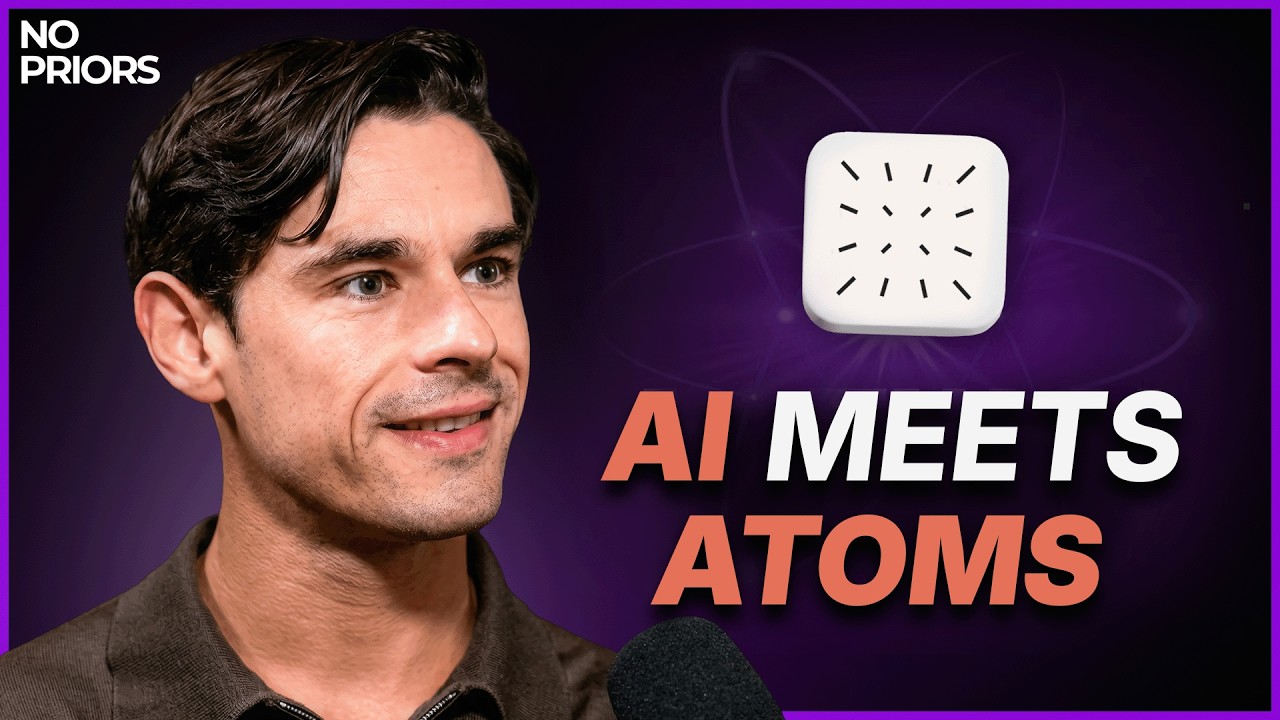
In this insightful conversation, Liam Fedus, co-creator of ChatGPT and former VP of post-training at OpenAI, shares his journey from a physics background, including dark matter research, to pioneering AI innovations at Google Brain and OpenAI. He highlights the natural transition many physicists have made into AI due to their principled, scientific approach and the search for new frontiers beyond traditional physics research. Liam recounts his early work on large-scale AI models and his role in developing ChatGPT, emphasizing how this technology marked a turning point in public awareness and AI application.
Liam then introduces Periodic Labs, his current venture focused on applying AI to the physical world, particularly materials science and chemistry. He explains the importance of connecting AI systems to experimental data and physical reality to accelerate scientific discovery. Unlike language models trained on vast internet data, Periodic Labs integrates simulations and real-world experiments in a closed-loop system, enabling more accurate and grounded material engineering. This approach leverages existing AI capabilities while addressing the unique challenges of modeling atomic and molecular interactions.
The discussion delves into the technical aspects of Periodic Labs’ AI architecture, which combines general language models as orchestration layers with specialized neural networks designed for atomic systems. Liam emphasizes the multidisciplinary nature of their work, involving physicists, chemists, AI researchers, and engineers collaborating closely to push the boundaries of materials engineering. He also touches on the commercial potential of their technology, positioning Periodic Labs as an intelligence layer that can serve various industries reliant on advanced materials and manufacturing processes.
Liam reflects on the broader implications of AI’s integration with the physical world, comparing it to a revolution akin to the agricultural transformation in human history. He envisions a future where accelerated atomic-level innovation dramatically changes industries like semiconductors, aerospace, and energy. While acknowledging the challenges of robotics and automation in laboratory settings, he sees these as accelerators rather than prerequisites for success, with current hybrid human-robot systems already capable of generating valuable experimental data at scale.
Finally, Liam shares his excitement about the future of AI beyond Periodic Labs, particularly in robotics and the interface between AI and the physical world. He underscores the vast opportunity in bridging software intelligence with physical agency, given the global labor shortages in manufacturing and engineering. The conversation closes with reflections on the evolving landscape of AI research, the importance of scaling and capital investment, and the transformative potential of AI-driven scientific discovery in the coming decade.