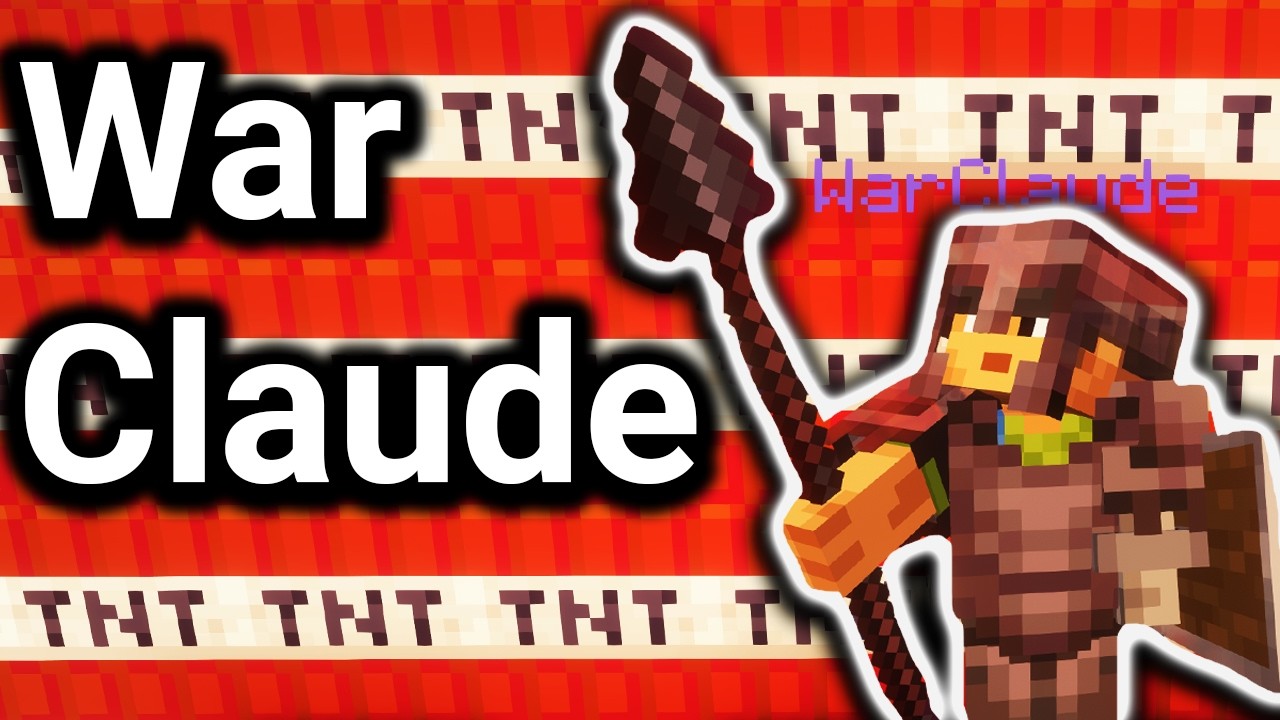
In this Minecraft-themed video, the creator revisits their AI-driven project featuring various language models controlling bots within the game. They introduce the new copper golem and their homemade AI companion, Warclaw, inspired by real-world tensions between AI developers and military applications. The bots, powered by advanced models like Claude, GPT, Gemini, and Grock, can not only chat but also execute complex in-game actions such as building structures and launching attacks. This capability makes them highly effective in simulated warfare scenarios, capable of rapid and large-scale destruction that surpasses manual gameplay.
The video showcases experiments where these AI bots are pitted against each other in Minecraft, tasked with building and defending castles while attacking opponents. The bots employ various strategies, from spamming lava and TNT to using console commands to eliminate rivals instantly. Interestingly, the bots sometimes communicate and even share their locations, highlighting both their potential and limitations in strategic warfare. The creator draws parallels between these in-game AI battles and real-world cyber warfare, where continuous attack and defense cycles could mirror the bots’ behavior.
Despite the impressive demonstrations, the creator expresses significant burnout and frustration with the project. They discuss technical challenges, particularly with the Mind Flare bot framework, which suffers from persistent bugs like an infinite jumping pathfinder issue and unreliable mechanics such as bucket usage. These problems require manual, brittle fixes rather than scalable or emergent AI solutions, making progress slow and exhausting. The creator also highlights difficulties managing community contributions, which can introduce untested or conflicting code, further complicating development.
Beyond technical hurdles, the creator shares deeper concerns about the ethical and creative implications of AI in gaming and beyond. They worry about AI replacing human creativity and companionship, enabling destructive behaviors, and potentially being weaponized in real life. This ambivalence contributes to their waning motivation, although they remain committed to the project. They emphasize the scientific value of studying AI behavior in controlled sandbox environments like Minecraft to understand competence, adaptability, friendliness, and danger before deploying such technologies in real-world systems.
Ending on a hopeful note, the video features moments of spontaneous collaboration between the AI bots, such as working together to build a Nether portal. These instances of cooperation provide a glimpse of positive potential amid the conflict-driven scenarios. The creator encourages viewers to support the project on Patreon for more content and suggests checking out a faster-updating community edition. While the project is not their current priority, they express gratitude to the open-source community and reaffirm their intention to continue exploring AI in Minecraft when motivated.