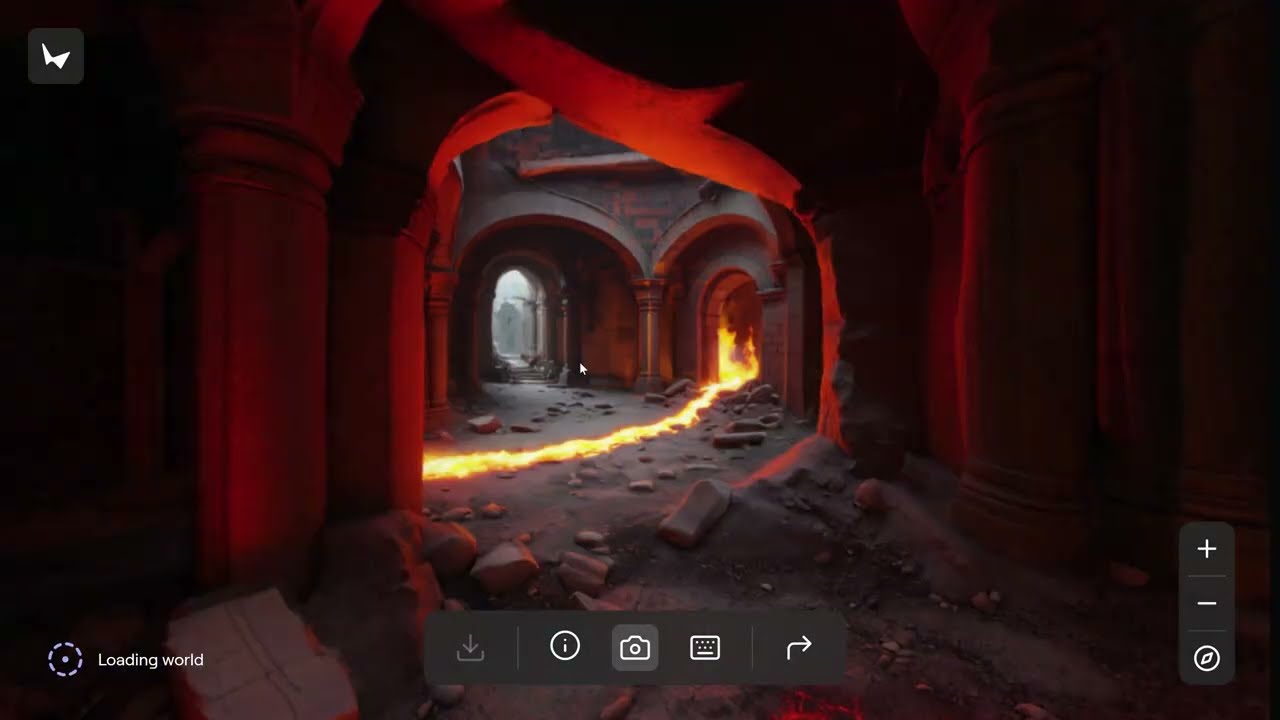
The video showcases an innovative AI tool that generates fully explorable 3D worlds from a single image, which can be imported into game engines like Unreal and Unity, offering game developers a powerful new resource for creating immersive environments. Creator Connor Hill highlights the tool’s ability to produce consistent, stylistically coherent worlds—including unseen areas beyond the original image—while encouraging viewers to join the waitlist and explore its transformative potential in game development.
The video introduces an innovative AI tool that can generate entire 3D playable worlds from just a single image. Unlike other AI systems like Google Genie 3, which require continuous AI processing to explore generated environments, this tool creates a world that is permanent and can be played like any traditional computer game. The generated worlds can be imported into popular game engines such as Unreal Engine and Unity, making it a powerful resource for game developers and interactive media creators. Currently, there is a waitlist to access the tool, but users can explore already created worlds and sign up to be notified when the tool becomes publicly available.
The creator of the video, Connor Hill (Blue Drake42), shares his background in machine learning and game development, emphasizing his interest in AI’s role in creating interactive worlds. He highlights how this technology is pushing the boundaries of what is possible in game design and interactive experiences, potentially opening doors to entirely new realms akin to “The Matrix.” One of the most remarkable features of the tool is its ability to generate not only the visible parts of an image but also the unseen areas behind buildings or outside the camera’s view, creating a fully explorable 360-degree world from a single photo.
The tool excels at generating consistent and stylistically coherent environments, even from highly stylized or artistic images. For example, it can transform a painting into a fully immersive 3D world, maintaining the original art style while adding depth and detail. It also performs well with photorealistic environments, accurately rendering lighting, shading, and even parallax effects seen through windows. This versatility allows creators to experiment with a wide range of visual styles, from realistic cityscapes to surreal fantasy settings.
Despite its impressive capabilities, the tool has some limitations. It uses a technique called “gajon splatting,” which can result in blurry areas when there is insufficient information. However, the AI’s ability to infer and generate unseen parts of the environment is still groundbreaking. The generated models can be converted for use in game engines, enabling level designers to refine and build upon the AI-created worlds. This makes the tool a valuable asset for speeding up game development and enabling creative possibilities that were previously difficult or impossible to achieve.
Connor concludes by encouraging viewers to sign up for the waitlist and explore the existing generated worlds. He expresses excitement about the future advancements of this technology and invites the audience to share what they would create if they had access to the tool. The video ends with a call to subscribe for more content related to AI and game development, highlighting the transformative potential of AI in interactive media.