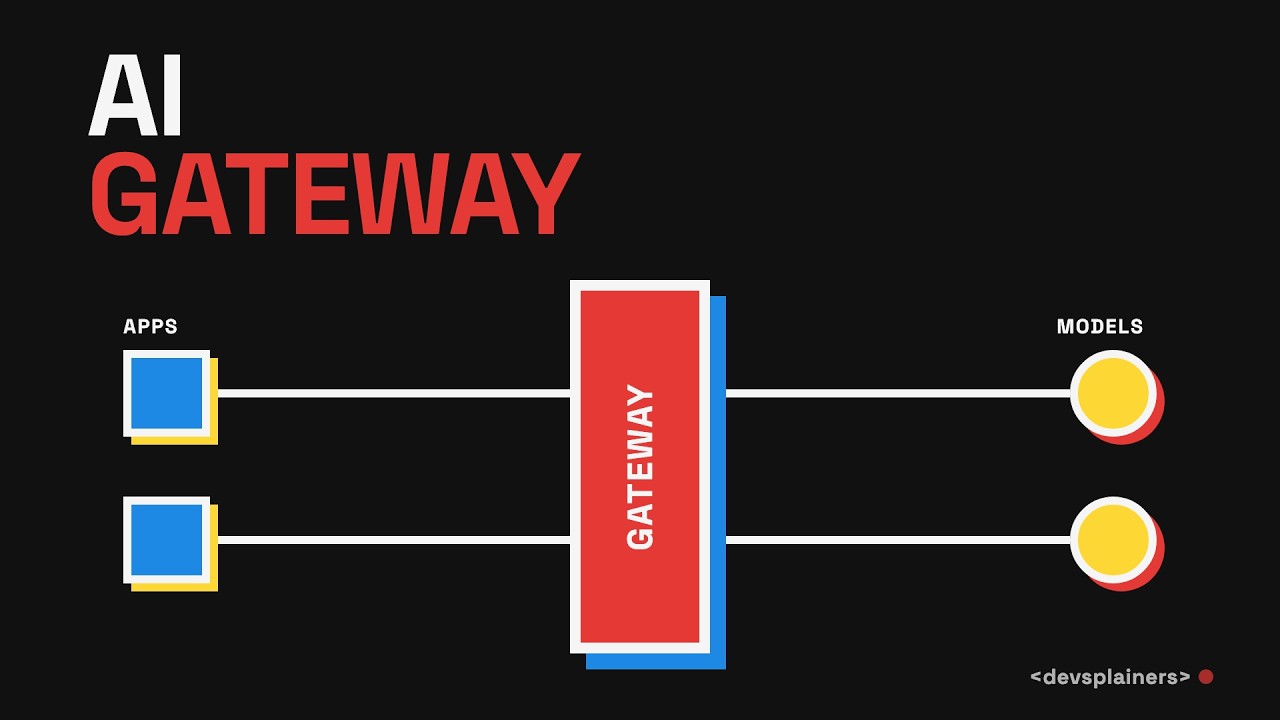
The AI gateway is an essential but often overlooked component in a maturing AI stack, acting as an intermediary layer between applications and the various AI models they use. Initially, teams start by calling a single model directly, but as usage grows, multiple providers and services get involved, leading to duplicated retry logic, scattered API keys, and unclear cost tracking. This complexity creates operational challenges similar to those faced by web APIs a decade ago, which were resolved by introducing API gateways. The AI gateway serves a similar purpose but is specialized for managing AI model interactions.
At its core, the AI gateway provides five key functions: it standardizes communication across different AI models by hiding provider-specific quirks behind a unified interface; securely manages API keys by centralizing them and issuing disposable keys to apps; handles retries and failovers to maintain service reliability; tracks usage and costs by tagging requests by team, app, and model; and offers centralized monitoring of latency, errors, and spending. This makes it a critical infrastructure layer that simplifies AI integration and governance across an organization.
There is some confusion around terminology, with AI gateway and LLM gateway often used interchangeably, though the former tends to emphasize enterprise governance and broader AI modalities, while the latter focuses more on developer routing for language models. Additionally, related concepts include API gateways (the older, more general pattern), MCP gateways (which govern agent tool usage), and inference gateways (which distribute traffic across GPUs). The AI gateway can either be a simple proxy or a more advanced router that intelligently directs requests to the most appropriate model based on rules or prompt complexity.
Smart routing within AI gateways aims to optimize costs by sending simpler queries to cheaper models and reserving expensive models for complex tasks. However, this approach faces a fundamental challenge: to accurately assess query difficulty, the router must understand prompts nearly as well as the expensive model itself, which limits the potential savings. Moreover, switching models mid-conversation can negate cost benefits due to the loss of warm cache on the new model, increasing token processing costs. Effective routing must therefore consider caching effects to avoid inadvertently raising expenses.
Despite its benefits, the AI gateway introduces trade-offs, including added latency from an extra network hop and the risk of a single point of failure that can bring down all AI features if the gateway goes down. It also concentrates sensitive API keys in one place, increasing security risks. Teams should adopt an AI gateway only when their AI usage grows complex—such as involving multiple providers, services, or cost centers—and not for simple, single-provider setups. Ultimately, the AI gateway is a vital infrastructure layer that addresses the operational challenges of scaling AI across organizations, though its exact form and integration remain evolving.