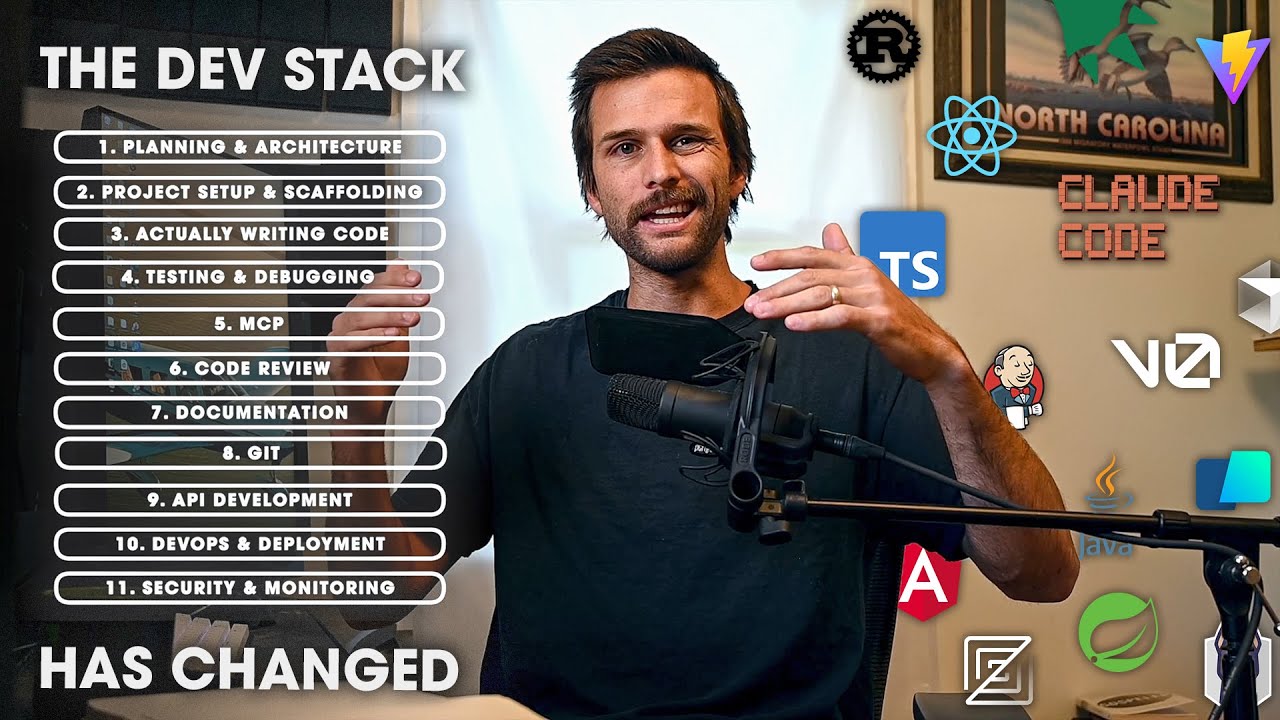
The video explores how AI is transforming the software development workflow in 2025, integrating into every stage from planning to deployment. It begins with planning and architecture, where AI tools like ChatGPT or Claude can help consolidate scattered requirements into crisp project requirement documents (PRDs) and generate diagrams from whiteboard sketches. For new features in existing codebases, AI tools with codebase context such as Cursor or Claude Code can suggest implementations while encouraging developers to critically evaluate AI’s recommendations rather than blindly accepting them.
Next, the video discusses project setup and scaffolding, highlighting AI-powered app generation tools like Vercel’s VO, Bolt, Lovable, and Chef by Convex. These tools scaffold projects with UI components tailored to specific tech stacks, primarily focusing on TypeScript and JavaScript ecosystems. While these tools accelerate initial setup, developers should be aware of their tech stack dependencies and limitations. The core coding phase benefits from AI-powered IDE extensions and CLI tools that understand the codebase context, enabling code generation, refactoring, debugging, and test writing. However, developers must review AI-generated code carefully to avoid errors or unintended changes.
Testing, debugging, and documentation are also enhanced by AI. AI can generate test suites, especially for common “happy path” scenarios, but developers need to specify edge cases based on domain knowledge. Debugging is simplified by feeding stack traces directly into AI agents for explanations and fixes. Documentation can be auto-generated for functions and APIs, though developers should supplement AI-generated docs with contextual “why” explanations that AI cannot infer. Additionally, AI can streamline Git workflows, Docker configurations, and CI/CD pipelines by translating natural language commands into code and scripts, saving time on repetitive tasks.
The video introduces advanced concepts like Model Context Protocol (MCP), which allows AI to connect directly to tools and data sources such as DataDog, Jira, or GitHub, enabling more integrated and automated workflows. AI-assisted code review tools like Code Rabbit can catch logic bugs and security issues before human reviewers see the code, though human oversight remains crucial due to occasional AI inaccuracies. AI also improves security scanning and monitoring by explaining vulnerabilities in human terms and analyzing production logs for anomalies, but caution is advised to avoid exposing sensitive data.
Finally, the video addresses potential pitfalls of AI in software development, including skill atrophy if developers rely too heavily on AI, and the risk of AI introducing security vulnerabilities or breaking infrastructure code. The presenter encourages developers to adopt AI tools gradually, focusing on areas that solve their biggest pain points, and to maintain critical thinking and thorough code review practices. The overarching message is that AI will not replace programmers but will prioritize those who effectively leverage AI, making it essential for developers to start integrating AI into their workflows today.