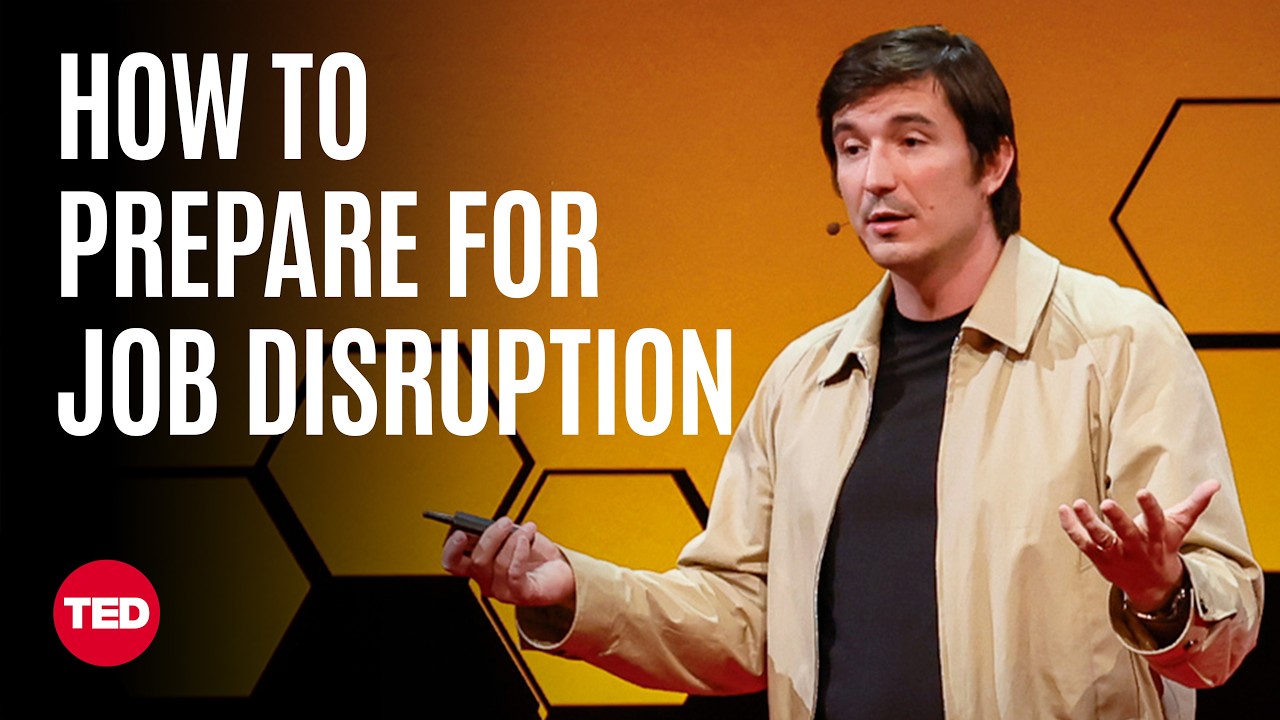
Vlad Tenev discusses how the rise of AI is causing anxiety about job security, but argues that technological disruption has always led to new and unforeseen opportunities throughout history. He encourages people to embrace change and trust in humanity’s ability to adapt, create new roles, and find meaning in work alongside advancing technology.
Vlad Tenev begins his talk by reflecting on the uncertainty many people feel when starting their careers, especially in the face of rapidly changing technology. He shares his own experience as a young graduate during the 2008 financial crisis, noting how the simultaneous emergence of the iPhone and the App Store provided a sense of optimism and new opportunities, even as traditional job security was shaken. Today, however, he observes that emerging technologies like artificial intelligence (AI) are a source of anxiety rather than hope for many young people, who worry about whether their chosen careers will even exist in the future.
Tenev highlights that AI is fundamentally different from previous technological advances because it is the first tool capable of operating independently and potentially surpassing human abilities in a wide range of fields. He shares his involvement in developing mathematical superintelligence—an AI that could outperform any human mathematician—and acknowledges the unsettling implications of such advancements. This leads him to the central question of his talk: what happens to society when most of today’s jobs are rendered obsolete by AI?
To answer this, Tenev takes a historical perspective, tracing the evolution of work from the Paleolithic era to the present. He points out that most jobs throughout history—hunter, gatherer, blacksmith, farmer—have disappeared or transformed, often replaced by new, unforeseen roles. He uses personal anecdotes, such as his great-grandfather’s reaction to seeing an automobile for the first time, to illustrate how each generation has faced and adapted to disruptive changes in the job market. Tenev notes that even our surnames often reflect professions that no longer exist, emphasizing the constant flux of employment.
Tenev argues that job disruption is not only inevitable but also essential to human progress. Each wave of innovation, from the agricultural revolution to the internet era, has led to the creation of entirely new industries and job categories. He introduces the concept of a “job singularity”—a future explosion of new job types and entrepreneurial opportunities enabled by AI. While acknowledging that the pace of change may be faster and more disorienting than ever, he believes that humanity’s creativity and adaptability will ensure that meaningful work continues to emerge.
In conclusion, Tenev urges the audience not to let fears about job automation deter them from pursuing their passions. He points out that past predictions about technological unemployment have often been proven wrong, and that humans have always found ways to create meaning and purpose, even in uncertain times. He expresses confidence that future generations, possibly working alongside AI, will continue to invent new roles and industries—some of which may seem unimaginable today—balancing both excitement and apprehension as they shape the future of work.