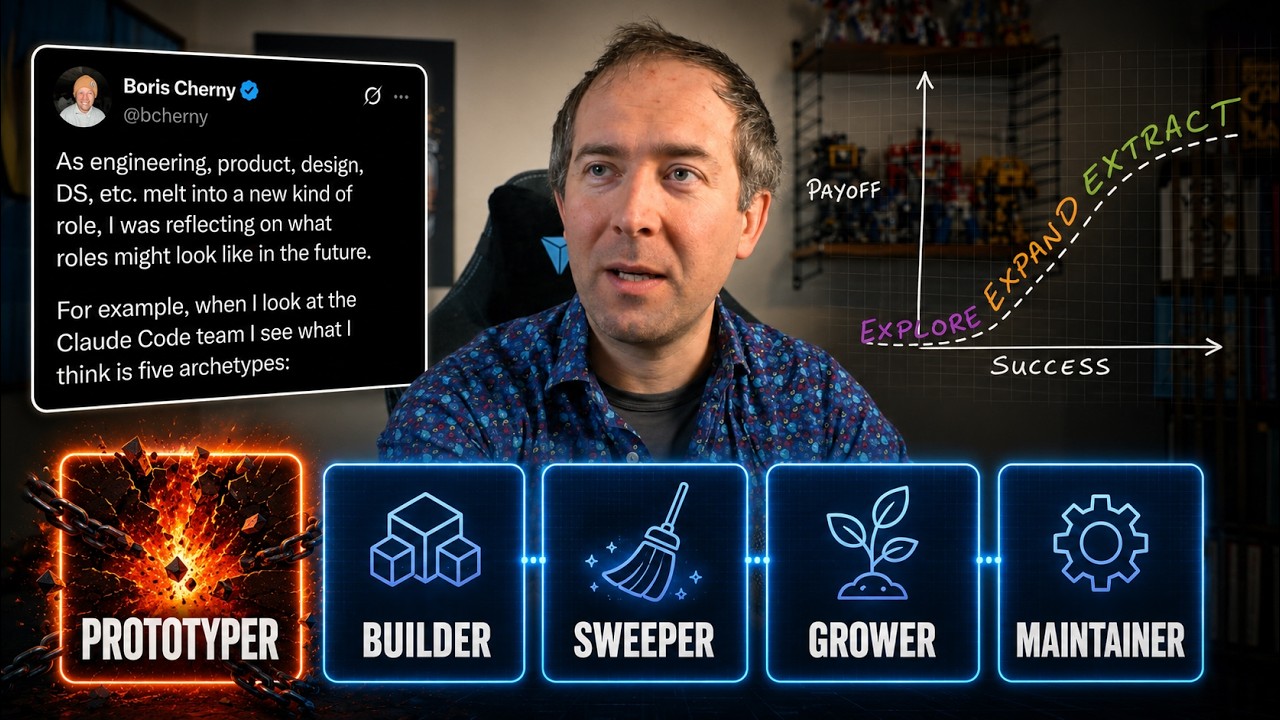
The video discusses a framework proposed by Boris Churnney from Anthropics, which categorizes product development roles into five archetypes: prototypers, builders, sweepers, maintainers, and growers. These archetypes represent different stages and skill sets required throughout a product’s lifecycle. Prototypers focus on generating and quickly testing new ideas, a role increasingly accessible due to AI coding tools. Builders take these prototypes and develop them into production-ready software, requiring deeper engineering skills. Sweepers clean up code, improve performance, and simplify the product, while maintainers ensure the system remains reliable, secure, and functional. Growers scale products that have achieved market fit, demanding strong system design and strategic thinking.
The video connects these archetypes to a 20-year-old concept known as the “worldly map” by Simon Wley, which describes product evolution through three phases: explorers, villagers, and town planners. Explorers correspond to prototypers who work in uncertain, experimental environments. Villagers align with growers who develop and expand the product, and town planners resemble maintainers who sustain mature systems. Sweepers are somewhat harder to place but are seen as essential across all phases, especially for maintaining code quality and system health. The product and team composition naturally evolve through these stages, requiring different expertise at each point.
Kent Beck’s 3x model, introduced in the video, parallels these ideas with phases called explore, expand, and extract, reinforcing the notion that AI coding assistants excel at the prototyping (explore) phase but require human expertise for building, growing, and maintaining products. Beck highlights that junior engineers benefit significantly from AI tools, accelerating their learning and productivity. This shift encourages hiring and investing in junior talent, as AI can help them ramp up faster than before. The video emphasizes that while AI can automate many tasks, roles like maintainers remain critical and undervalued.
For junior engineers and “vibe coders” who enjoy rapid prototyping, the video advises expanding skills beyond just creating prototypes. As products mature, the demand shifts toward builders, growers, and maintainers who handle complex engineering challenges, system design, and long-term product health. Sweepers, who focus on cleaning and optimizing codebases, are evolving to build automated systems that perform these tasks, rather than doing them manually. This evolution means that software engineers should develop versatile skills that span multiple archetypes to remain valuable in a fast-changing landscape.
Finally, the video encourages viewers to reflect on which archetype best fits their strengths and the current needs of their product or team. Misalignment between personal skills and product stage can lead to frustration or inefficiency, suggesting the need for skill development or role changes. The overarching message is that understanding these archetypes and the product lifecycle can help engineers navigate their careers strategically, leveraging AI tools effectively while preparing for the evolving demands of software development. The video invites viewers to share their archetype preferences and engage in further discussion.