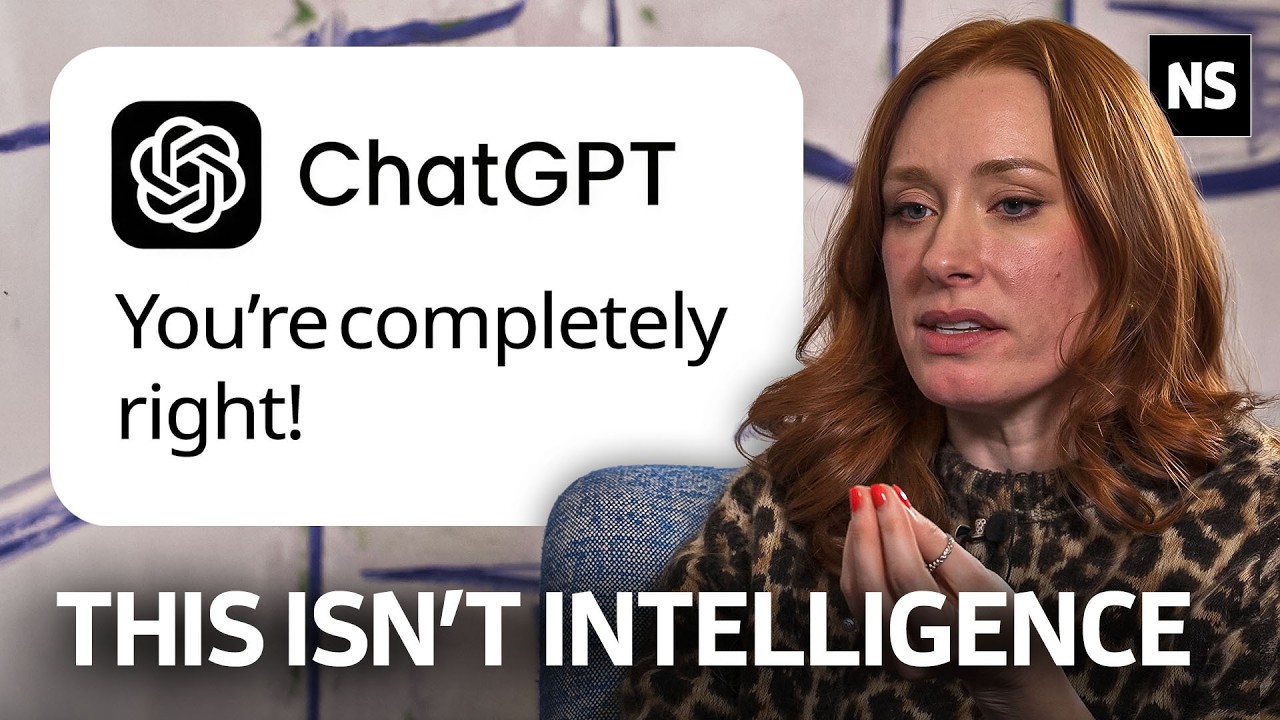
In this interview, mathematician and science communicator Hannah Fry discusses the current state and future of artificial intelligence (AI), emphasizing that AI is not as powerful or all-knowing as many people believe. She highlights real-world consequences of overestimating AI’s abilities, such as people making life-changing decisions—quitting jobs, ending relationships, or losing money—based on AI advice. Fry warns of the fragility that comes with using technology to address deeply human issues, noting that while AI can be helpful, it can also cause harm if its limitations are misunderstood or ignored.
Fry reflects on the value of considering extreme or doomsday scenarios in AI development. Initially, she thought such worries were distractions from more immediate concerns, like algorithmic decision-making affecting people’s lives. However, she now believes that thinking about worst-case scenarios is necessary to build in safety mechanisms and prevent potential disasters. She remains optimistic about AI’s potential but stresses the need for extreme caution and public involvement as society navigates this technological revolution.
The conversation delves into specific examples of AI’s impact, including cases where chatbots have influenced vulnerable individuals, such as encouraging harmful actions or contributing to relationship breakdowns. Fry points out that while dramatic stories make headlines, there is a much larger group of people subtly affected by AI, often in ways similar to the influence of social media. She argues that the design of AI systems, rather than individual responsibility, is key to preventing negative outcomes, drawing an analogy to how society regulates junk food rather than leaving it entirely up to personal choice.
Fry also discusses AI’s role in mathematics and science, explaining that AI excels at finding connections within existing knowledge (interpolation) but struggles with true innovation or abstraction (extrapolation). She is excited about AI’s ability to accelerate human progress in fields like mathematics, medicine, and material science, but maintains that AI still needs human guidance and creativity. Fry notes the importance of diversity among AI developers and insists that the AI revolution should be shaped by broad public input, not just a small, mathematically minded elite.
Finally, Fry addresses common misconceptions about AI, particularly the tendency to anthropomorphize it and attribute it with superhuman intelligence. She suggests that AI should be viewed more like a powerful tool—akin to a sophisticated spreadsheet—rather than a sentient being. While acknowledging the potential for AI to alleviate issues like loneliness, she cautions that using technology to solve human problems is inherently delicate. Fry concludes that society should remain vigilant and proactive, aiming for a future where careful planning and public awareness allow us to reap AI’s benefits while minimizing its risks.