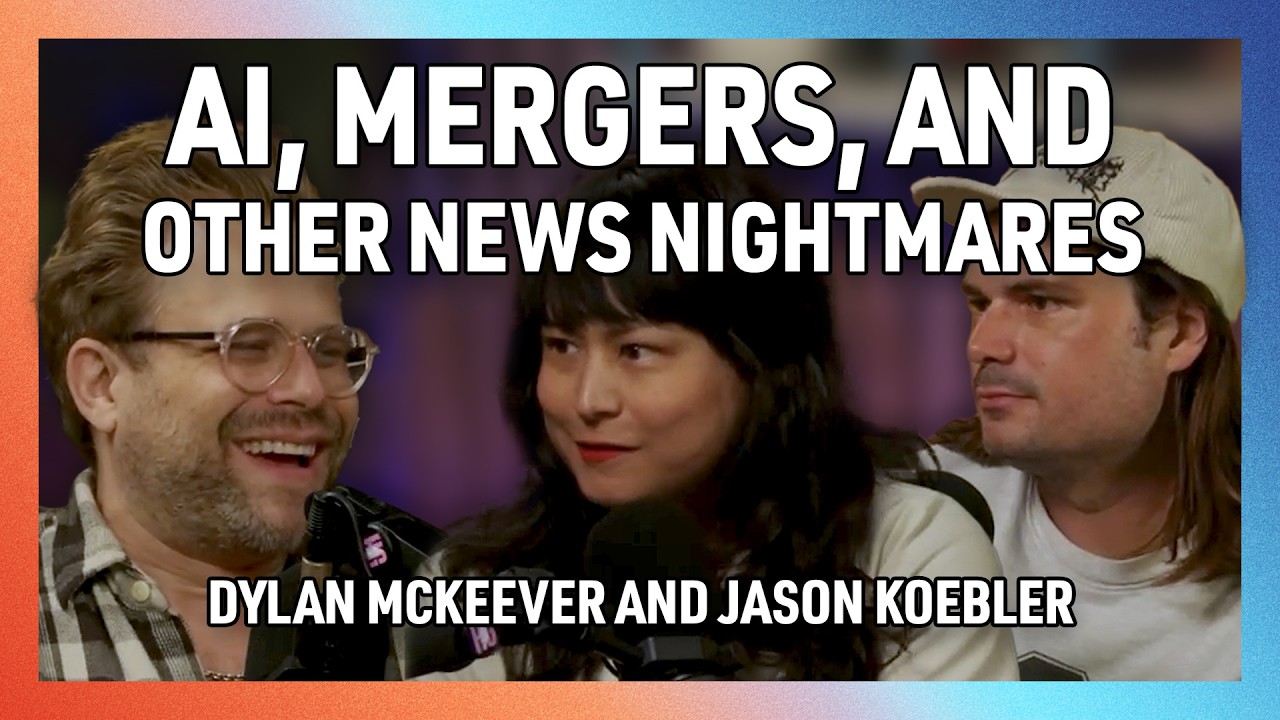
Adam Conover hosts a special panel-format episode of Factually, joined by tech journalist Jason Koebler (404 Media) and comedian Dylan McKeever. The episode opens with casual banter about adjusting to daylight savings and personal anecdotes, before shifting to the main topics: the intersection of AI, military contracts, and recent media mergers. Adam explains the new format is an experiment, inviting feedback from listeners, and plugs his upcoming stand-up shows.
The first major discussion centers on the controversy between AI companies Anthropic (makers of Claude) and OpenAI regarding Pentagon contracts. Jason explains that Anthropic refused to allow its AI to be used for mass domestic surveillance or autonomous weapons, while OpenAI quickly agreed to a Pentagon deal with fewer restrictions. The panel discusses the ambiguity around how the military actually uses these AI tools, the ethical posturing of companies like Anthropic, and the reality that both companies are eager to secure lucrative government contracts despite their public stances. They also touch on the proliferation of AI models, the ease of bypassing safeguards, and the predominance of AI-generated content for niche or questionable purposes.
The conversation then shifts to the recent wave of media mergers, focusing on the attempted acquisition of Warner Bros. by Netflix and the eventual purchase by Paramount’s parent company, Skydance, led by David Ellison. Adam and the panelists critique the destructive pattern of media consolidation, likening it to house-flipping where companies are gutted for short-term profit at the expense of workers, creativity, and the broader cultural landscape. They lament the decline of Hollywood as a global cultural force, the loss of jobs, and the shrinking space for innovative or mid-budget films, noting that even successful years for studios are overshadowed by executive decisions to sell or merge.
The panel also discusses the broader implications of these mergers for news organizations, such as CNN and CBS News, and the lack of meaningful antitrust enforcement in the U.S. They highlight the role of state attorneys general as a last line of defense against unchecked consolidation, but express skepticism about the likelihood of stopping such deals. The conversation underscores how legacy media companies have failed to adapt to new viewing habits, ceding ground to platforms like YouTube, and how their defeatist attitude has contributed to their decline.
To close, the panel touches on recent political developments, particularly the Democratic Party’s wavering stance on trans rights, and the importance of clear, principled messaging. They express hope that a new generation of politicians is learning to stand firm on human rights issues. The episode ends on a lighter note, with each panelist recommending a piece of art or media that has inspired them recently, emphasizing the importance of culture and creativity as reasons to stay hopeful despite the bleakness of current events.