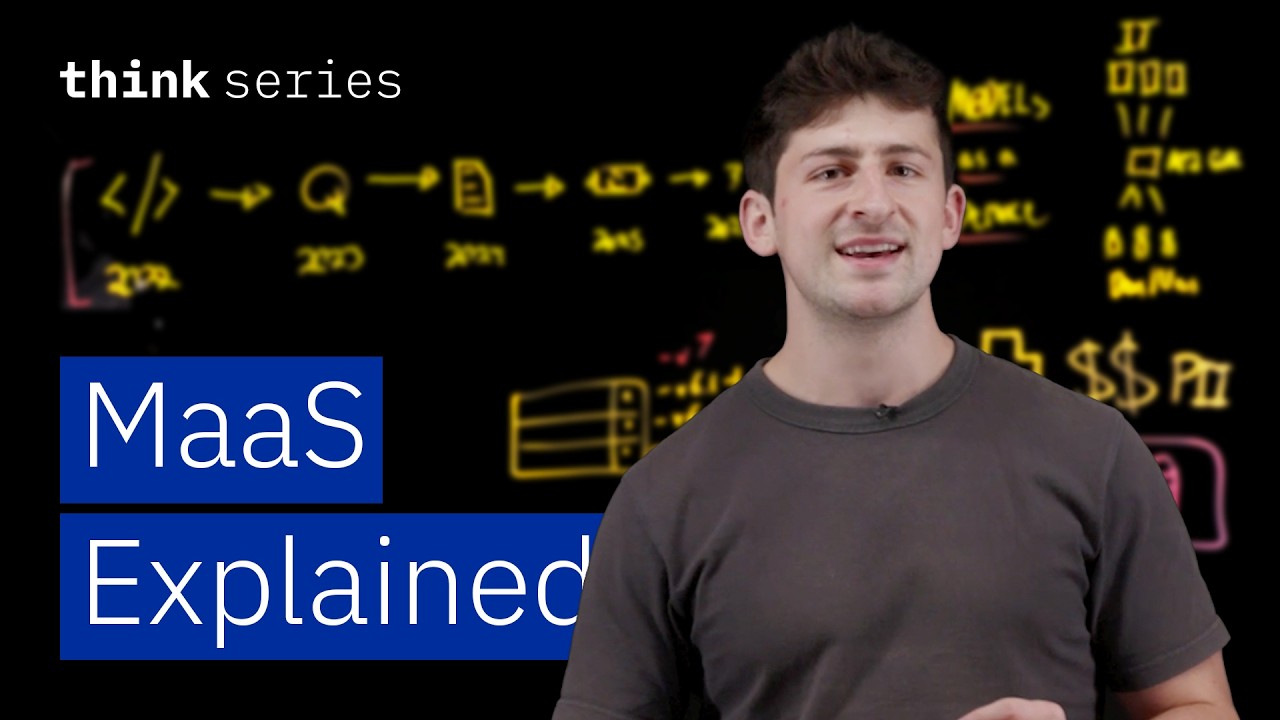
The speaker, an engineer with years of experience using generative AI, traces the evolution of AI tools from early coding assistants in IDEs to advanced models like GPT and techniques such as retrieval-augmented generation (RAG). Over time, the use of public APIs to access AI models has become common, but this approach involves sending sensitive data and incurring costs to third-party providers. As organizations seek to deploy private and sovereign AI solutions, they face challenges in managing costs, ensuring data privacy, maintaining governance, and scaling AI usage across teams and end users.
To address these challenges, the concept of “models as a service” (MaaS) is introduced. MaaS is likened to software as a service (SaaS) but focuses on serving multiple AI models—whether language or vision models—through a single API. This API provides transparency in billing, data privacy, governance, and observability, enabling IT teams to manage models centrally while developers and end users consume them efficiently. This approach mirrors how AI giants provide access to models via APIs, but MaaS allows organizations to run and control their own models, reducing dependency on third-party services.
A key advantage of MaaS is the control it offers over model lifecycle management. Developers often face issues when third-party providers deprecate older model versions without notice, forcing costly and time-consuming upgrades. With MaaS, organizations can manage which models are deployed, when to upgrade, and how to handle changes in model behavior, thereby minimizing disruptions. This control extends to sensitive environments like healthcare and financial services, where data privacy and regulatory compliance are paramount. MaaS enables these organizations to run AI models on-premises or in hybrid cloud setups, maintaining strict data sovereignty and security.
The architecture of MaaS involves a layered approach starting with infrastructure and orchestration platforms like OpenShift or Kubernetes, which unify diverse environments including on-premises, cloud, and edge computing. On top of this, AI platform layers incorporate inference engines and orchestration tools such as VLLM and KServe to manage AI workloads like microservices. An API gateway adds enterprise features like authentication, rate limiting, usage tracking, and observability, leveraging open-source tools like Prometheus, Grafana, and Jaeger to provide telemetry and logging. This comprehensive setup supports scalable, secure, and manageable AI deployments across an organization.
In conclusion, models as a service is emerging as a de facto standard for organizations aiming to deploy sovereign AI infrastructure. It balances cost control, data privacy, governance, and scalability, enabling multiple teams to independently scale their AI efforts while maintaining centralized oversight. The speaker encourages viewers to embrace this approach and stay engaged with ongoing developments in AI and open-source technologies, highlighting MaaS as a critical enabler for the future of enterprise AI applications.