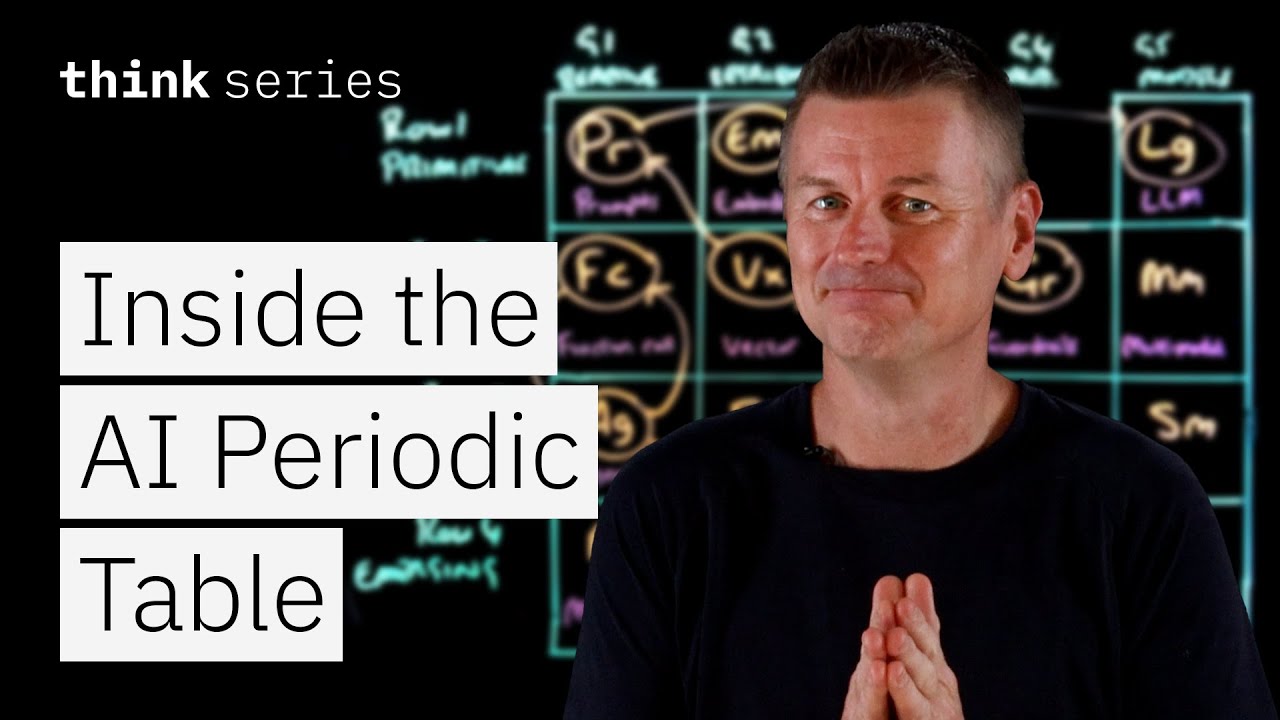
The video introduces the concept of an “AI periodic table” as a way to organize and make sense of the many terms and technologies in the field of artificial intelligence. Drawing inspiration from the structure of the chemical periodic table, the presenter proposes a framework that categorizes AI components into families (groups) and levels of complexity (rows). This structure helps clarify how different AI elements—such as prompts, embeddings, retrieval-augmented generation (RAG), agents, and guardrails—fit together and interact within modern AI systems.
The table is organized into five families across the top: reactive, retrieval, orchestration, validation, and models. Vertically, there are four rows representing increasing complexity: primitives, compositions, deployment, and emerging technologies. The first row includes foundational elements like prompts (Pr), embeddings (Em), and large language models (Lg), which serve as the atomic building blocks for more complex AI systems. Each subsequent row adds layers of functionality, such as function calling (Fc), vector databases (Vx), RAG (Rg), guardrails (Gr), and multi-modal models (Mm).
As the table progresses, it captures the evolution from simple control (prompts) to action (function calling) and autonomy (agents). The deployment row introduces elements like agents (Ag), fine-tuning (Ft), frameworks (Fw), red teaming (Rt), and small models (Sm), reflecting how AI systems are put into production and adapted for specific tasks. The emerging row highlights cutting-edge developments, including multi-agent systems (Ma), synthetic data (Sy), interpretability (In), and thinking models (Th), which represent the frontier of AI research and application.
The video demonstrates how this periodic table can be used to map out real-world AI architectures. For example, a production RAG system combines embeddings, vector databases, RAG, prompts, large language models, and guardrails to create a chatbot that can answer questions based on company documentation. Similarly, agentic loops—where an AI agent autonomously plans and executes tasks using function calling and frameworks—are mapped onto the table to show how these elements interact in practice.
Ultimately, the AI periodic table serves as a tool for understanding, categorizing, and predicting how different AI technologies combine to form complex systems. It encourages viewers to use this framework to analyze new AI products, features, or startups by identifying which elements are present, how they interact, and whether anything important is missing. The presenter suggests that, just as the chemical periodic table became a staple in classrooms, a similar table for AI could help demystify the field and foster clearer communication about its rapidly evolving components.