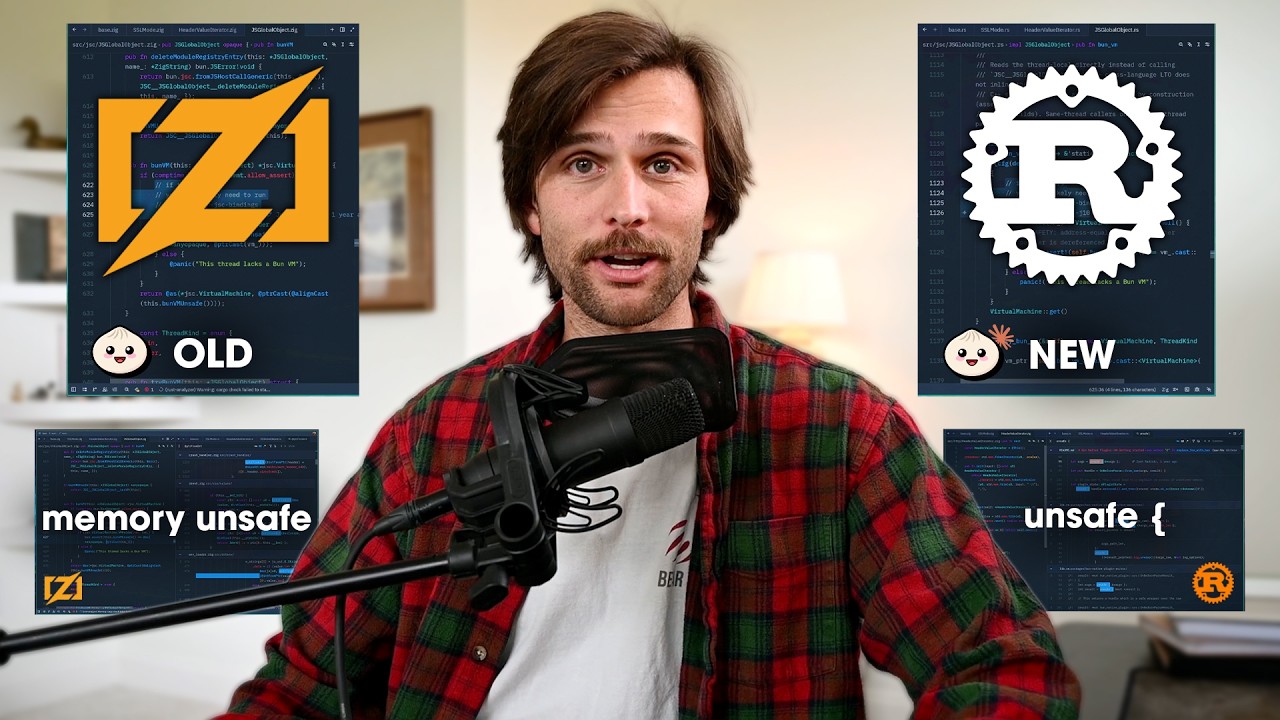
The video discusses the recent AI-driven rewrite of Bun, a popular JavaScript runtime originally written in Zig, into Rust. This ambitious project was initiated by Jarred Sumner, Bun’s creator, who wanted to experiment with AI’s ability to port a large Zig codebase to Rust. The rewrite involved over a million lines of Rust code merged into the Bun repository, which still contains substantial Zig code that will be gradually phased out. Rust is now the default language, and the port was done in phases, starting with a faithful draft that captures the original logic before making the code compile and optimizing it.
A key part of the process was a detailed porting guide (porting.md) containing around 300 rules that AI agents followed to translate Zig code to Rust. The port aimed to be a direct, one-to-one translation rather than adopting idiomatic Rust practices initially. The result is a Rust codebase that passes Bun’s existing test suite across platforms, fixes memory leaks, reduces binary size by 3 to 8 megabytes, and performs comparably or better than the original Zig code. The rewrite also benefits from Rust’s compiler-assisted memory safety features, which help prevent bugs that previously cost the team significant debugging time.
The video highlights some technical details, such as the increase in code length in Rust due to its explicitness compared to Zig’s brevity, and the presence of many unsafe blocks in the Rust code. These unsafe blocks are largely a consequence of faithfully porting Zig’s raw pointer manipulations and interfacing with C and C++ libraries, which are unavoidable. Despite concerns raised by some comparing Bun’s Rust code to C++ with Rust syntax, the creator acknowledges the high number of unsafe blocks and plans to reduce them over time. The Rust code is considered competent and functional, though not idiomatic Rust.
One notable improvement in the Rust version is the elimination of costly cross-language calls by directly accessing thread-local storage in assembly, which the Zig version could not do efficiently. The AI-driven port also preserved original comments and added helpful notes explaining translation decisions, making the code easier to review. While the Rust code is not perfect, it is comparable in quality to the original Zig code, which itself contained many memory-unsafe operations. The AI rewrite demonstrates that automated tools can produce maintainable and performant Rust code from a complex Zig codebase.
Finally, the video speculates on the motivations behind the rewrite, including potential marketing benefits for Anthropic, Bun’s parent company, and the desire to improve stability and reduce bugs, especially in light of issues with Claude code, another Anthropic project. Although some memory leaks remain, the Rust port fixes many problems and is expected to improve Bun’s long-term reliability. The video concludes that the AI-assisted rewrite is a fascinating case study in using AI for large-scale code migration and that only time will tell how stable and maintainable Bun will be as the Rust codebase replaces Zig.