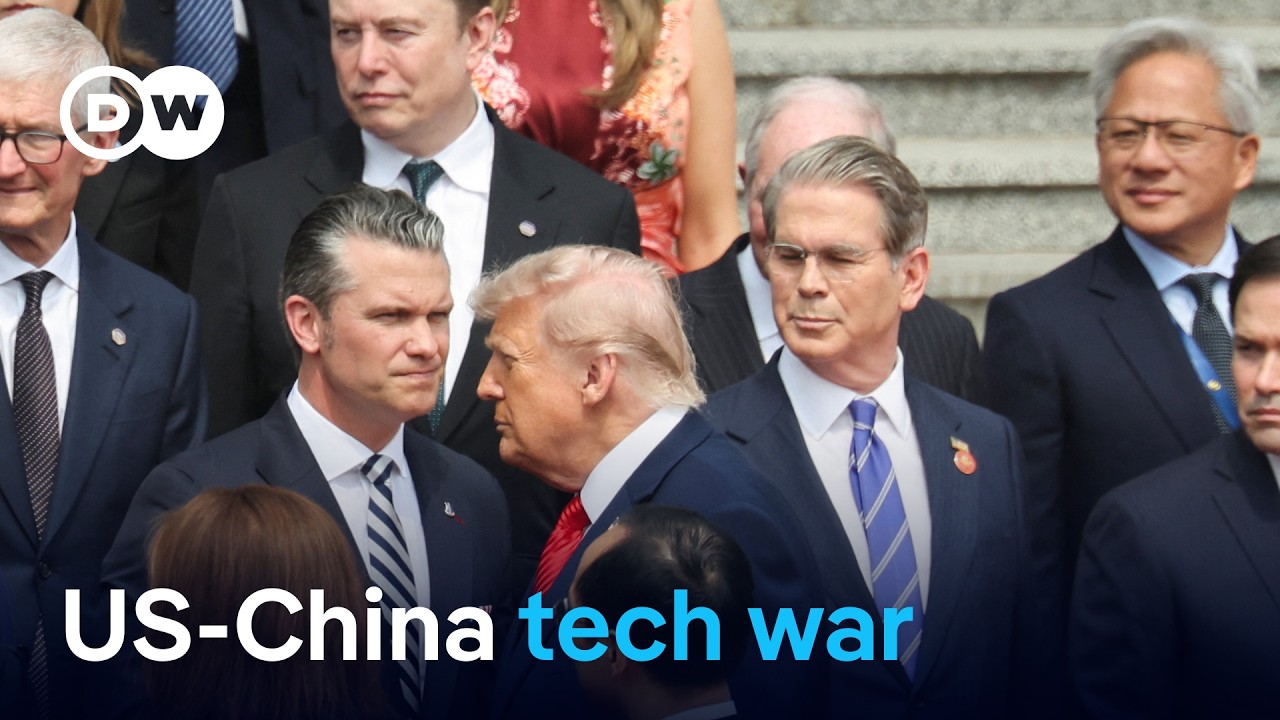
Former U.S. President Donald Trump’s recent visit to China with a delegation of tech CEOs underscores the intense U.S.-China rivalry in AI and advanced technologies, with both nations competing rather than cooperating in this critical sector. Experts highlight China’s rapid technological advancements across multiple fields, urging Western countries, especially Europe, to adopt a balanced strategy that safeguards national security while engaging competitively with China’s growing tech influence.
The video discusses the recent visit of former U.S. President Donald Trump to China, accompanied by a delegation of prominent technology CEOs, including Elon Musk, Tim Cook of Apple, and Jensen Huang of Nvidia. This delegation reflects the ongoing rivalry between the U.S. and China for dominance in high-tech industries, particularly artificial intelligence (AI). The selection of CEOs appeared to be based on two main categories: those with significant business interests in China who maintain friendly ties, and those facing challenges in the Chinese market seeking solutions. Notably, many major American companies with Chinese business were absent, resulting in a relatively small delegation.
Treasury Secretary comments about potential dialogue between the U.S. and China on AI were met with skepticism. The relationship between the two countries in AI is largely adversarial, with the U.S. investing heavily in AI development through companies like OpenAI and Anthropic, while China advances with more cost-efficient models. The expert interviewed expressed doubt about meaningful cooperation between U.S. and Chinese AI firms, viewing them as significant competitors rather than collaborators.
Broadening the scope beyond AI, the expert argues that China has effectively taken the lead in the global technology race. Citing research from the Australian Strategic Policy Institute, China is ahead in 66 out of 74 critical advanced technologies. While the U.S. retains advantages in areas like semiconductors and some AI sectors, China is rapidly advancing in many fields, including electric vehicles, batteries, biotechnology, and pharmaceuticals. This rapid progress threatens the dominance of longstanding U.S. and European tech companies.
The discussion highlights a common misunderstanding in the West regarding the speed and scale of China’s technological ascent. Western countries have been slow to recognize China’s growing leadership, partly due to limited contact during the COVID-19 pandemic. However, recent acknowledgments from European leaders signal a growing awareness that China is reshaping the global economic and technological landscape, ushering in a new paradigm centered on Chinese innovation and influence.
In response to this shifting dynamic, the expert advises European companies and governments to adopt a hybrid strategy similar to Trump’s current approach: balancing national security concerns with efforts to engage and compete in the Chinese market. This means protecting critical interests while enabling businesses to expand and compete globally. Such a nuanced approach is essential for Europe to navigate the intensifying U.S.-China tech rivalry and the emerging reality of Chinese technological dominance.