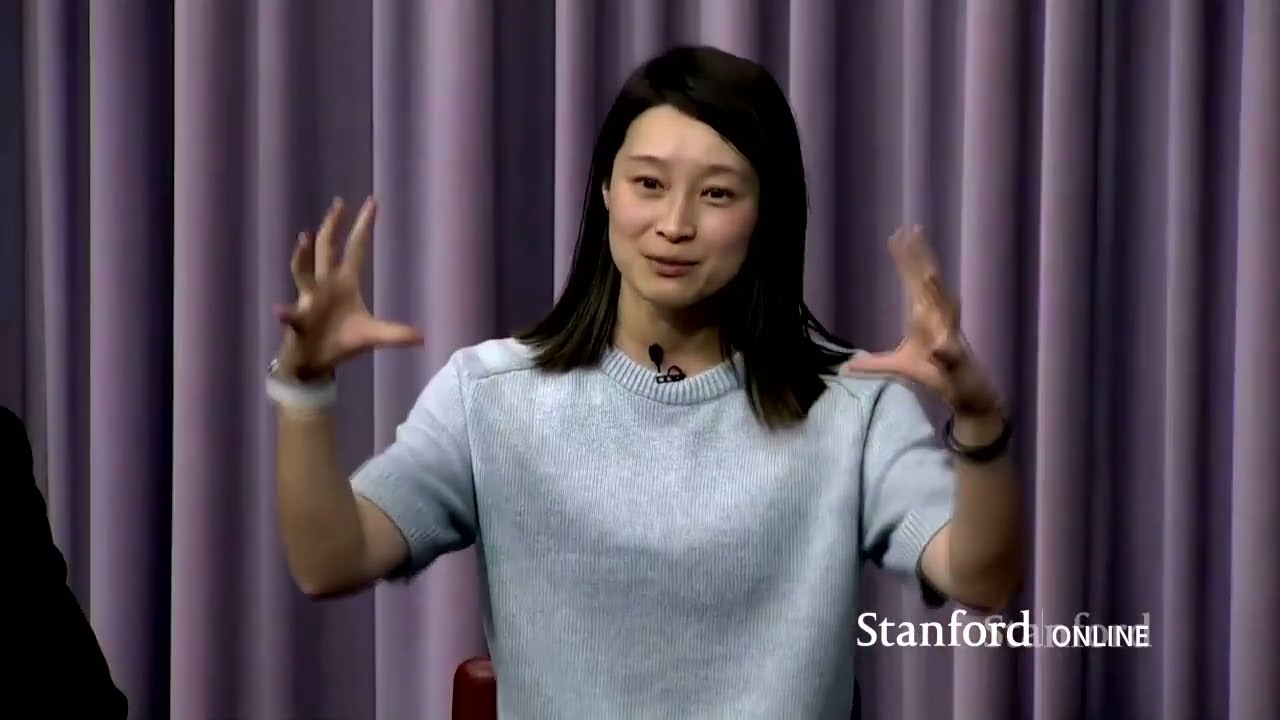
The discussion on the AI-Robotics frontier featured Professors Monroe Kennedy III and Renee Xiao from Stanford University, who shared their cutting-edge research and visions for the future of robotics. Professor Kennedy’s work focuses on developing robotic systems that improve everyday life by anticipating and acting on human needs, particularly through assistive robotics and intelligent wearables. He highlighted the societal needs driving robotics innovation, such as supporting the aging population with dexterous robotic assistants, enhancing manufacturing and agriculture through automation, and enabling advanced prosthetics that can interpret human intent. His lab is advancing tactile sensing technologies to enable robots to perform delicate tasks, such as handling fragile objects, with a sense of touch akin to humans.
Professor Xiao’s research centers on soft robotics and stimuli-responsive materials, inspired by biological systems like earthworms, octopus arms, and elephant trunks. Her lab develops miniaturized, soft robotic systems capable of complex deformations and multifunctional tasks, which are particularly suited for navigating confined environments like the human body. She presented groundbreaking work on a millimeter-scale magnetic spinner designed for mechanical thrombectomy to treat blood clots in the brain, offering a promising alternative to current stroke treatments. This tiny device can navigate tortuous blood vessels using magnetic fields controlled by robotic arms, potentially enabling robotic surgery that is less dependent on highly specialized surgeons and more accessible to patients in remote areas.
The collaboration between the two professors exemplifies the integration of advanced robotic control and innovative soft robotic devices. Professor Kennedy’s lab contributes by developing real-time control algorithms that allow robotic arms to navigate complex environments and perform precise movements, overcoming challenges such as singular poses in robotic kinematics. This control capability is essential for guiding Professor Xiao’s magnetic spinners through the intricate and variable vascular structures of the brain, using imaging data like X-rays to map and navigate in three dimensions. Together, their work aims to create a closed-loop robotic system that can autonomously and accurately perform delicate surgical interventions.
A key theme of the discussion was the importance of the sense of touch in robotics, both for robots operating in human environments and for prosthetic devices. Professor Kennedy emphasized that touch is critical for manipulating objects safely and effectively, citing studies showing how humans rely heavily on tactile feedback for tasks as simple as striking a match. His lab is developing tactile sensors that mimic human skin’s ability to detect forces, textures, and vibrations, and exploring ways to convey this sensory information to users of prosthetic limbs, potentially through unconventional pathways such as the face. This sensory feedback is crucial for enabling robots and prosthetics to perform complex tasks with human-like dexterity and precision.
Looking beyond medical applications, Professor Xiao discussed the broader potential of soft robotics and stimuli-responsive materials in creating agile, adaptable robots that can operate in complex and confined spaces without bulky motors or cables. She highlighted the advantages of soft materials in conforming to environments and performing multimodal deformations, which could revolutionize robotic design by mimicking biological organisms with distributed neural control. The conversation concluded with reflections on future collaborations and the evolving role of humans in the loop, envisioning robotic systems that not only perform tasks autonomously but also enhance human capabilities, particularly in surgery and assistive technologies. The synergy between their labs at Stanford positions them at the forefront of realizing these transformative robotic futures.