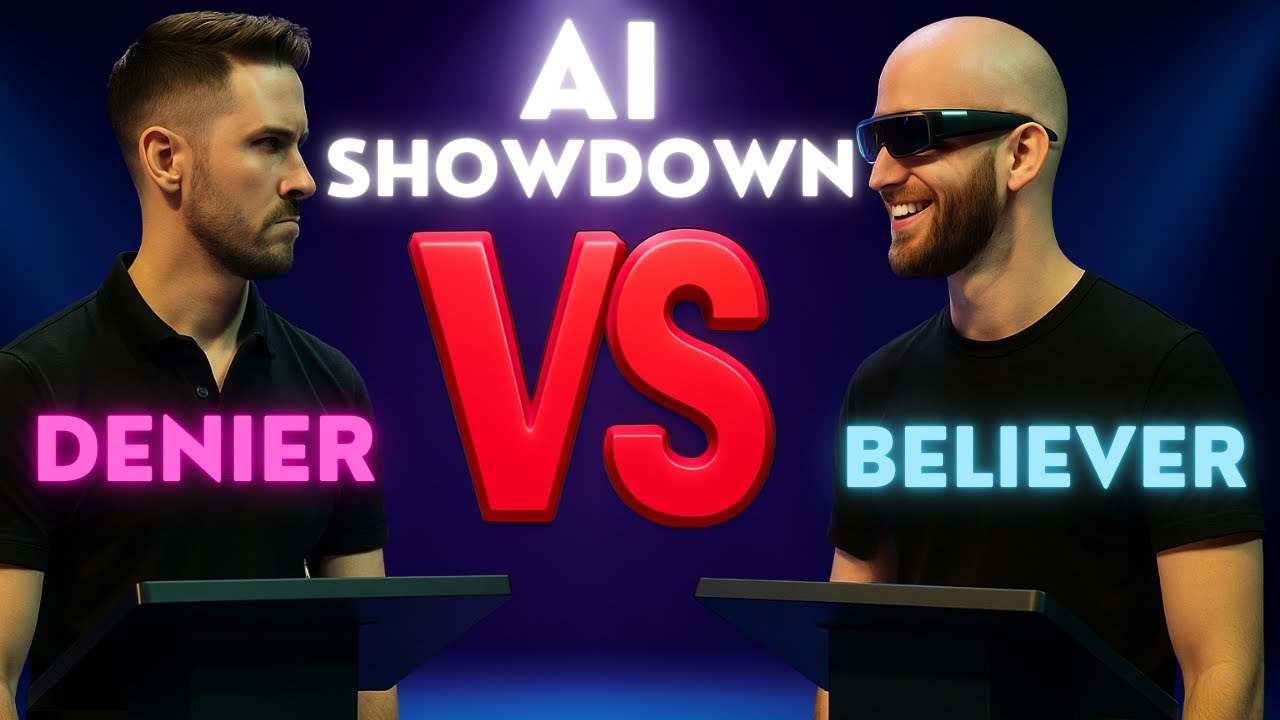
In this episode of the AI Showdown, two experts, Chadwick Turner and Dr. Emanuel Majerori, engage in a nuanced debate about the transformative potential of AI. Chadwick, a creative technologist with extensive experience in media and tech, argues that AI is on the cusp of being a highly disruptive technology, potentially reaching a 10 out of 10 in impact if breakthroughs in AGI (Artificial General Intelligence) occur. He highlights the rapid acceleration in AI capabilities, comparing it to transformative moments like the internet, and emphasizes the significant societal disruptions expected, particularly in job markets where repetitive and cognitive tasks could be automated away. Chadwick also touches on the philosophical implications of AI, such as the nature of consciousness and identity, and foresees a future where AI deeply integrates into daily life, possibly even affecting human relationships.
Conversely, Dr. Emanuel Majerori, a seasoned software engineer and AI author, takes a more cautious stance, rating AI’s transformative impact around a 4 out of 10 at present. He points out the significant technical limitations of current AI systems, especially issues like hallucinations and the inability to handle rare or unexpected scenarios (the “long tail” problem). Emanuel argues that many AI projects fail to deliver real ROI, and that the hype around AI often overlooks these fundamental weaknesses. He stresses that while AI will disrupt certain low-level or repetitive jobs, many complex roles requiring human judgment, creativity, and social skills will remain largely unaffected. Emanuel also highlights the importance of understanding business fundamentals and client needs over purely technical AI capabilities.
Both experts agree that AI is disruptive but differ on the scale and immediacy of its impact. Chadwick envisions a near future where AI tools democratize innovation, enabling individuals and small teams to rapidly prototype and automate tasks, potentially reshaping entire industries. He warns, however, that this disruption will lead to significant job displacement and economic challenges, urging workers to adapt by learning new skills and leveraging AI tools. Emanuel, meanwhile, emphasizes the need for realistic expectations, advocating for AI applications that acknowledge current limitations and focus on augmenting rather than replacing human work. He also discusses the evolving nature of education and information consumption in an AI-driven world, noting potential declines in cognitive skills due to overreliance on AI.
The conversation also delves into practical examples, such as AI-powered voice assistants replacing call center jobs, automated compliance tools that assist rather than fully automate legal work, and the challenges facing autonomous vehicles due to AI’s inability to handle unpredictable real-world scenarios. Both guests highlight that while AI can accelerate mundane tasks and improve efficiency, mission-critical applications still require human oversight. They also discuss the economic implications, including the potential for bubbles in AI investment and the uneven distribution of benefits across different sectors and job types.
In closing, Chadwick encourages listeners to actively engage with AI tools and seize the opportunities they present, while Emanuel advocates for a balanced understanding of AI’s capabilities and limitations. Both stress the importance of critical thinking, business acumen, and continuous learning in navigating the AI-driven future. The episode ends on a note of cautious optimism, recognizing AI’s potential to transform society while acknowledging the significant challenges and uncertainties that remain.