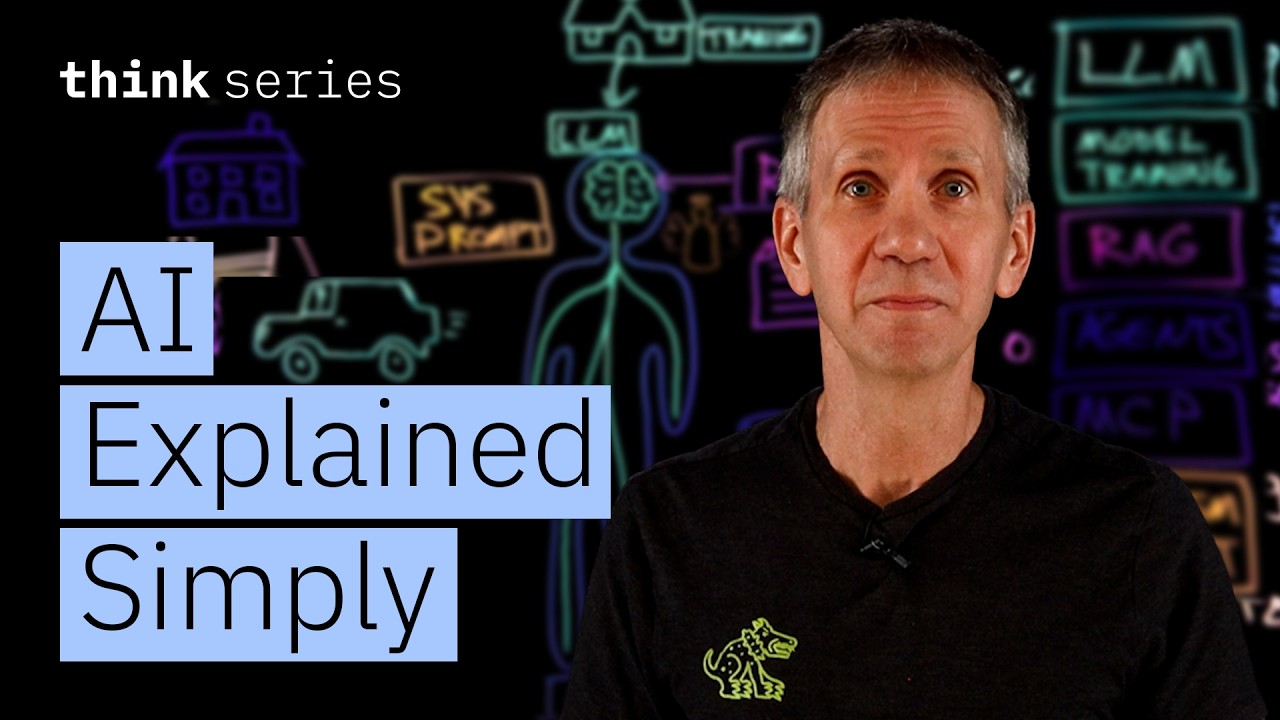
The video begins by defining artificial intelligence (AI) as a subfield of computer science aimed at creating computers that match or exceed human intelligence. To make the complex terminology of AI more accessible, the presenter uses an analogy comparing AI components to parts of human intelligence. The core of modern AI systems is the “brain,” represented by large language models (LLMs), which generate content by predicting probabilities, functioning like an advanced autocomplete system.
Next, the video explains that just like humans need education to become intelligent, AI models require training and tuning to learn language, math, history, and other skills. This training process equips the AI with foundational knowledge. However, to stay current and accurate, AI systems also use Retrieval Augmented Generation (RAG), which supplements their knowledge with trusted external sources, helping to reduce errors known as hallucinations and grounding the AI in reliable information.
The analogy continues by describing how AI gains the ability to act in the world through tools, similar to how humans use their hands and feet. These AI agents can perform tasks autonomously by interacting with databases, writing code, searching the web, and more. The coordination between the AI brain and its tools is managed by the Model Context Protocol (MCP), which acts like a central nervous system, orchestrating communication and actions.
A crucial aspect highlighted is the need for guiding principles or ethics in AI behavior. Unlike humans who learn social norms over time, AI systems are deployed quickly and can be naive, making them vulnerable to manipulation through prompt injections—akin to social engineering attacks on people. To address this, AI systems use system prompts, which are sets of rules that constrain the AI’s responses, ensuring it refuses to engage in harmful or unethical activities and adapts over time to new threats.
In summary, the video outlines six essential AI concepts using human analogies: the brain (large language model), education (training and tuning), ongoing learning (retrieval augmented generation), physical interaction (AI agents with tools), communication (Model Context Protocol), and ethics (system prompts). These foundational ideas provide a clear and simplified understanding of modern AI, serving as a starting point for those new to the field. The presenter also suggests further resources for viewers interested in exploring AI, machine learning, deep learning, and generative AI in more depth.