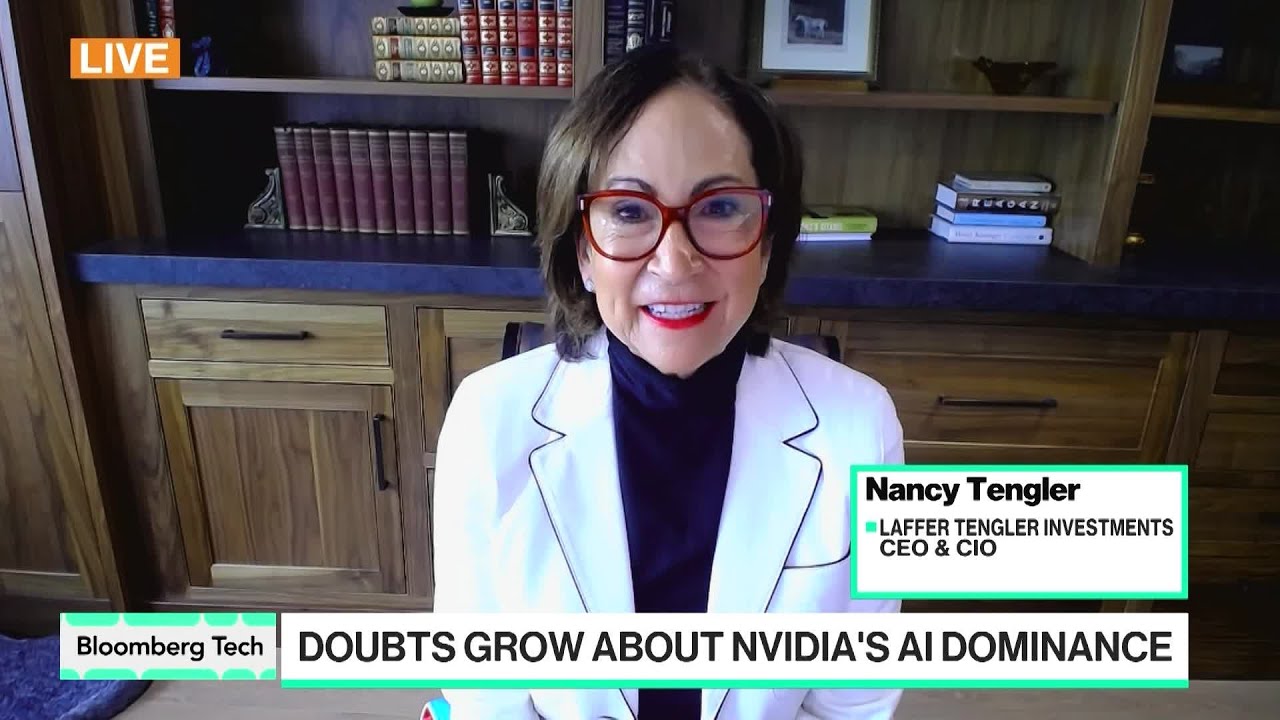
In the discussion, Nancy Tengler highlights the promising opportunities in the AI technology sector, particularly focusing on companies that provide the essential tools or “picks and shovels” for AI development. She emphasizes the importance of NVIDIA, especially its CUDA software system used by developers for embedded chips, drawing an analogy to Apple’s App Store, which transformed the company’s value beyond just hardware. Tengler also mentions owning shares in AMD and Broadcom, which are key players in the AI hardware space, suggesting multiple avenues for investors to benefit from the AI trade.
Tengler points out that the impact of AI is extending beyond pure technology companies into traditional industries. She uses Walmart as a prime example of an “old economy” company successfully integrating new technologies, particularly in e-commerce and automation. Walmart’s significant growth in digital orders and the use of robots in fulfillment centers illustrate how AI is driving efficiency and productivity gains in non-tech sectors. She also notes Raytheon’s use of AI to improve supply chain logistics, reinforcing the broadening application of AI across various industries.
Addressing concerns about a potential tech bubble, Tengler contrasts the current environment with the late 1990s tech boom. She notes that unlike the 1996-2000 period, when growth stocks saw soaring valuations despite contracting earnings, today’s growth stocks are experiencing robust earnings growth of around 20% on average. Capital expenditures, which were strong throughout the 1990s, are only now beginning to ramp up again, and many tech companies currently maintain strong balance sheets, reducing the risk of a bubble driven by financial instability.
Tengler also discusses Oracle’s financial situation, clarifying that while the company carries significant debt, it has a history of managing it effectively. She points out that Oracle’s debt-to-equity ratio has improved year over year, even after issuing $18 billion in debt for data center expansion. Despite some concerns about rising interest rates on debt instruments like five-year CDs, she views these as manageable risks within a broader investment strategy. However, she expresses caution about market concentration around OpenAI and the need for the industry to resolve competitive dynamics.
In conclusion, Nancy Tengler believes the AI-driven technological revolution is fundamentally different from the 1990s tech boom. She argues that the current growth is supported by strong earnings and increasing capital investment, not speculative excess. While acknowledging some risks, particularly related to market concentration and debt, she remains optimistic about the long-term prospects of AI and technology investments. Tengler expects future discussions to focus more on company fundamentals rather than bubble fears, signaling confidence in the sustainability of this technological wave.