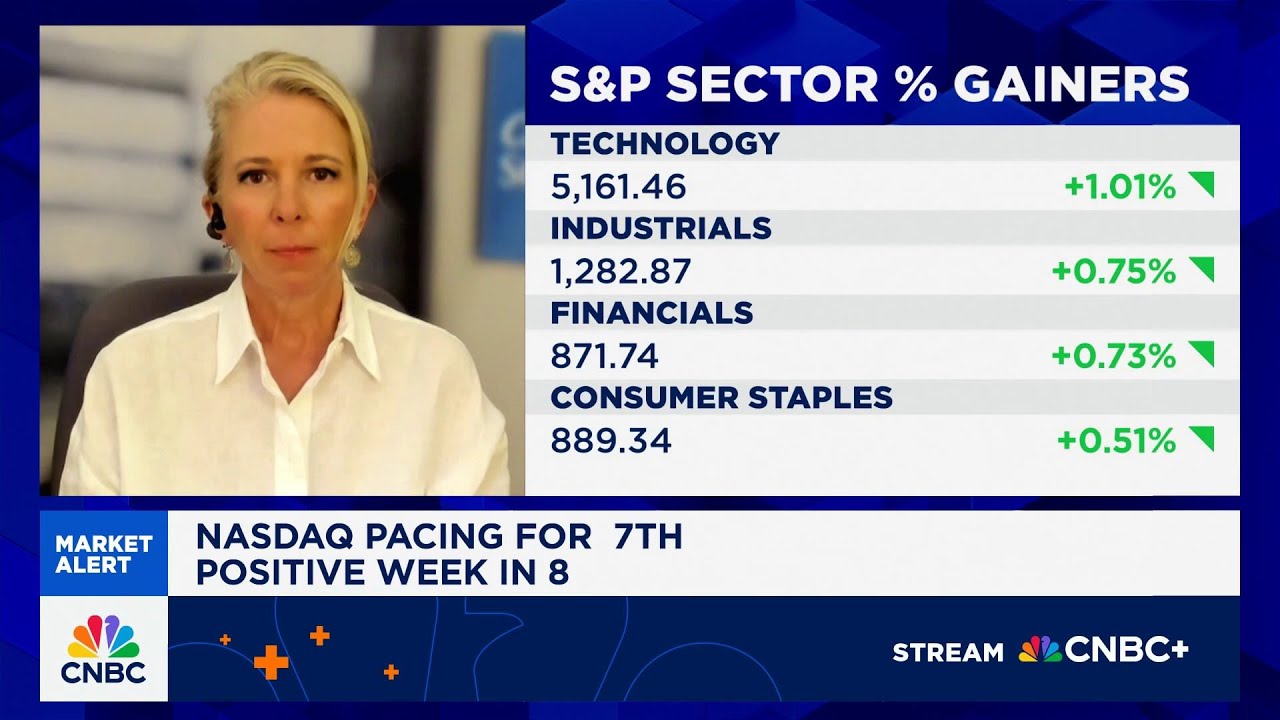
In the discussion with Liz Ann Sonders, Chief Investment Strategist at Charles Schwab, she highlights the evolving nature of the AI trade in the stock market. While certain tech giants like Nvidia, Meta, and Microsoft have seen significant rallies this year, there is now more discernment in which companies perform well within this sector. The market is experiencing greater dispersion, especially among previously dominant groups like the “Mag seven,” some of which have underperformed recently, leading to new categorizations such as the “Mag three” or even the “Lag seven.”
Sonders points out that despite changing market labels and groupings, the AI trade remains a powerful force, particularly influenced by capital expenditures (CapEx) and investment in technology. However, she notes a bifurcation in performance, indicating that not all companies benefit equally from the AI-driven momentum. This nuanced view contrasts with the more uniform enthusiasm seen in past tech booms, suggesting investors are becoming more selective.
Addressing concerns about a potential AI bubble, Sonders acknowledges the risk of concentration in a few large stocks, which could pose challenges for individual investors lacking diversified portfolios. However, she differentiates the current environment from the late 1990s dot-com bubble by emphasizing the stronger fundamentals of today’s leading companies. Unlike many dot-com era firms that had no profits or clear paths to profitability, current tech giants have robust cash flows, solid balance sheets, and promising futures.
The conversation also touches on the longevity and stability of today’s tech leaders compared to the fleeting companies of the 1990s. While many dot-com firms quickly rose and fell, companies like Nvidia, Apple, Microsoft, and Amazon have established enduring market presence over decades. This longevity contributes to a fundamentally different market landscape, even though some valuation excesses and frothy sentiment reminiscent of the late 90s are present.
Finally, Sonders cautions that despite these differences, the market is not immune to corrections. Valuation excesses, particularly in highly concentrated stocks, may require adjustments. She stresses the importance of balanced investment strategies to navigate potential volatility, underscoring that while the AI trade is grounded in stronger fundamentals than the dot-com era, investors should remain vigilant about risks associated with market concentration and sentiment-driven froth.