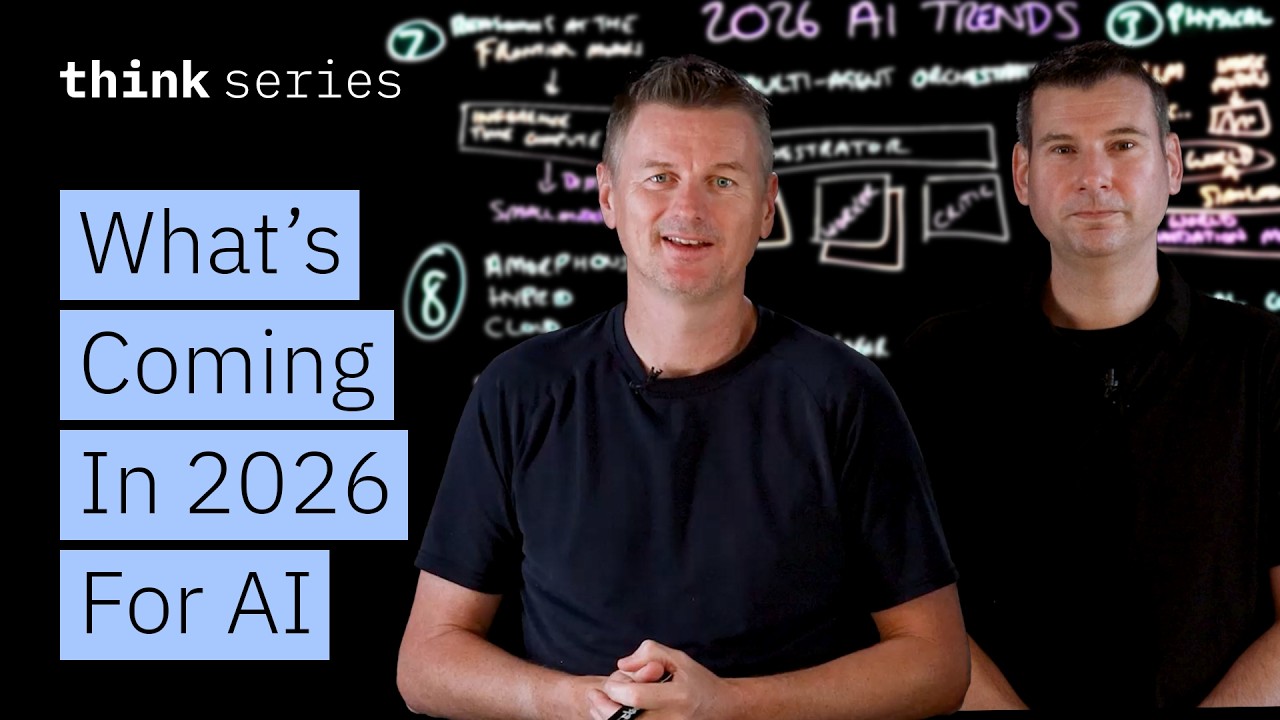
Certainly! Here’s a five-paragraph summary of the video “AI Trends 2026: Quantum, Agentic AI & Smarter Automation,” with spelling and grammar corrected:
The video discusses the most important trends expected in artificial intelligence by 2026, with insights from two experts, Martin and Aaron Baughman. They begin by highlighting the rise of multi-agent orchestration, where teams of specialized AI agents collaborate to solve complex tasks. Instead of relying on a single agent, these orchestrated systems use planner, worker, and critic agents, coordinated by an orchestrator, to break down problems, cross-check work, and ensure higher reliability and efficiency.
The second major trend is the emergence of a digital labor workforce—autonomous digital workers capable of interpreting multimodal input, executing workflows, and integrating with existing systems. These digital workers are enhanced by human-in-the-loop AI, which provides oversight, correction, and strategic guidance, effectively multiplying human capabilities. Closely related is the trend of physical AI, where AI models move beyond digital outputs to interact with the real world through robotics. These models, sometimes called world foundation models, are trained in simulation to understand physics and manipulate objects, enabling humanoid robots to transition from research to commercial production.
Another significant trend is social computing, where humans and AI agents interact within a shared digital fabric. This interconnected environment allows for seamless collaboration, context exchange, and mutual understanding, resulting in a form of collective intelligence or swarm computing. The video also emphasizes the importance of verifiable AI, especially with the upcoming EU AI Act, which will require high-risk AI systems to be auditable, transparent, and traceable. This includes clear documentation, transparency about machine-generated content, and data lineage to ensure compliance and ethical use.
Quantum computing is identified as a transformative trend, with 2026 expected to mark the beginning of quantum utility at scale. Quantum computers will start solving real-world problems more efficiently than classical computers, particularly in optimization, simulation, and decision-making. This hybrid quantum-classical era will integrate quantum processing units (QPUs) with traditional infrastructure, making quantum computing a mainstream part of business operations.
Finally, the video discusses reasoning at the edge and amorphous hybrid computing. Smaller AI models capable of advanced reasoning will run locally on devices, enabling real-time, private, and mission-critical applications without relying on data centers. Amorphous hybrid computing refers to the blending of AI model architectures and cloud infrastructure, combining CPUs, GPUs, TPUs, QPUs, and even neuromorphic chips into a unified, adaptive computing environment. This fluid backbone will optimize performance and efficiency, potentially paving the way for even more exotic computing paradigms like DNA computing in the future. The presenters conclude by inviting viewers to share their own predictions for AI trends in 2026.