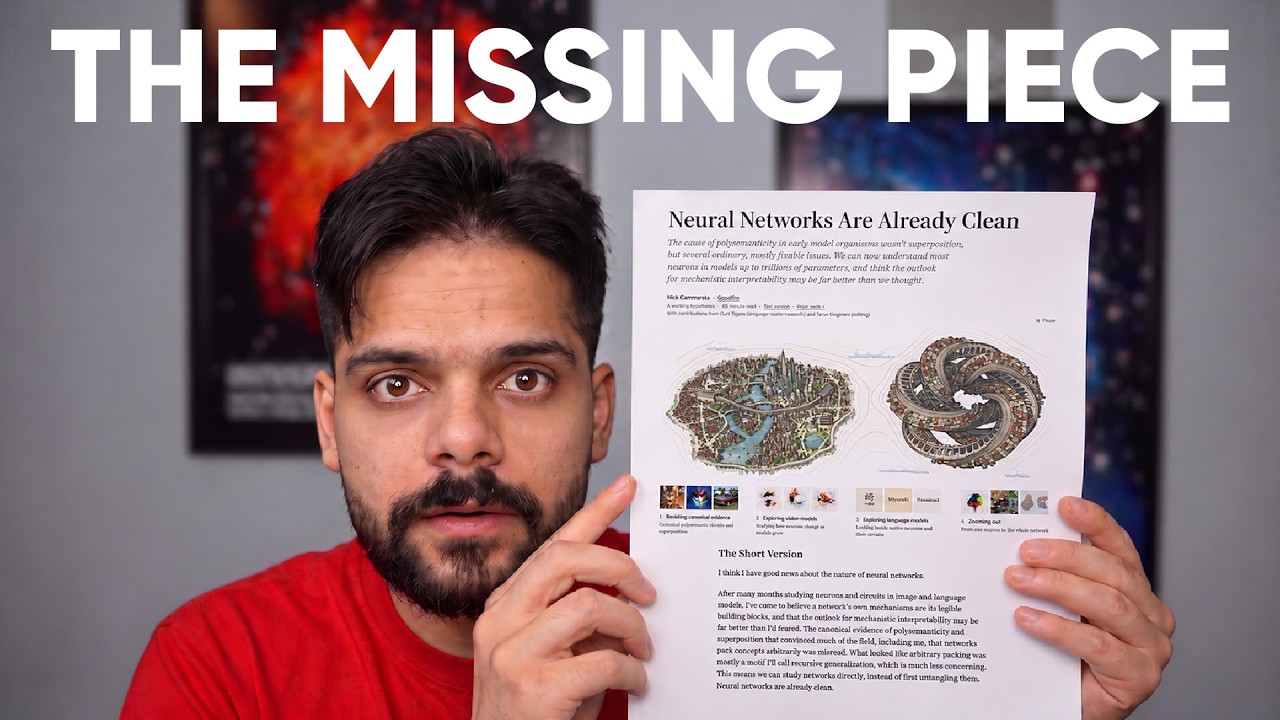
The longstanding belief that AI operates as a “black box,” with internal workings largely inscrutable, has been challenged by recent research from Nick Cammarata and his team. Historically, the idea that neural networks use distributed representations—where concepts emerge from complex patterns of neuron activations rather than individual neurons—led to the assumption that understanding AI’s internal logic was nearly impossible. This view was reinforced by phenomena like superposition, where single neurons respond to seemingly unrelated concepts, making interpretation difficult. Despite these challenges, distributed representation offered advantages such as efficiency, robustness, and generalization, which helped it dominate AI research.
Anthropic’s work in 2022 highlighted the inevitability of superposition due to the limited dimensionality of neural networks, suggesting that neurons must encode overlapping concepts, further complicating interpretability. However, Nick Cammarata revisited these assumptions using modern AI tools and found that what appeared as arbitrary neuron activations were actually instances of “recursive generalization.” This means neurons start by detecting simple, specific features and progressively generalize to more abstract concepts, maintaining a coherent internal logic rather than random overlap. For example, a neuron initially responding to a letter combination evolved to recognize an abbreviation and then the full phrase it represented.
This discovery implies that neurons often have well-defined, primary functions, with about 90% of neurons in large models showing clear, interpretable roles. Weak activations, previously thought to contribute to confusion, were found to have minimal impact on model accuracy, while strong activations were crucial. This nuanced understanding bridges the gap between the localist and distributed representation theories, suggesting that neurons can simultaneously serve specific, localized functions while participating in broader distributed patterns. Essentially, AI’s internal structure resembles an organized, evolving system rather than a chaotic jumble.
The implications of this research are significant. If AI models are more interpretable than previously believed, it opens the door to developing robust tools for monitoring and guiding AI behavior. Understanding the “city-like” organization of neural networks allows researchers to optimize performance, reduce errors, and enhance safety by targeting specific neurons or pathways. This newfound clarity could accelerate AI development by shifting from cautious exploration to confident advancement, knowing that the internal decision-making processes are largely transparent and understandable.
In summary, the myth of AI as an impenetrable black box is being dismantled. Through careful analysis and modern techniques, researchers have revealed that neural networks organize information in a structured, interpretable manner via recursive generalization. This breakthrough not only challenges decades-old assumptions but also promises practical benefits in AI safety, reliability, and development. As this work gains peer validation, it may fundamentally change how we design, understand, and trust artificial intelligence systems.
Useful Links