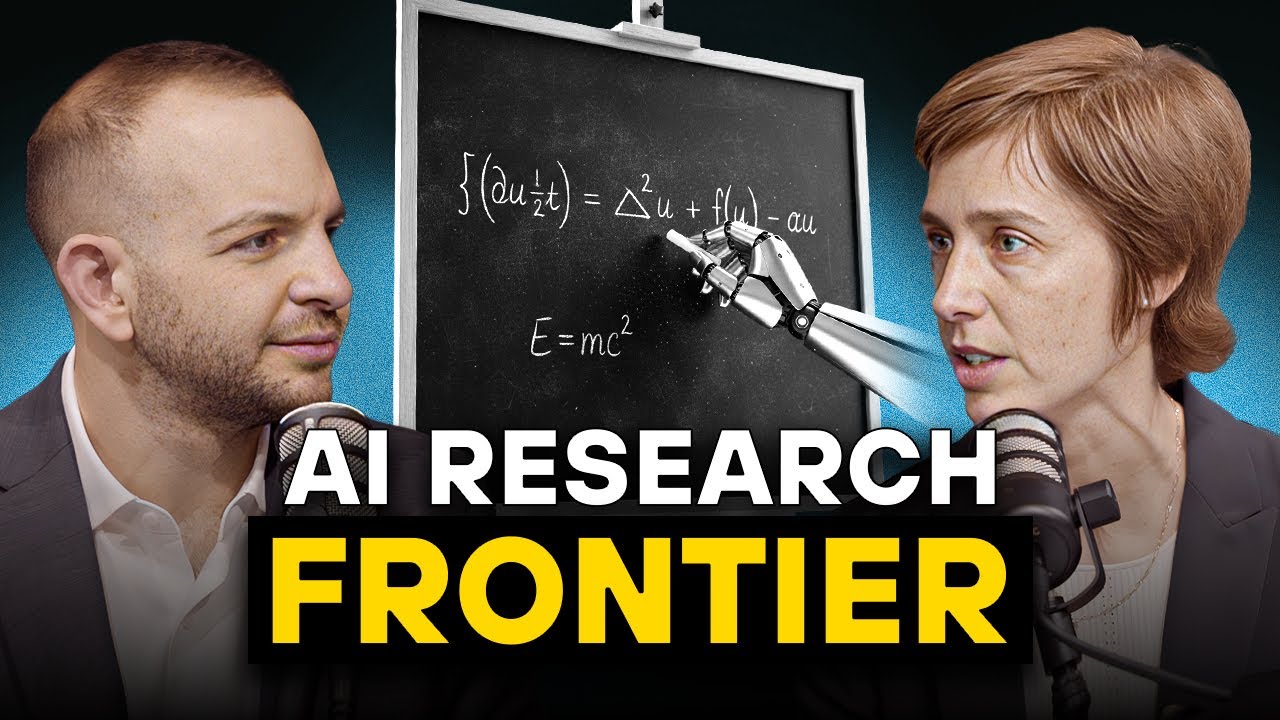
On the Big Technology Podcast, host Alex Kantrowitz interviews Joelle Pineau, Chief AI Scientist at Cohere and former head of Meta’s Fundamental AI Research division, about the current frontiers of AI research and its practical applications. Pineau outlines three major research themes: improving memory in AI systems, developing world models that allow agents to predict the consequences of their actions, and advancing reasoning and planning capabilities. She emphasizes that while transformer architectures and attention mechanisms have driven recent progress, there remain significant challenges in making AI systems more selective and efficient in how they use memory, as well as in enabling hierarchical planning and reasoning.
The conversation delves into the distinction between memory and continual learning. Pineau explains that while memory is about retrieving relevant information for a given task, continual learning involves adapting to changing contexts over time. She notes that continual learning is still a difficult research problem, partly because the field lacks consensus on how to define and measure progress. The discussion touches on the risks of models that learn online without sufficient oversight, referencing Microsoft’s Tay chatbot as a cautionary example of unsupervised continual learning leading to undesirable outcomes.
Pineau and Kantrowitz discuss the practical limitations of current AI systems, such as the difficulty in retrieving specific information from large datasets (e.g., finding the first email exchanged with a spouse). Pineau explains that these challenges often stem from issues with data access, information encoding (embeddings), and retrieval mechanisms. However, she notes that when memory functions well, as seen in some recent AI models, it can be quite powerful and transformative for users.
The interview also explores the concept of world models, both physical (for robotics) and digital (for web-based agents), and why they are essential for AI agents to operate effectively in complex environments. Pineau argues that while some agents may need to understand physical concepts like gravity, others may only require knowledge of digital systems. She predicts a future with many specialized AI agents rather than a single, all-knowing superintelligent agent. The conversation also covers the idea of a “capability overhang,” where current AI systems are capable of much more than is currently being deployed, often due to organizational inertia, efficiency trade-offs, or incomplete integration with existing business processes.
Finally, the discussion turns to the business and societal implications of AI adoption. Pineau highlights the growing importance of enterprise AI with strong privacy and security guarantees, especially in sectors like financial services. She discusses the impact of AI on the workforce, noting that those who can effectively leverage AI tools will have a significant advantage. The conversation concludes with reflections on the rapid pace of AI development, the importance of open scientific exchange, and the need for robust strategies (including AI sovereignty) to ensure organizations and countries maintain control and flexibility as the technology evolves.