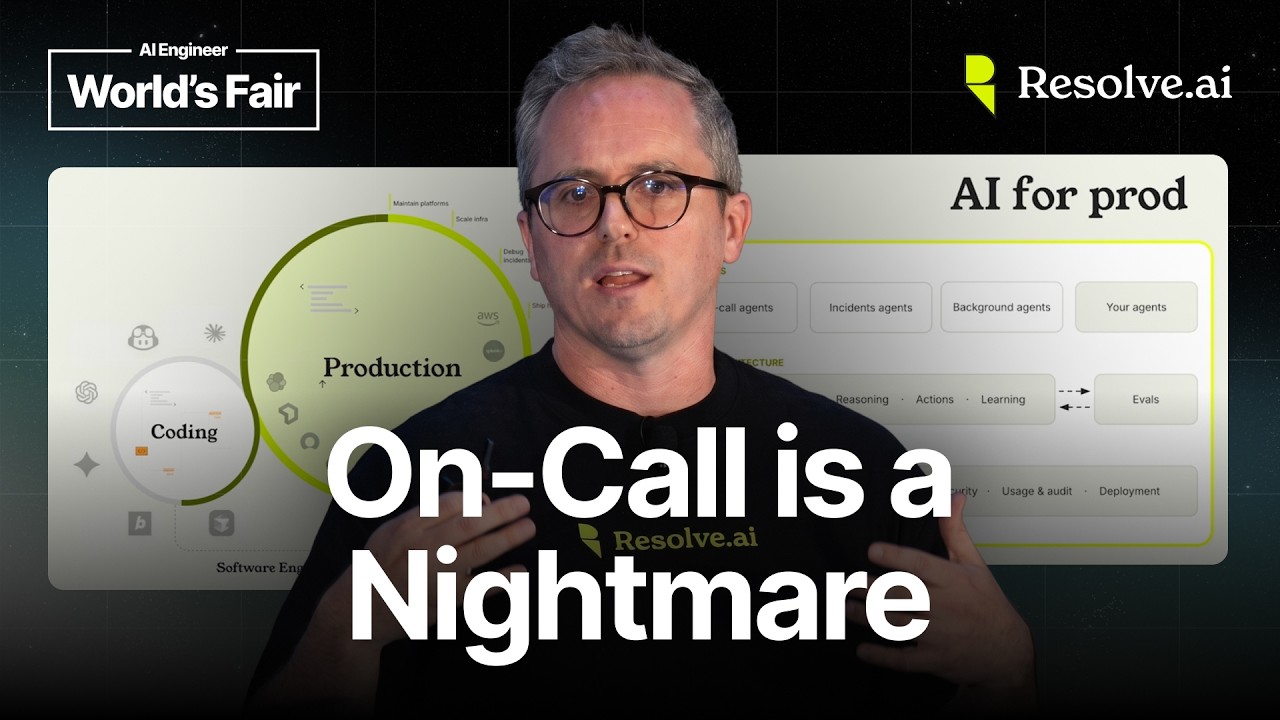
In this talk, Justin Smith, a founding product engineer at Resolve AI, discusses the challenges of running production systems in the era of rapidly evolving AI-driven software development. He highlights that while AI has significantly increased developer productivity and accelerated code shipping, the majority of engineering effort—about 70%—is still spent on running, maintaining, and debugging production systems rather than just coding. This operational burden, often referred to as the “on-call tax,” involves managing alerts, incidents, escalations, and maintaining runbooks, which becomes increasingly complex as AI-driven changes flood production environments.
Justin emphasizes that AI is not only transforming software creation but also complicating production environments, requiring new approaches to manage this complexity. He introduces Resolve AI’s approach, which leverages AI-powered agents designed to assist with production operations. These agents range from on-call agents that triage alerts and conduct root cause analysis to background agents that handle ongoing operational tasks without immediate fires. The agents integrate deeply with existing systems and provide contextual understanding, enabling them to autonomously monitor, learn, and adapt to evolving production environments.
A key focus of the talk is on background agents, which perform routine but critical operational work such as deployment monitoring, health checks, incident digests, and answering engineering questions via Slack. These agents operate continuously or on schedules, triggered by events or messages, and maintain a memory system to learn and improve over time. Justin illustrates how these agents can dynamically tailor monitoring based on the specifics of each deployment, going beyond traditional CI/CD checks to catch subtle issues and reduce cognitive load on engineers.
Justin also showcases practical examples of how these agents function within a demo environment, highlighting their ability to monitor deployments, generate handoff reports, and autonomously respond to Slack queries. He stresses the importance of integrating these agents into the tools engineers already use, like Slack or MS Teams, to minimize disruption and maximize efficiency. The agents’ flexibility allows teams to customize workflows and automate a wide range of operational tasks, freeing engineers to focus on higher-value work.
In conclusion, Justin advocates for embracing AI-powered background agents as a way to reduce the operational complexity and on-call burden in modern production environments. He encourages creativity in applying these agents to unique organizational needs and underscores the importance of a robust knowledge system that continuously learns and adapts. Resolve AI’s platform offers extensibility through integrations and custom skills, aiming to make production operations more manageable and aligned with the fast pace of AI-driven software development. Attendees are invited to explore these solutions further at the Resolve booth.