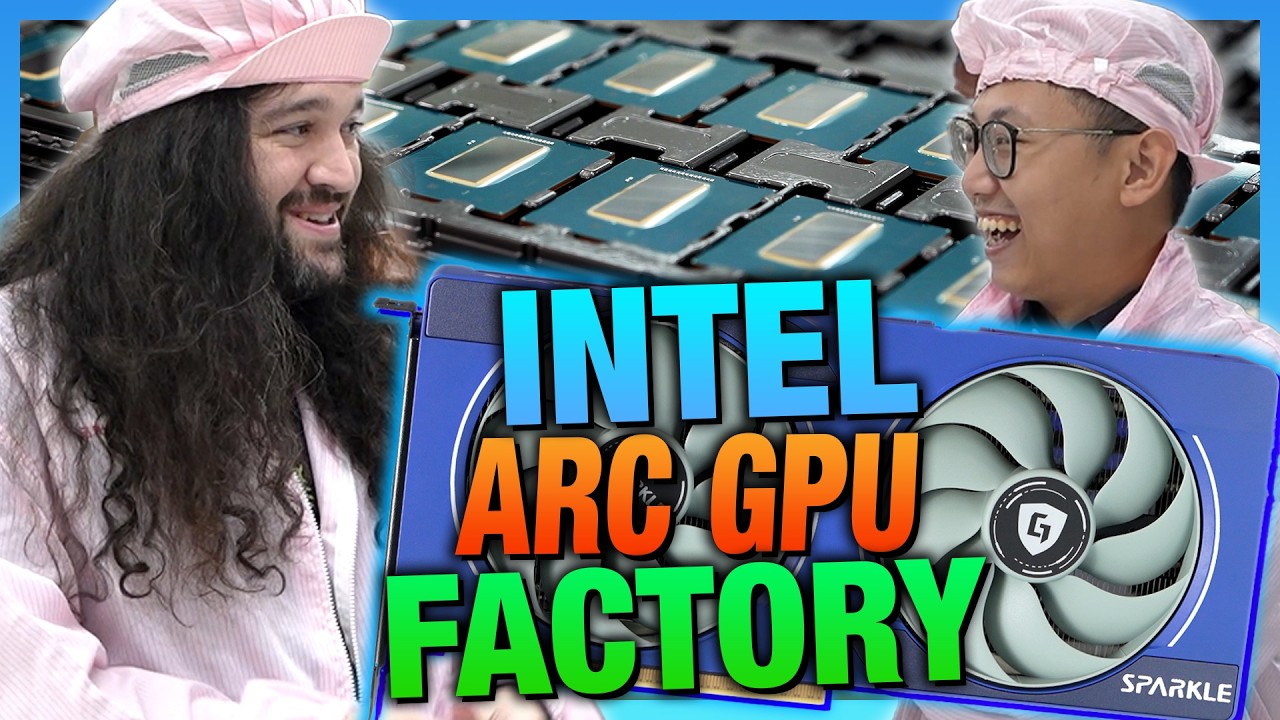
The video provides an in-depth tour of Sparkle’s Taiwanese factory, where Intel Arc GPUs are manufactured, highlighting the company’s role as a new competitor in a market segment largely abandoned by AMD and Nvidia. The hosts, joined by Lucas—a former EVGA employee with experience in Nvidia products—explore how Sparkle produces over 1,000 Intel Arc video cards per day, primarily for shipment to the United States. The move to Taiwanese manufacturing was prompted by high tariffs on Chinese imports, making Taiwan a strategic location for serving the US market.
The tour begins with the Surface Mount Technology (SMT) line, where the assembly process starts. Components such as PCBs, GPUs, VRAM, and various capacitors are sourced from multiple suppliers and brought together for assembly. The process involves applying solder paste, automated pick-and-place machines for mounting components, and reflow ovens to solidify the connections. Quality control is rigorous, with automated optical inspection (AOI) machines and manual checks to ensure each board meets standards, resulting in a low defect rate.
After SMT, the boards move to the Dual Inline Package (DIP) process in a second factory, where larger components like capacitors and connectors are manually installed. Wave soldering, now enhanced with nitrogen to reduce oxidation, is used to secure these components. Workers then perform manual inspections, cleaning, and any necessary rework to address defects such as short circuits. The assembly is completed with the installation of brackets, thermal paste, and fans, followed by further quality checks using multimeters and visual guides.
Every finished GPU undergoes a series of functional tests, including benchmarks like 3DMark Time Spy and Intel’s proprietary software, to verify performance, PCIe compatibility, and fan operation. Once tested, the cards are physically packed with protective materials and anti-static bags, then scanned for traceability and compliance with US import regulations. Shipping methods vary by product: higher-end models are shipped by air for speed, while lower-cost, mass-market cards use ocean freight to save costs, balancing supply chain efficiency with market demand.
A key takeaway from the video is the contrast between Intel’s approach to board partners and that of Nvidia and AMD. Intel offers Sparkle significant flexibility in product design and customization, especially in the entry-level GPU segment that competitors have largely abandoned. The video also provides rare insights into manufacturing costs, such as the $1 licensing fee per HDMI port. The hosts emphasize that their tours are independently funded, aiming to provide transparent, behind-the-scenes looks at hardware manufacturing and industry dynamics.