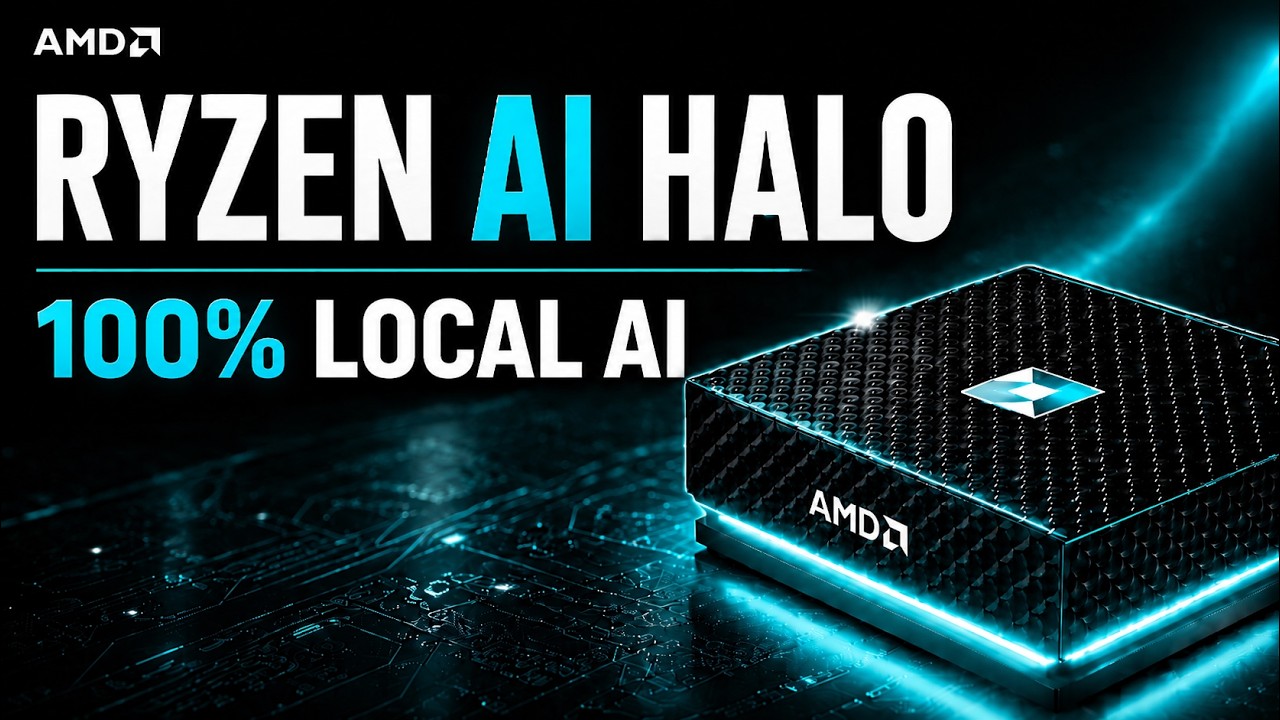
The video introduces the AMD Ryzen AI Halo, a powerful AI workstation featuring 128GB of unified memory, which significantly surpasses the previous Radeon AI Pro R9700’s 32GB VRAM limitation. This unified memory architecture allows the CPU and GPU to share a large pool of fast LPDDR5X memory, enabling the local running of much larger AI models, including 100 billion parameter models like GPT-OSS 120B and advanced Qwen 3.6 models. Unlike traditional discrete GPU setups, this design avoids the severe token speed drops when offloading to system RAM, providing a more seamless and efficient AI processing experience.
The Ryzen AI Halo runs on a Ryzen AI Max Plus 395 chip with 16 CPU cores, a Radeon 8060S GPU delivering around 60 teraflops at FP16, and an NPU capable of 50 TOPS, although current AI stacks do not fully utilize the NPU yet. The machine comes in both Windows and Linux versions, with the Linux version showcased in the video. It offers an out-of-the-box experience with the AMD Ryzen AI Developer Center software, which simplifies managing AI applications, system settings, and memory allocation between CPU and GPU. This setup also supports remote access via SSH, making it convenient to run AI workloads on a dedicated machine remotely.
The video demonstrates the Ryzen AI Halo’s capabilities with various AI models and applications. It runs large language models (LLMs) like the Ornith 9B, Qwen 3.6 35B MoE, and GPT-OSS 120B efficiently, achieving token generation speeds suitable for practical use cases such as chatbots, coding assistants, and retrieval-augmented generation (RAG) applications. The machine also excels in creative AI tasks, such as image and video generation using Comfy UI and models like Qwen image and LTX. The presenter highlights a project generating dancing kitten videos programmatically, showcasing the machine’s ability to handle complex workflows involving prompt generation, image synthesis, and video creation without incurring API costs.
Further, the Ryzen AI Halo supports advanced AI workflows including running local agents like Hermes Agent and OpenClaw with multiple models loaded simultaneously, thanks to its large memory pool. It also facilitates fine-tuning of models using tools like Unsloth, enabling users to train medium-sized models locally with gradient accumulation techniques. The machine is stable under continuous heavy workloads, making it suitable for overnight training and inference tasks. This versatility makes it an attractive option for AI enthusiasts and developers who want a powerful, private, and cost-effective local AI solution.
In conclusion, the AMD Ryzen AI Halo is positioned as a practical and affordable workstation for running large open-weight AI models locally, especially those beyond 40 billion parameters. While discrete GPU setups may still offer advantages in speed for smaller models, the Halo’s unified memory and ease of use make it a compelling choice for users prioritizing model size and flexibility. The upcoming Pro 495 version with up to 192GB of memory promises even greater capabilities. The presenter encourages viewers to consider their priorities—whether running multiple models or a single large model—and to explore the growing potential of local AI powered by this innovative hardware.